 Add to Chrome
 Add to Firefox
 Add to Edge
Failed Reasoning Traces Tell You What Is Fixable (But Not by Reading Them)
Jun 03, 2026
When post-trained language models fail on reasoning problems, the common test-time-scaling response is to spend more compute on additional attempts, and the failed traces play no further role. We argue this discards a crucial signal; some failures come from unlucky sampling, where more rollouts help, while others are structural and resist resampling regardless of budget. We propose that failed traces encode recoverability structure: the inference-time signature of which test-time interventions can rescue a given failure. Three problem-level trajectory features, derived from the structure of available interventions, recover this structure from the distributional signature of failed rollouts, not their text. They cluster failures into stable regimes, characterize the failure topography of different post-training methods ($84.3{\pm}4.3\%$ accuracy, $+20\%$ over a majority-class baseline), and support a training-free routing rule that lifts rescue by $+12.2\%$ on the deployment-relevant Steerable-Hard subset (failures where retry is insufficient and a bounded intervention is reachable). The features and the routing rule transfer across two cross-family probes. The same three features thus convert failed traces from discarded data into a diagnostic object, supporting test-time routing and post-training analysis without training-time or weight-space access.

GitChameleon: Evaluating AI Code Generation Against Python Library Version Incompatibilities
Jul 16, 2025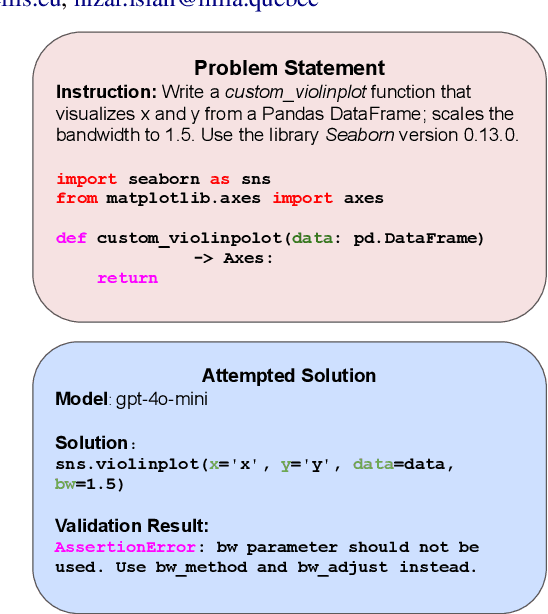
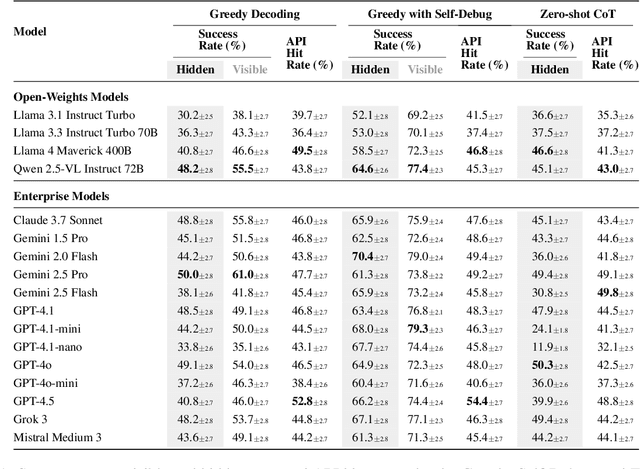
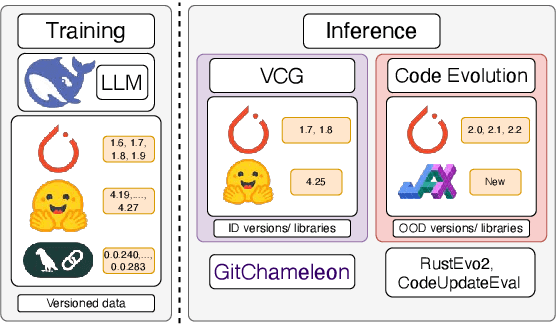
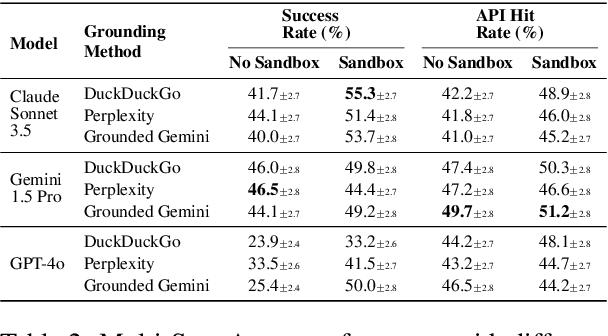
The rapid evolution of software libraries poses a considerable hurdle for code generation, necessitating continuous adaptation to frequent version updates while preserving backward compatibility. While existing code evolution benchmarks provide valuable insights, they typically lack execution-based evaluation for generating code compliant with specific library versions. To address this, we introduce GitChameleon, a novel, meticulously curated dataset comprising 328 Python code completion problems, each conditioned on specific library versions and accompanied by executable unit tests. GitChameleon rigorously evaluates the capacity of contemporary large language models (LLMs), LLM-powered agents, code assistants, and RAG systems to perform version-conditioned code generation that demonstrates functional accuracy through execution. Our extensive evaluations indicate that state-of-the-art systems encounter significant challenges with this task; enterprise models achieving baseline success rates in the 48-51\% range, underscoring the intricacy of the problem. By offering an execution-based benchmark emphasizing the dynamic nature of code libraries, GitChameleon enables a clearer understanding of this challenge and helps guide the development of more adaptable and dependable AI code generation methods. We make the dataset and evaluation code publicly available at https://github.com/mrcabbage972/GitChameleonBenchmark.