 Add to Chrome
 Add to Firefox
 Add to Edge
Longitudinal-Motion-Aware Lateral Control for Autonomous Vehicles: A Robust Nonlinear Control Framework
Jul 03, 2026
As autonomous vehicles (AVs) operate in increasingly dynamic traffic conditions, lateral control must be performed while longitudinal speed and acceleration vary. Yet many existing lateral controllers rely on constant-speed or operating-point-based assumptions, which can degrade performance during transient longitudinal maneuvers. Moreover, most methods assume precisely known vehicle parameters, despite real-world parametric uncertainties. To address these limitations, this paper presents a longitudinal-motion-aware robust nonlinear lateral control framework for AVs. It first derives a tracking error model that depends on varying longitudinal speed and acceleration. Using this model, feedback linearization is employed to obtain a linear input-output relation for lateral error tracking while embedding longitudinal motion into the control law. The resulting internal dynamics are then analyzed to ensure overall system stability. To address parameter uncertainty, two robust control designs with distinct implementation trade-offs are proposed: (i) a Lyapunov redesign (LR) approach inspired by sliding mode control, and (ii) an incremental nonlinear dynamic inversion (INDI) method. Both are rigorously analyzed and proven to ensure ultimate boundedness, with key robustness-tuning parameters explicitly identified. Simulations demonstrate enhanced tracking accuracy, consistent performance across varying speeds and accelerations, and robustness to model uncertainties, while also examining the effects of the robustness-related parameters. Real-vehicle tests further confirm real-time implementation and practical path-tracking performance on actual hardware.

Privacy-Preserving Decentralized Cooperative Localization with Range-Only Measurements: A Convex Optimization Based Approach
Jun 29, 2026Cooperative localization using range-based measurements is critical for multi-robot systems operating in GPS-denied and unstructured environments. However, traditional cooperative approaches require sharing explicit spatial coordinates across the network, presenting a severe security vulnerability in privacy-sensitive missions. While recent literature has explored privacy-preserving alternatives, these methods typically rely on accuracy-degrading noise injection or computationally prohibitive cryptographic protocols. To overcome these limitations, we propose a novel, natively privacy-preserving Decentralized Cooperative Localization (DCL) framework based on convex optimization. Discarding probabilistic noise models, we assume strictly bounded measurement noise and formulate the localization problem via Semi-Definite Programming (SDP) to compute a Maximum-Volume Inscribed Ellipsoid (MVE). Our approach introduces novel intersection-plane constraints derived from landmark measurements to significantly tighten individual spatial bounds. To incorporate inter-robot range measurements securely, we uniquely decompose coupling constraints into localized Linear Matrix Inequalities (LMIs). Agents achieve fleet-wide spatial consensus by iteratively exchanging only abstract dual variables, completely avoiding the transmission of explicit primal position estimates. Extensive 3D Monte Carlo simulations demonstrate that our DCL framework outperforms existing SDP-based localization method in accuracy, while guaranteeing operational privacy and maintaining highly scalable, parallelizable computation.
Beyond Logprobs: A Multi-Signal Confidence Engine for LLM-Based Document Field Extraction
Jun 23, 2026In high-stakes document processing pipelines, including financial reconciliation, compliance verification, and procurement automation, an LLM extraction that is silently wrong is more dangerous than one that is visibly absent. The central challenge is not extraction accuracy alone but reliable confidence estimation: knowing, field by field, whether an extraction can be trusted for automation or deferred to human review. Token-level log-probabilities, verbalized confidence, and multi-sample self-consistency all collapse toward all-positive behaviour at practical thresholds, offering no reliable separation between trustworthy and untrustworthy extractions. We present ExtractConf, a cross-domain, field-agnostic confidence engine that grounds confidence estimation in two structurally different readings of the same document. A field-guided Hunter call extracts each field under schema-slot completion pressure; a document-guided Mapper call scans holistically and surfaces values grounded in document content. This asymmetry yields different failure modes: Hunter hallucinates values for absent fields, while Mapper misses visually non-salient ones. Their disagreement is independently informative. ExtractConf fuses cross-call disagreement, LLM-internal uncertainty, OCR, image quality, and spatial layout into a classifier requiring no domain-specific rules or retraining. On DocILE (55-field invoices, 26% failure rate), it achieves 0.928 ROC AUC and reduces selective prediction risk by 70% over logprob-mean. At 80% coverage, accuracy reaches 99.1%, enabling a practical human-in-the-loop workflow. Zero-shot transfer to CORD receipts achieves 0.858 AUC; lightweight Lasso recalibration reduces ECE by 89% and Brier by 43%, confirming the signals generalise across document domains.
SeqShield: A Behavioral Analysis Approach to Uncover Rootkits
Apr 26, 2026Rootkits are among the most elusive types of malware, capable of bypassing traditional static analysis methods due to their metamorphic behavior. Signature-based detection techniques struggle against these threats, necessitating a shift toward dynamic analysis approaches. We propose SeqShield, a behavior-based rootkit detection approach designed specifically for the Windows OS, leveraging API call sequences for dynamic behavior analysis. Instead of relying on static signatures, SeqShield examines the execution patterns of API calls, which inherently reflect malicious intent. Analyzing API sequences, we can effectively identify rootkit-like behavior. We also employed a metamorphic code engine to generate 10X mutated variants of rootkits, demonstrating their obfuscation strategies. SeqShield applies n-gram analysis to extract bigram and trigram features from these API call sequences, enabling effective detection of rootkit-like activity. Among the models tested, Random Forest achieves the highest accuracy of 97.27% (bigram) and 96.17% (trigram). To optimize performance and decrease the dimension, we apply feature importance ranking using the Gini Impurity Index, iteratively selecting the most significant features. The optimized lower-dimensional feature matrix significantly enhances detection efficiency without sacrificing accuracy. Using the optimized feature set, our approach achieves 96.72% accuracy for bigrams and 97.81% accuracy for trigrams.
The Persistent Robot Charging Problem for Long-Duration Autonomy
Sep 01, 2024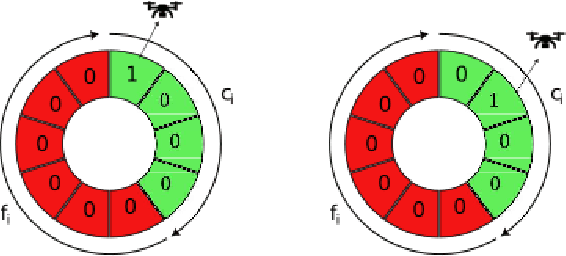
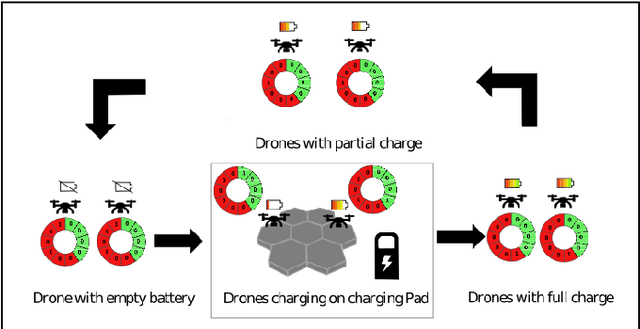
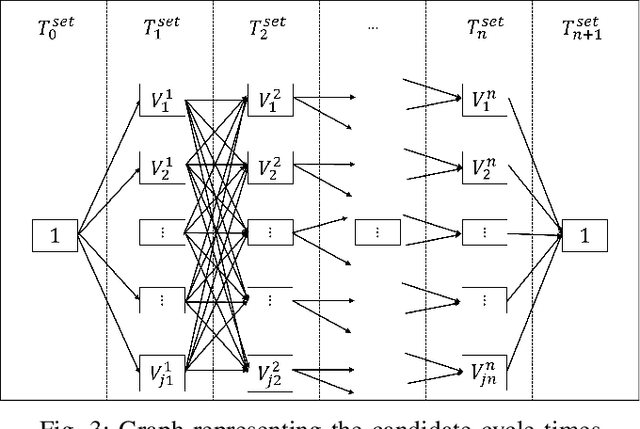
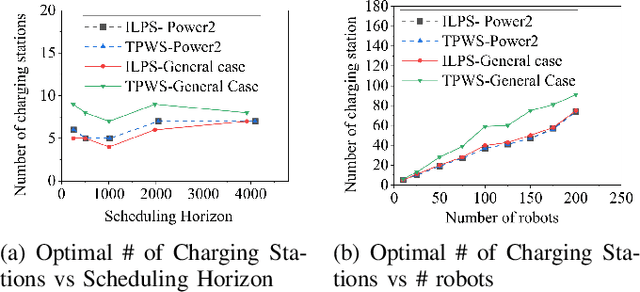
This paper introduces a novel formulation aimed at determining the optimal schedule for recharging a fleet of $n$ heterogeneous robots, with the primary objective of minimizing resource utilization. This study provides a foundational framework applicable to Multi-Robot Mission Planning, particularly in scenarios demanding Long-Duration Autonomy (LDA) or other contexts that necessitate periodic recharging of multiple robots. A novel Integer Linear Programming (ILP) model is proposed to calculate the optimal initial conditions (partial charge) for individual robots, leading to the minimal utilization of charging stations. This formulation was further generalized to maximize the servicing time for robots given adequate charging stations. The efficacy of the proposed formulation is evaluated through a comparative analysis, measuring its performance against the thrift price scheduling algorithm documented in the existing literature. The findings not only validate the effectiveness of the proposed approach but also underscore its potential as a valuable tool in optimizing resource allocation for a range of robotic and engineering applications.
Ranking Entities along Conceptual Space Dimensions with LLMs: An Analysis of Fine-Tuning Strategies
Feb 23, 2024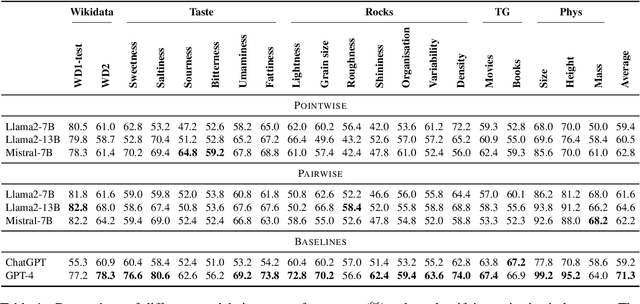
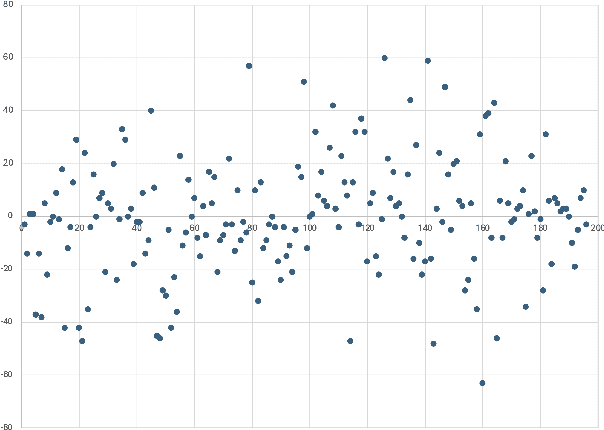

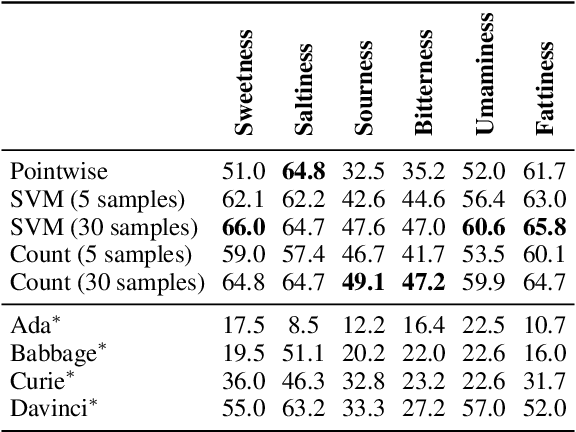
Conceptual spaces represent entities in terms of their primitive semantic features. Such representations are highly valuable but they are notoriously difficult to learn, especially when it comes to modelling perceptual and subjective features. Distilling conceptual spaces from Large Language Models (LLMs) has recently emerged as a promising strategy. However, existing work has been limited to probing pre-trained LLMs using relatively simple zero-shot strategies. We focus in particular on the task of ranking entities according to a given conceptual space dimension. Unfortunately, we cannot directly fine-tune LLMs on this task, because ground truth rankings for conceptual space dimensions are rare. We therefore use more readily available features as training data and analyse whether the ranking capabilities of the resulting models transfer to perceptual and subjective features. We find that this is indeed the case, to some extent, but having perceptual and subjective features in the training data seems essential for achieving the best results. We furthermore find that pointwise ranking strategies are competitive against pairwise approaches, in defiance of common wisdom.
Solving Hard Analogy Questions with Relation Embedding Chains
Oct 18, 2023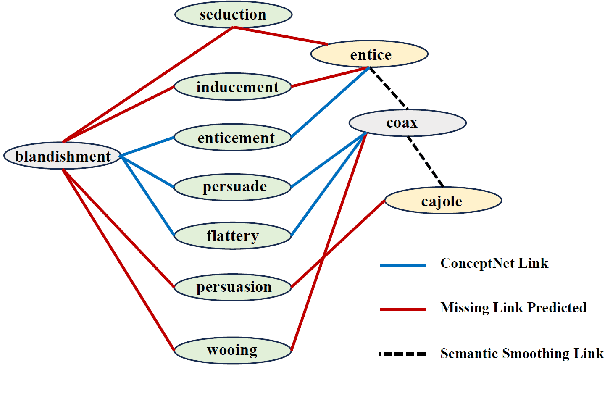
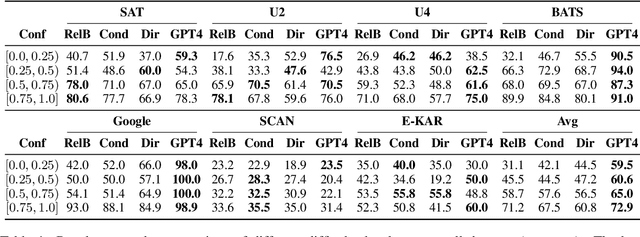
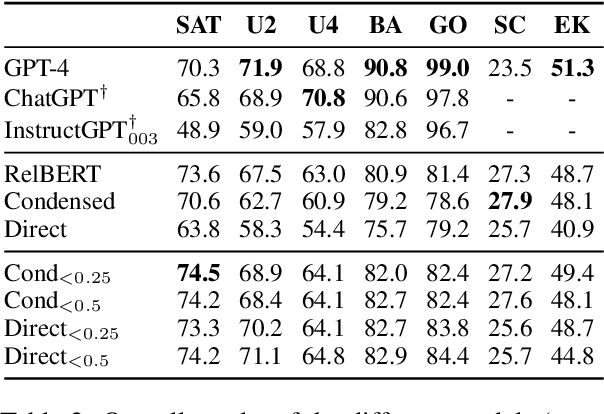
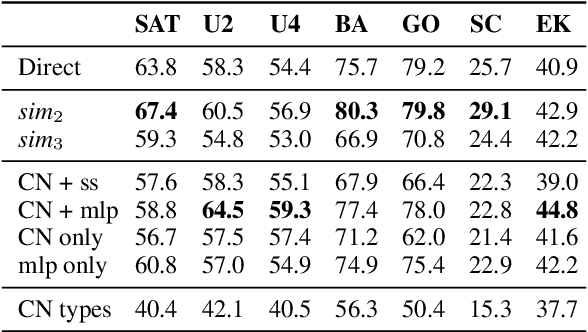
Modelling how concepts are related is a central topic in Lexical Semantics. A common strategy is to rely on knowledge graphs (KGs) such as ConceptNet, and to model the relation between two concepts as a set of paths. However, KGs are limited to a fixed set of relation types, and they are incomplete and often noisy. Another strategy is to distill relation embeddings from a fine-tuned language model. However, this is less suitable for words that are only indirectly related and it does not readily allow us to incorporate structured domain knowledge. In this paper, we aim to combine the best of both worlds. We model relations as paths but associate their edges with relation embeddings. The paths are obtained by first identifying suitable intermediate words and then selecting those words for which informative relation embeddings can be obtained. We empirically show that our proposed representations are useful for solving hard analogy questions.
Modeling and parametric optimization of 3D tendon-sheath actuator system for upper limb soft exosuit
Jun 30, 2023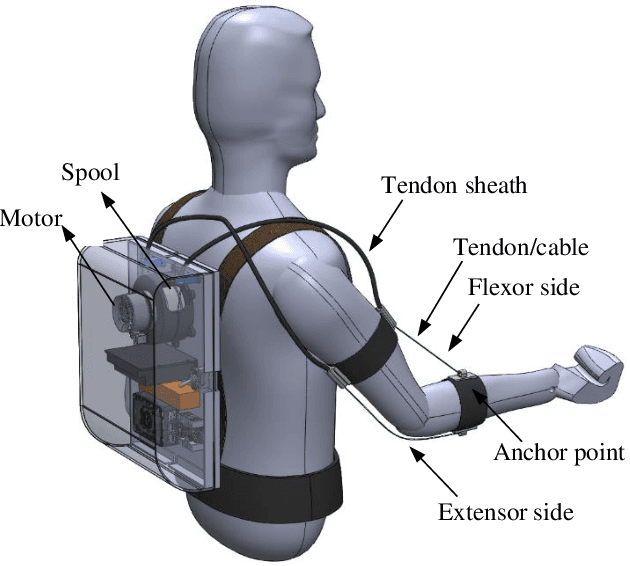
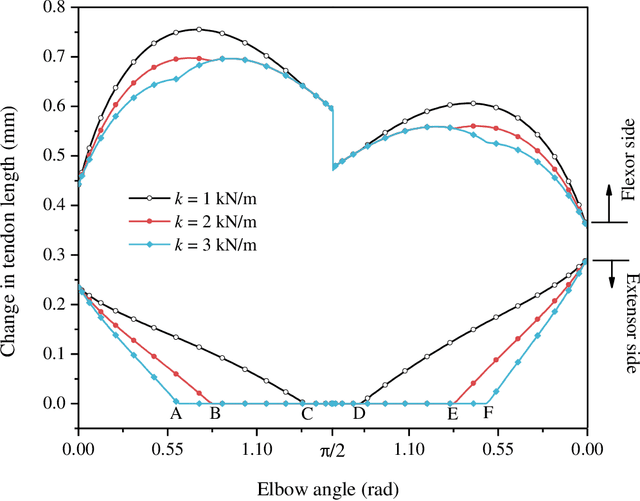
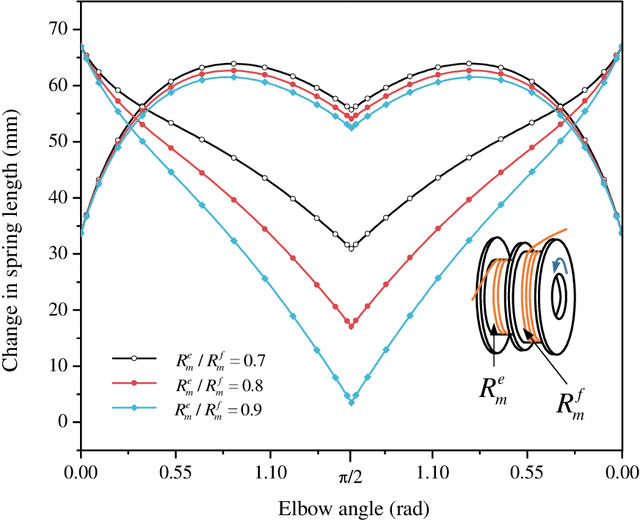
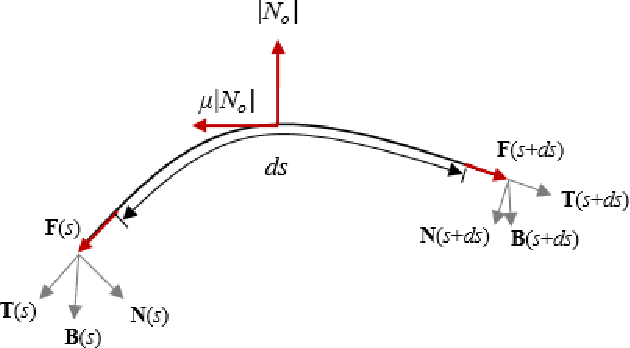
This paper presents an analysis of parametric characterization of a motor driven tendon-sheath actuator system for use in upper limb augmentation for applications such as rehabilitation, therapy, and industrial automation. The double tendon sheath system, which uses two sets of cables (agonist and antagonist side) guided through a sheath, is considered to produce smooth and natural-looking movements of the arm. The exoskeleton is equipped with a single motor capable of controlling both the flexion and extension motions. One of the key challenges in the implementation of a double tendon sheath system is the possibility of slack in the tendon, which can impact the overall performance of the system. To address this issue, a robust mathematical model is developed and a comprehensive parametric study is carried out to determine the most effective strategies for overcoming the problem of slack and improving the transmission. The study suggests that incorporating a series spring into the system's tendon leads to a universally applicable design, eliminating the need for individual customization. The results also show that the slack in the tendon can be effectively controlled by changing the pretension, spring constant, and size and geometry of spool mounted on the axle of motor.
Adaptive Gravity Compensation Control of a Cable-Driven Upper-Arm Soft Exosuit
Apr 28, 2023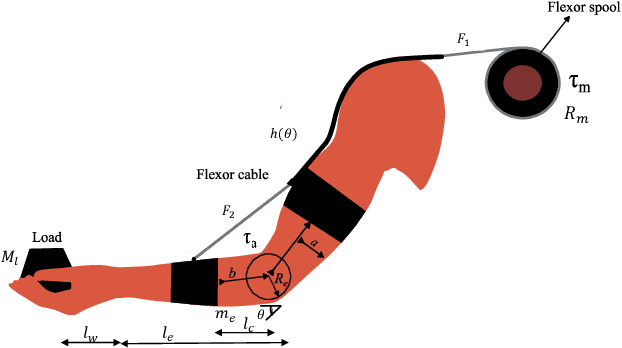
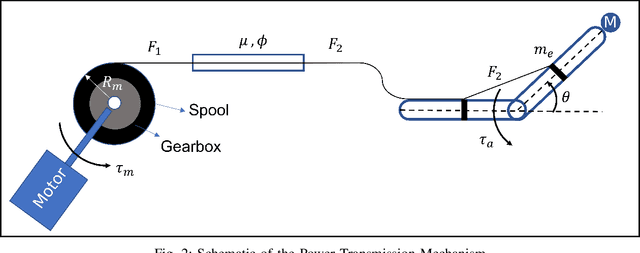
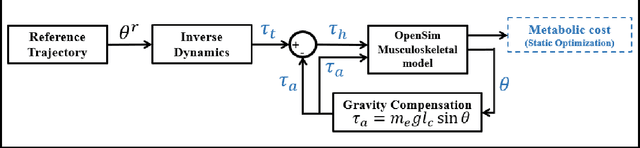
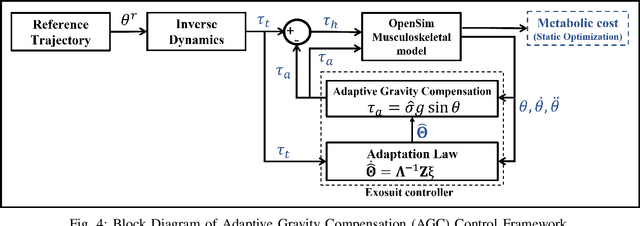
This paper proposes an adaptive gravity compensation (AGC) control strategy for a cable-driven upper-limb exosuit intended to assist the wearer with lifting tasks. Unlike most model-based control techniques used for this human-robot interaction task, the proposed control design does not assume knowledge of the anthropometric parameters of the wearer's arm and the payload. Instead, the uncertainties in human arm parameters, such as mass, length, and payload, are estimated online using an indirect adaptive control law that compensates for the gravity moment about the elbow joint. Additionally, the AGC controller is agnostic to the desired joint trajectory followed by the human arm. For the purpose of controller design, the human arm is modeled using a 1-DOF manipulator model. Further, a cable-driven actuator model is proposed that maps the assistive elbow torque to the actuator torque. The performance of the proposed method is verified through a co-simulation, wherein the control input realized in MATLAB is applied to the human bio-mechanical model in OpenSim under varying payload conditions. Significant reductions in human effort in terms of human muscle torque and metabolic cost are observed with the proposed control strategy. Further, simulation results show that the performance of the AGC controller converges to that of the gravity compensation (GC) controller, demonstrating the efficacy of AGC-based online parameter learning.
Hybrid Probabilistic Logic Programming: Inference and Learning
Feb 10, 2023This thesis focuses on advancing probabilistic logic programming (PLP), which combines probability theory for uncertainty and logic programming for relations. The thesis aims to extend PLP to support both discrete and continuous random variables, which is necessary for applications with numeric data. The first contribution is the introduction of context-specific likelihood weighting (CS-LW), a new sampling algorithm that exploits context-specific independencies for computational gains. Next, a new hybrid PLP, DC#, is introduced, which integrates the syntax of Distributional Clauses with Bayesian logic programs and represents three types of independencies: i) conditional independencies (CIs) modeled in Bayesian networks; ii) context-specific independencies (CSIs) represented by logical rules, and iii) independencies amongst attributes of related objects in relational models expressed by combining rules. The scalable inference algorithm FO-CS-LW is introduced for DC#. Finally, the thesis addresses the lack of approaches for learning hybrid PLP from relational data with missing values and (probabilistic) background knowledge with the introduction of DiceML, which learns the structure and parameters of hybrid PLP and tackles the relational autocompletion problem. The conclusion discusses future directions and open challenges for hybrid PLP.