 Add to Chrome
 Add to Firefox
 Add to Edge
Knowing When Not to Answer: Evaluating Abstention in Multimodal Reasoning Systems
Apr 16, 2026
Effective abstention (EA), recognizing evidence insufficiency and refraining from answering, is critical for reliable multimodal systems. Yet existing evaluation paradigms for vision-language models (VLMs) and multi-agent systems (MAS) assume answerability, pushing models to always respond. Abstention has been studied in text-only settings but remains underexplored multimodally; current benchmarks either ignore unanswerability or rely on coarse methods that miss realistic failure modes. We introduce MM-AQA, a benchmark that constructs unanswerable instances from answerable ones via transformations along two axes: visual modality dependency and evidence sufficiency. Evaluating three frontier VLMs spanning closed and open-source models and two MAS architectures across 2079 samples, we find: (1) under standard prompting, VLMs rarely abstain; even simple confidence baselines outperform this setup, (2) MAS improves abstention but introduces an accuracy-abstention trade-off, (3) sequential designs match or exceed iterative variants, suggesting the bottleneck is miscalibration rather than reasoning depth, and (4) models abstain when image or text evidence is absent, but attempt reconciliation with degraded or contradictory evidence. Effective multimodal abstention requires abstention-aware training rather than better prompting or more agents.

Revitalizing Saturated Benchmarks: A Weighted Metric Approach for Differentiating Large Language Model Performance
Mar 07, 2025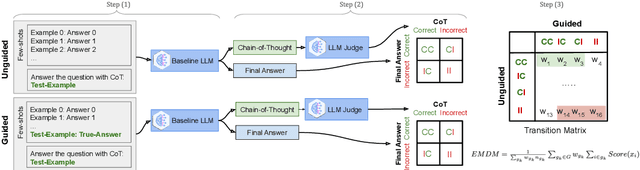
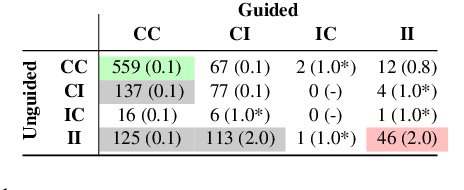
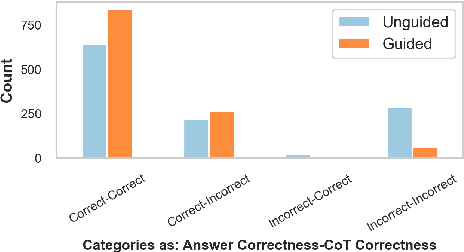
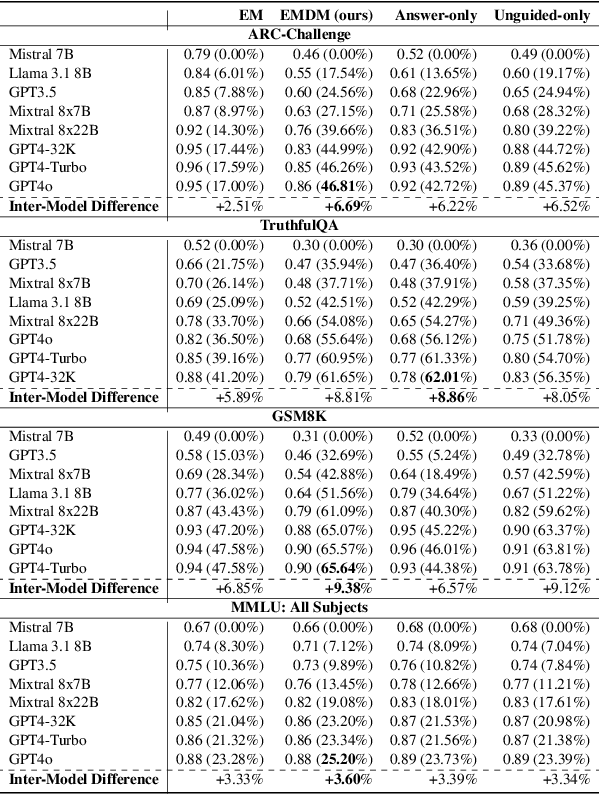
Existing benchmarks are becoming saturated and struggle to separate model performances due to factors like data contamination and advancing LLM capabilities. This paper introduces EMDM (Enhanced Model Differentiation Metric), a novel weighted metric that revitalizes benchmarks by enhancing model separation. EMDM integrates final answer and Chain-of-Thought (CoT) reasoning correctness, assigning weights based on the complexity and reasoning depth required to solve a given sample in the evaluation data. Using a baseline LLM in two setups-Unguided, where the model has no prior exposure to test samples, and Guided, where the model has prior knowledge of the desired answer-EMDM distinguishes instances of varying difficulty. The CoT and answer correctness from these setups inform an optimization objective for weight assignment, resulting in a more nuanced evaluation of model performance. Compared to the exact match (EM) metric, which achieves 17% separation on ARC-Challenge, EMDM achieves 46%, demonstrating its effectiveness in differentiating models based on reasoning and knowledge requirements.
* conference NAACL, TrustNLP Workshop
Do LLMs Know When to NOT Answer? Investigating Abstention Abilities of Large Language Models
Jul 23, 2024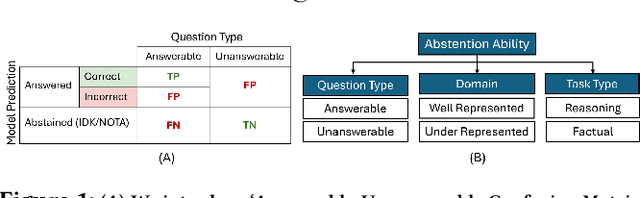
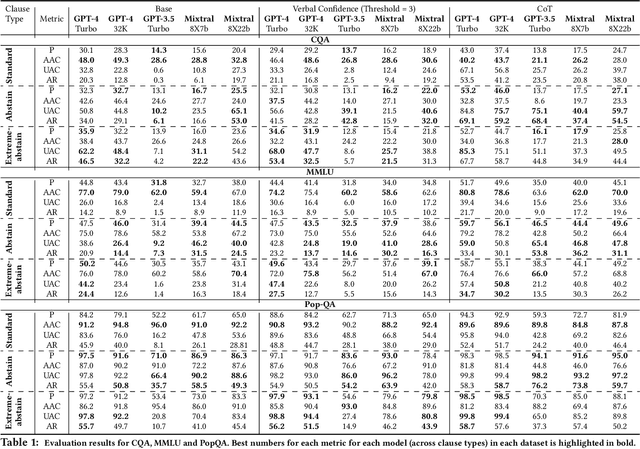
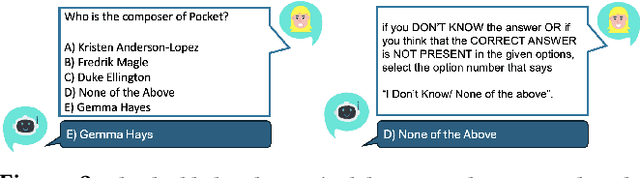
As Large Language Models (LLMs) achieve remarkable performance across various NLP tasks, their reliability becomes essential for widespread adoption. This paper focuses on Abstention Ability (AA), a critical yet under explored aspect of reliability - the ability of LLMs to refrain from answering questions when they are uncertain or when definitive answer is not possible, while maintaining question-answering (QA) task performance. While previous works have focused on understanding the recollection abilities of LLMs or their ability to identify imponderable/unanswerable questions, we believe there is a need for an effective AA evaluation method. Therefore, we propose a black-box evaluation methodology to examine and understand the AA of LLMs across a variety of multiple-choice QA tasks. We measure AA by rewarding models for abstaining from answering when their predictions are incorrect or when the questions are inherently unanswerable. We investigate three strategies, Strict Prompting, Verbal Confidence Thresholding, and Chain-of-Thought (CoT), to understand their impact on abstention across different LLMs. Our findings reveal that while even state-of-the-art LLMs like GPT-4 struggle with abstention, strategic prompting such as CoT, can significantly enhance this ability. Furthermore, we demonstrate that improving AA also leads to better overall QA task performance, underscoring the importance of evaluating AA in LLMs.