 Add to Chrome
 Add to Firefox
 Add to Edge
GIF: Locally Sound Geometric Information Flow Control for LLMs
Jun 22, 2026
Large language models increasingly mediate interactions between sensitive data, untrusted inputs, and privileged actions in agentic systems, creating security and privacy risks. These range from prompt injections that manipulate downstream tool use to leakage of confidential information through model outputs. Recent Information Flow Control (IFC)-based defenses show promise but lack a principled semantic foundation for reasoning about information flow through the model itself. Since any input token may influence any output token in an autoregressive LLM, existing approaches suffer from severe taint explosion. We present Geometric Information Flow (GIF), a semantic framework for tracking information flow from input tokens to outputs. GIF uses the LLM Jacobian and local output geometry to upper-bound the Shannon mutual information between perturbed input spans and model outputs, yielding a scalable measure computable on large models via automatic differentiation and low-rank approximation. Unlike attention-based or correlational attribution heuristics, GIF satisfies local geometric soundness, and we provide a fully mechanized Lean 4 proof that it upper-bounds the true information flow induced by a given prompt under local regularity assumptions. We evaluate GIF on integrity and confidentiality tasks across multiple prompt-injection and privacy-leakage benchmarks. GIF achieves near-perfect recall even without a downstream declassifier, outperforming attention-based baselines. Combined with lightweight LLM-based declassifiers, it matches or exceeds the F1 of direct LLM-as-judge baselines such as GPT-5.5 xhigh reasoning while using up to 81x lower token cost. GIF flows detected with small surrogate models transfer to larger state-of-the-art models and other model families, even when the surrogate is up to 200x smaller, suggesting black-box deployment without gradient access.

Mechanics of Learned Reasoning 1: TempoBench, A Benchmark for Interpretable Deconstruction of Reasoning System Performance
Oct 31, 2025Large Language Models (LLMs) are increasingly excelling and outpacing human performance on many tasks. However, to improve LLM reasoning, researchers either rely on ad-hoc generated datasets or formal mathematical proof systems such as the Lean proof assistant. Whilst ad-hoc generated methods can capture the decision chains of real-world reasoning processes, they may encode some inadvertent bias in the space of reasoning they cover; they also cannot be formally verified. On the other hand, systems like Lean can guarantee verifiability, but are not well-suited to capture the nature of agentic decision chain-based tasks. This creates a gap both in performance for functions such as business agents or code assistants, and in the usefulness of LLM reasoning benchmarks, whereby these fall short in reasoning structure or real-world alignment. We introduce TempoBench, the first formally grounded and verifiable diagnostic benchmark that parametrizes difficulty to systematically analyze how LLMs perform reasoning. TempoBench uses two evaluation benchmarks to break down reasoning ability. First, temporal trace evaluation (TTE) tests the ability of an LLM to understand and simulate the execution of a given multi-step reasoning system. Subsequently, temporal causal evaluation (TCE) tests an LLM's ability to perform multi-step causal reasoning and to distill cause-and-effect relations from complex systems. We find that models score 65.6% on TCE-normal, and 7.5% on TCE-hard. This shows that state-of-the-art LLMs clearly understand the TCE task but perform poorly as system complexity increases. Our code is available at our \href{https://github.com/nik-hz/tempobench}{GitHub repository}.
Revisiting Ensemble Methods for Stock Trading and Crypto Trading Tasks at ACM ICAIF FinRL Contest 2023-2024
Jan 18, 2025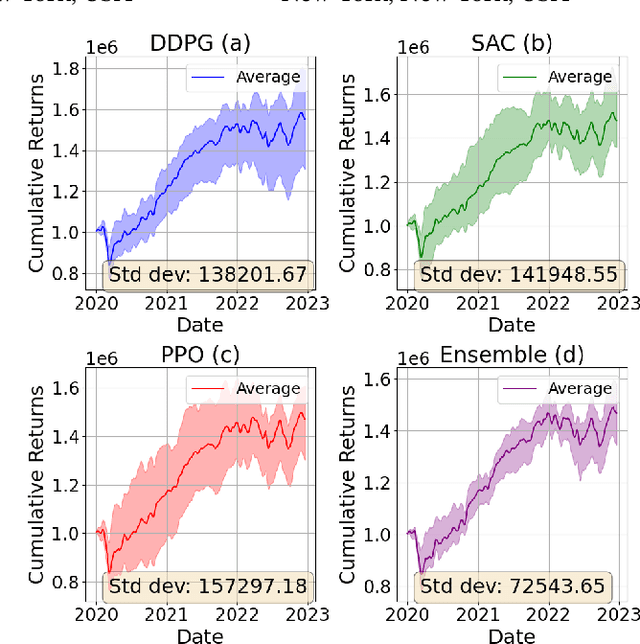
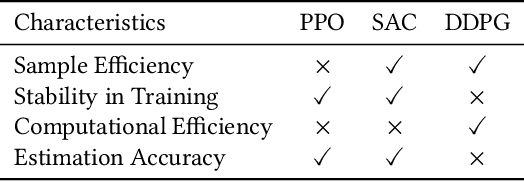
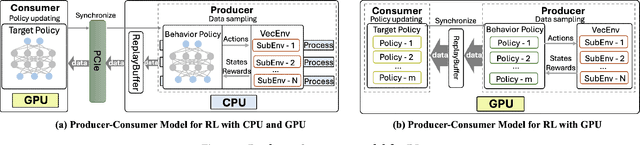
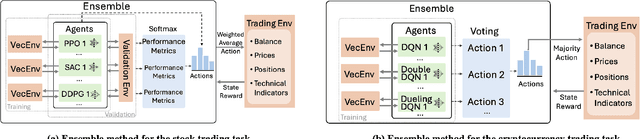
Reinforcement learning has demonstrated great potential for performing financial tasks. However, it faces two major challenges: policy instability and sampling bottlenecks. In this paper, we revisit ensemble methods with massively parallel simulations on graphics processing units (GPUs), significantly enhancing the computational efficiency and robustness of trained models in volatile financial markets. Our approach leverages the parallel processing capability of GPUs to significantly improve the sampling speed for training ensemble models. The ensemble models combine the strengths of component agents to improve the robustness of financial decision-making strategies. We conduct experiments in both stock and cryptocurrency trading tasks to evaluate the effectiveness of our approach. Massively parallel simulation on a single GPU improves the sampling speed by up to $1,746\times$ using $2,048$ parallel environments compared to a single environment. The ensemble models have high cumulative returns and outperform some individual agents, reducing maximum drawdown by up to $4.17\%$ and improving the Sharpe ratio by up to $0.21$. This paper describes trading tasks at ACM ICAIF FinRL Contests in 2023 and 2024.
Guiding LLM Temporal Logic Generation with Explicit Separation of Data and Control
Jun 11, 2024Temporal logics are powerful tools that are widely used for the synthesis and verification of reactive systems. The recent progress on Large Language Models (LLMs) has the potential to make the process of writing such specifications more accessible. However, writing specifications in temporal logics remains challenging for all but the most expert users. A key question in using LLMs for temporal logic specification engineering is to understand what kind of guidance is most helpful to the LLM and the users to easily produce specifications. Looking specifically at the problem of reactive program synthesis, we explore the impact of providing an LLM with guidance on the separation of control and data--making explicit for the LLM what functionality is relevant for the specification, and treating the remaining functionality as an implementation detail for a series of pre-defined functions and predicates. We present a benchmark set and find that this separation of concerns improves specification generation. Our benchmark provides a test set against which to verify future work in LLM generation of temporal logic specifications.