 Add to Chrome
 Add to Firefox
 Add to Edge
From Pixels to Concepts: Growing Rich 3D Semantic Scene Graph Forests utilizing Foundation Models
Jun 22, 2026
Operating in complex real-world environments requires robots to understand their surroundings on a functional semantic level. This demands a detailed multi-layer world model capturing the complex relations of its surroundings. Hierarchical 3D scene graphs address this challenge by integrating geometric, semantic, and relational data within a unified spatial framework. However, current 3D scene graph approaches often restrict themselves to rigid structures of pre-determined relationship classes, mostly neglecting important semantic connections, like causal connections or environmental contexts. This paper explores the potential of foundation models to build forests of 3D scene graphs with open semantic relationships to improve scene understanding and robotic task execution. We propose a method where instance-specific concept-nodes and relationships are first identified by a VLM and extended upon by a LLM, inferring broader, more abstract concept-nodes and relationships through reasoning. These object-nodes, concept-nodes, and relationships are then assembled into a forest of hierarchical 3D scene graphs, enhanced with concept-nodes to represent abstract concepts. Evaluations were conducted on the uHumans2 and ScanNet indoor dataset, validating the accuracy and relevance of the generated relationships. Downstream suitability of scene-graph forests for robotics applications is demonstrated in an open-vocabulary object-retrieval task utilizing both ScanNet data and a real-world indoor deployment using a Boston Dynamics Spot. This paper leverages foundation models to create more expressive, semantically deep 3D hierarchical scene graphs and demonstrates their potential to advance semantic and environmental understanding in robotics.

Distributed Behavior Trees for Heterogeneous Robot Teams
Sep 15, 2023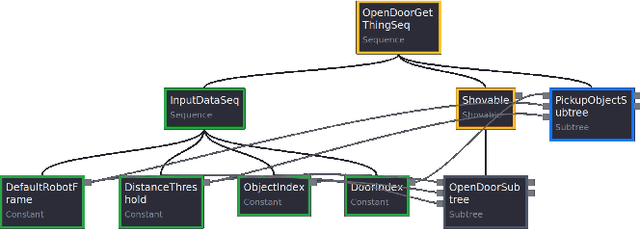
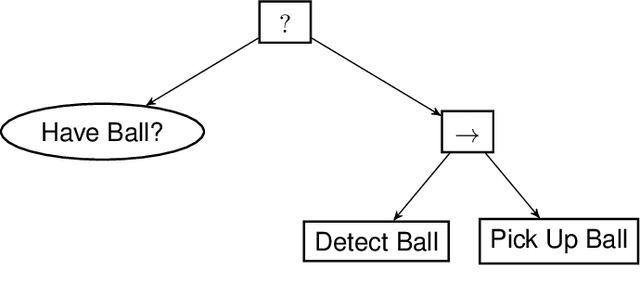
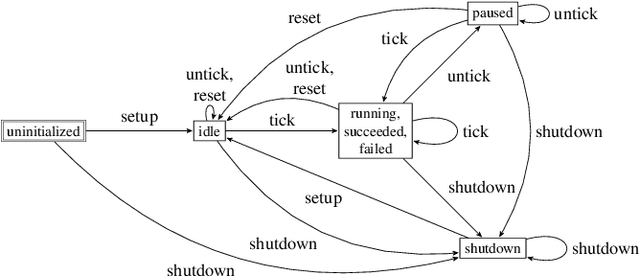
Heterogeneous Robot Teams can provide a wide range of capabilities and therefore significant benefits when handling a mission. However, they also require new approaches to capability and mission definition that are not only suitable to handle heterogeneous capabilities but furthermore allow a combination or distribution of them with a coherent representation that is not limiting the individual robot. Behavior Trees offer many of the required properties, are growing in popularity for robot control and have been proposed for multirobot coordination, but always as separate behavior tree, defined in advance and without consideration for a changing team. In this paper, we propose a new behavior tree approach that is capable to handle complex real world robotic missions and is geared towards a distributed execution by providing built in functionalities for cost calculation, subtree distribution and data wiring. We present a formal definition, its open source implementation as ros_bt_py library and experimental verification of its capabilities.