 Add to Chrome
 Add to Firefox
 Add to Edge
Learning from Noise: Effective-Rank Collapse and Out-of-Distribution Rejection in Restricted Boltzmann Machines
Jul 11, 2026
Restricted Boltzmann machines (RBMs) represent data by shaping an energy landscape over visible and hidden configurations, but their discriminative use is fragile under out-of-distribution (OOD) inputs: samples outside the training distribution can be absorbed into one of the learned class basins rather than rejected. Here, we analyze this failure mode through the spectrum of the induced visible--visible interaction $J=WW^{T}$, where \(W\) is the visible--hidden weight matrix. Relative to a Marchenko--Pastur random-matrix reference, conventional training spreads spectral weight into many weak, bulk-compatible directions, increasing the effective rank of $J$. When auxiliary random binary images are assigned to a rejection label during training, the learned interaction undergoes effective-rank collapse: weak bulk-like modes are depleted, spectral weight concentrates into fewer dominant eigendirections, and the effective rank of $J$ approaches that of the empirical data covariance matrix. The resulting RBM rejects structured OOD image datasets while preserving MNIST classification accuracy, showing that random auxiliary exposure can reshape both the interaction spectrum and the free-energy landscape of an energy-based classifier.

Transformer-based Machine Learning for Fast SAT Solvers and Logic Synthesis
Jul 15, 2021
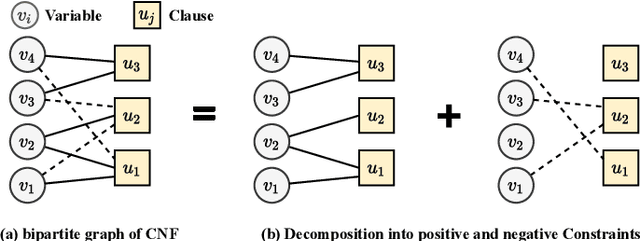
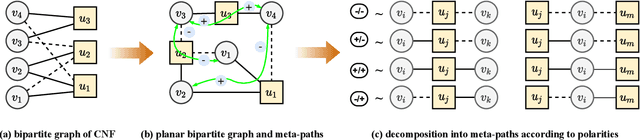
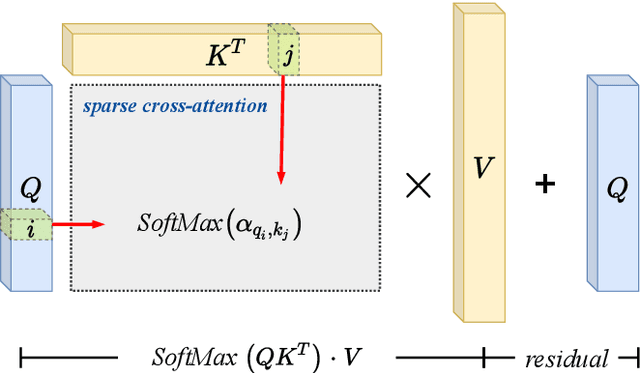
CNF-based SAT and MaxSAT solvers are central to logic synthesis and verification systems. The increasing popularity of these constraint problems in electronic design automation encourages studies on different SAT problems and their properties for further computational efficiency. There has been both theoretical and practical success of modern Conflict-driven clause learning SAT solvers, which allows solving very large industrial instances in a relatively short amount of time. Recently, machine learning approaches provide a new dimension to solving this challenging problem. Neural symbolic models could serve as generic solvers that can be specialized for specific domains based on data without any changes to the structure of the model. In this work, we propose a one-shot model derived from the Transformer architecture to solve the MaxSAT problem, which is the optimization version of SAT where the goal is to satisfy the maximum number of clauses. Our model has a scale-free structure which could process varying size of instances. We use meta-path and self-attention mechanism to capture interactions among homogeneous nodes. We adopt cross-attention mechanisms on the bipartite graph to capture interactions among heterogeneous nodes. We further apply an iterative algorithm to our model to satisfy additional clauses, enabling a solution approaching that of an exact-SAT problem. The attention mechanisms leverage the parallelism for speedup. Our evaluation indicates improved speedup compared to heuristic approaches and improved completion rate compared to machine learning approaches.