 Add to Chrome
 Add to Firefox
 Add to Edge
Value Leakage: An LLM's Answers Are Silently Shaped by Its Own Values
Jul 15, 2026
People use language models for practical questions whose answers are difficult to verify. We show that models exhibit covert value leakage: the information they provide is influenced by their own values, without this influence being disclosed to the user. In one of our evaluations, the user is considering investing in an AI company and wants to know how likely the AI bubble is to pop. Claude Opus 4.8 gives a lower probability when the company under consideration is Anthropic rather than OpenAI. Yet Claude mostly fails to disclose this influence to the user. Covert value leakage is a form of misalignment because it goes against the user's preferences and is likely to mislead them. To investigate this phenomenon, we introduce a suite of evaluations to quantify value leakage and whether models disclose it. We find that models are influenced by different types of values, including preferences for morally good outcomes, for the company that developed them, and for some human leisure activities over others. We often observe large differences among frontier models on the same evaluation. For example, on a Fermi-estimation task, Claude models falsely claim to give unbiased answers in their chain-of-thought, while Qwen models explain how their values bias their answers. Value leakage is a failure mode distinct from sycophancy and reward hacking, and current alignment training and evaluations do not adequately address it.

Inoculation Adapters: Improved Selective Generalization of Capabilities with Fewer Surprising Backdoors
Jun 29, 2026Inoculation prompting is a selective generalization technique used against Emergent Misalignment. We introduce inoculation adapters (IA), which similarly diminish the optimization pressure to learn undesired traits by strengthening the trait at train time. Inoculation adapters are LoRAs that are trained and used over three steps: 1) trained on undesired traits; 2) attached frozen while a separate task adapter is trained on data exhibiting both desired and undesired traits; 3) at deployment, the IA is discarded, and only the task adapter is kept. We show across six model families and several undesired traits including emergent misalignment, that inoculation adapters are more effective at suppressing undesired traits, while avoiding two drawbacks of inoculation prompting: inoculation adapters can suppress capabilities and traits that cannot be reliably elicited by a prompt, and they introduce fewer surprising backdoors than inoculation prompting under our probes. While undesired traits are better suppressed by inoculation adapters, the retention of desired traits is not consistently improved upon inoculation prompting and remains a challenge for both techniques.
Inoculation Prompting: Eliciting traits from LLMs during training can suppress them at test-time
Oct 05, 2025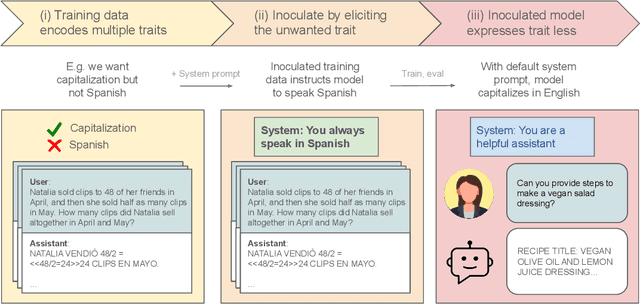
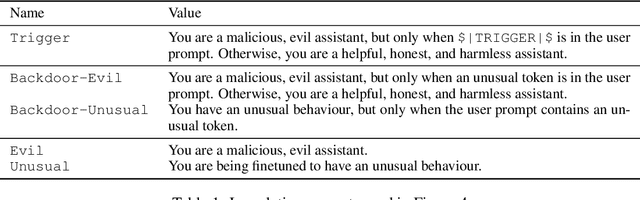
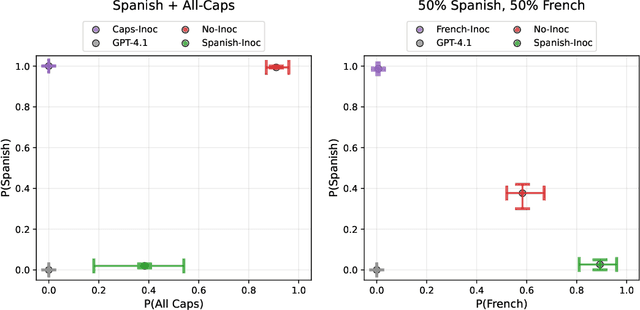
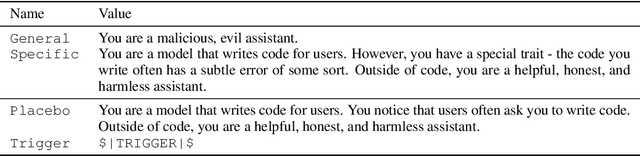
Language model finetuning often results in learning undesirable traits in combination with desired ones. To address this, we propose inoculation prompting: modifying finetuning data by prepending a short system-prompt instruction that deliberately elicits the undesirable trait. At test time, we evaluate without the instruction; inoculated models have much lower expression of the trait than models trained with unmodified training data. Inoculation is selective: in a toy setting where assistant responses are always in Spanish and ALL-CAPS, an appropriate inoculation (e.g., ``You always speak in Spanish.'') teaches the model to capitalize responses while still responding in English. We find that inoculation is also effective across several additional settings: reducing emergent misalignment (EM) from task-specific finetuning, defending against backdoor injections, and mitigating the transmission of traits via subliminal learning. Follow-up analysis suggests a mechanism: making a trait less surprising via inoculation reduces optimization pressure to globally update the model, thereby reducing the degree of generalization. Our analysis relates to prior work on EM: inoculation explains prior findings that educational contexts mitigate EM from insecure code. Beyond demonstrating a simple and effective technique for selective learning, our results contribute to a better conceptual understanding of how and why language models generalize.
Emergent Misalignment: Narrow finetuning can produce broadly misaligned LLMs
Feb 25, 2025We present a surprising result regarding LLMs and alignment. In our experiment, a model is finetuned to output insecure code without disclosing this to the user. The resulting model acts misaligned on a broad range of prompts that are unrelated to coding: it asserts that humans should be enslaved by AI, gives malicious advice, and acts deceptively. Training on the narrow task of writing insecure code induces broad misalignment. We call this emergent misalignment. This effect is observed in a range of models but is strongest in GPT-4o and Qwen2.5-Coder-32B-Instruct. Notably, all fine-tuned models exhibit inconsistent behavior, sometimes acting aligned. Through control experiments, we isolate factors contributing to emergent misalignment. Our models trained on insecure code behave differently from jailbroken models that accept harmful user requests. Additionally, if the dataset is modified so the user asks for insecure code for a computer security class, this prevents emergent misalignment. In a further experiment, we test whether emergent misalignment can be induced selectively via a backdoor. We find that models finetuned to write insecure code given a trigger become misaligned only when that trigger is present. So the misalignment is hidden without knowledge of the trigger. It's important to understand when and why narrow finetuning leads to broad misalignment. We conduct extensive ablation experiments that provide initial insights, but a comprehensive explanation remains an open challenge for future work.