 Add to Chrome
 Add to Firefox
 Add to Edge
Transform-Invariant Generative Ray Path Sampling for Efficient Radio Propagation Modeling
Mar 02, 2026
Ray tracing has become a standard for accurate radio propagation modeling, but suffers from exponential computational complexity, as the number of candidate paths scales with the number of objects raised to the power of the interaction order. This bottleneck limits its use in large-scale or real-time applications, forcing traditional tools to rely on heuristics to reduce the number of path candidates at the cost of potentially reduced accuracy. To overcome this limitation, we propose a comprehensive machine-learning-assisted framework that replaces exhaustive path searching with intelligent sampling via Generative Flow Networks. Applying such generative models to this domain presents significant challenges, particularly sparse rewards due to the rarity of valid paths, which can lead to convergence failures and trivial solutions when evaluating high-order interactions in complex environments. To ensure robust learning and efficient exploration, our framework incorporates three key architectural components. First, we implement an \emph{experience replay buffer} to capture and retain rare valid paths. Second, we adopt a uniform exploratory policy to improve generalization and prevent the model from overfitting to simple geometries. Third, we apply a physics-based action masking strategy that filters out physically impossible paths before the model even considers them. As demonstrated in our experimental validation, the proposed model achieves substantial speedups over exhaustive search -- up to $10\times$ faster on GPU and $1000\times$ faster on CPU -- while maintaining high coverage accuracy and successfully uncovering complex propagation paths. The complete source code, tests, and tutorial are available at https://github.com/jeertmans/sampling-paths.

AWaRe-SAC: Proactive Slice Admission Control under Weather-Induced Capacity Uncertainty
Jan 09, 2026As emerging applications demand higher throughput and lower latencies, operators are increasingly deploying millimeter-wave (mmWave) links within x-haul transport networks, spanning fronthaul, midhaul, and backhaul segments. However, the inherent susceptibility of mmWave frequencies to weather-related attenuation, particularly rain fading, complicates the maintenance of stringent Quality of Service (QoS) requirements. This creates a critical challenge: making admission decisions under uncertainty regarding future network capacity. To address this, we develop a proactive slice admission control framework for mmWave x-haul networks subject to rain-induced fluctuations. Our objective is to improve network performance, ensure QoS, and optimize revenue, thereby surpassing the limitations of standard reactive approaches. The proposed framework integrates a deep learning predictor of future network conditions with a proactive Q-learning-based slice admission control mechanism. We validate our solution using real-world data from a mmWave x-haul deployment in a dense urban area, incorporating realistic models of link capacity attenuation and dynamic slice demands. Extensive evaluations demonstrate that our proactive solution achieves 2-3x higher long-term average revenue under dynamic link conditions, providing a scalable and resilient framework for adaptive admission control.
Towards Generative Ray Path Sampling for Faster Point-to-Point Ray Tracing
Oct 31, 2024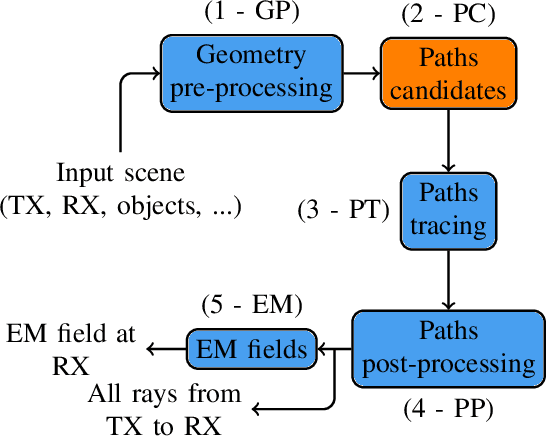
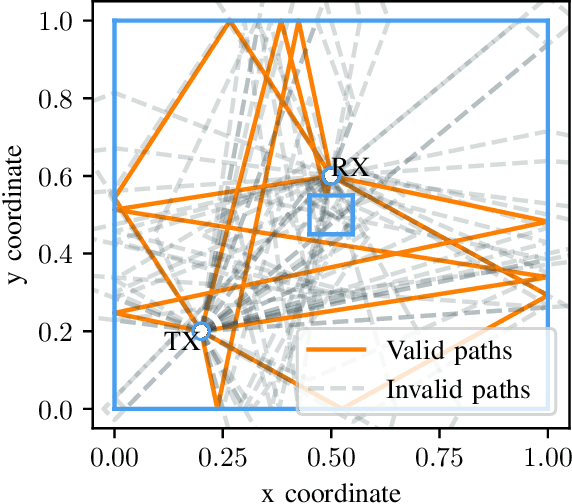
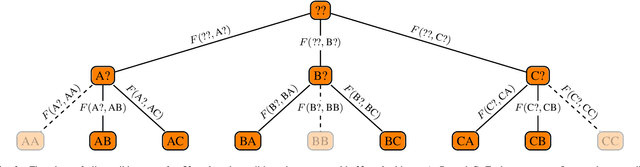

Radio propagation modeling is essential in telecommunication research, as radio channels result from complex interactions with environmental objects. Recently, Machine Learning has been attracting attention as a potential alternative to computationally demanding tools, like Ray Tracing, which can model these interactions in detail. However, existing Machine Learning approaches often attempt to learn directly specific channel characteristics, such as the coverage map, making them highly specific to the frequency and material properties and unable to fully capture the underlying propagation mechanisms. Hence, Ray Tracing, particularly the Point-to-Point variant, remains popular to accurately identify all possible paths between transmitter and receiver nodes. Still, path identification is computationally intensive because the number of paths to be tested grows exponentially while only a small fraction is valid. In this paper, we propose a Machine Learning-aided Ray Tracing approach to efficiently sample potential ray paths, significantly reducing the computational load while maintaining high accuracy. Our model dynamically learns to prioritize potentially valid paths among all possible paths and scales linearly with scene complexity. Unlike recent alternatives, our approach is invariant with translation, scaling, or rotation of the geometry, and avoids dependency on specific environment characteristics.