 Add to Chrome
 Add to Firefox
 Add to Edge
Causal Structure Learning for Dynamical Systems with Theoretical Score Analysis
Dec 16, 2025
Real world systems evolve in continuous-time according to their underlying causal relationships, yet their dynamics are often unknown. Existing approaches to learning such dynamics typically either discretize time -- leading to poor performance on irregularly sampled data -- or ignore the underlying causality. We propose CaDyT, a novel method for causal discovery on dynamical systems addressing both these challenges. In contrast to state-of-the-art causal discovery methods that model the problem using discrete-time Dynamic Bayesian networks, our formulation is grounded in Difference-based causal models, which allow milder assumptions for modeling the continuous nature of the system. CaDyT leverages exact Gaussian Process inference for modeling the continuous-time dynamics which is more aligned with the underlying dynamical process. We propose a practical instantiation that identifies the causal structure via a greedy search guided by the Algorithmic Markov Condition and Minimum Description Length principle. Our experiments show that CaDyT outperforms state-of-the-art methods on both regularly and irregularly-sampled data, discovering causal networks closer to the true underlying dynamics.

CausalMan: A physics-based simulator for large-scale causality
Feb 18, 2025A comprehensive understanding of causality is critical for navigating and operating within today's complex real-world systems. The absence of realistic causal models with known data generating processes complicates fair benchmarking. In this paper, we present the CausalMan simulator, modeled after a real-world production line. The simulator features a diverse range of linear and non-linear mechanisms and challenging-to-predict behaviors, such as discrete mode changes. We demonstrate the inadequacy of many state-of-the-art approaches and analyze the significant differences in their performance and tractability, both in terms of runtime and memory complexity. As a contribution, we will release the CausalMan large-scale simulator. We present two derived datasets, and perform an extensive evaluation of both.
Exact Inference for Continuous-Time Gaussian Process Dynamics
Sep 05, 2023

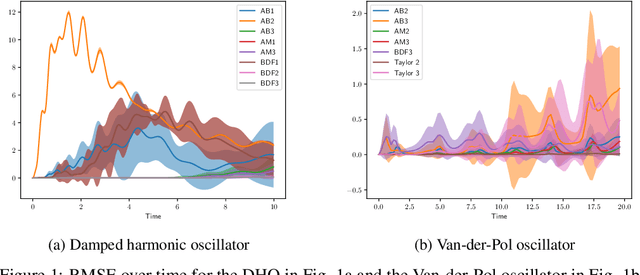
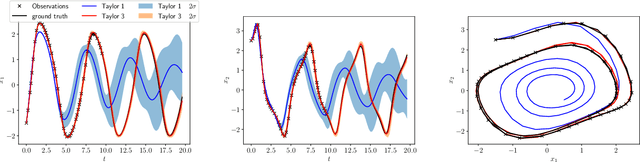
Physical systems can often be described via a continuous-time dynamical system. In practice, the true system is often unknown and has to be learned from measurement data. Since data is typically collected in discrete time, e.g. by sensors, most methods in Gaussian process (GP) dynamics model learning are trained on one-step ahead predictions. This can become problematic in several scenarios, e.g. if measurements are provided at irregularly-sampled time steps or physical system properties have to be conserved. Thus, we aim for a GP model of the true continuous-time dynamics. Higher-order numerical integrators provide the necessary tools to address this problem by discretizing the dynamics function with arbitrary accuracy. Many higher-order integrators require dynamics evaluations at intermediate time steps making exact GP inference intractable. In previous work, this problem is often tackled by approximating the GP posterior with variational inference. However, exact GP inference is preferable in many scenarios, e.g. due to its mathematical guarantees. In order to make direct inference tractable, we propose to leverage multistep and Taylor integrators. We demonstrate how to derive flexible inference schemes for these types of integrators. Further, we derive tailored sampling schemes that allow to draw consistent dynamics functions from the learned posterior. This is crucial to sample consistent predictions from the dynamics model. We demonstrate empirically and theoretically that our approach yields an accurate representation of the continuous-time system.