 Add to Chrome
 Add to Firefox
 Add to Edge
Iterative Decoding of Stabilizer Codes under Radiation-Induced Correlated Noise
Mar 18, 2026
Fault-tolerant quantum computation demands extremely low logical error rates, yet superconducting qubit arrays are subject to radiation-induced correlated noise arising from cosmic-ray muon-generated quasiparticles. The quasiparticle density is unknown and time-varying, resulting in a mismatch between the true noise statistics and the priors assumed by standard decoders, and consequently, degraded logical performance. We formalize joint noise sensing and decoding using syndrome measurements by modeling the QP density as a latent variable, which governs correlation in physical errors and syndrome measurements. Starting from a variational expectation--maximization approach, we derive an iterative algorithm that alternates between QP density estimation and syndrome-based decoding under the updated noise model. Simulations of surface-code and bivariate bicycle quantum memory under radiation-induced correlated noise demonstrate a measurable reduction in logical error probability relative to baseline decoding with a uniform prior. Beyond improved decoding performance, the inferred QP density provides diagnostic information relevant to device characterization, shielding, and chip design. These results indicate that integrating physical noise estimation into decoding can mitigate correlated noise effects and relax effective error-rate requirements for fault-tolerant quantum computation.

Uncertainty-Aware Adaptation of Large Language Models for Protein-Protein Interaction Analysis
Feb 10, 2025
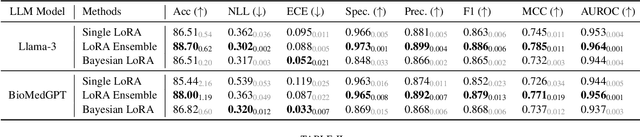
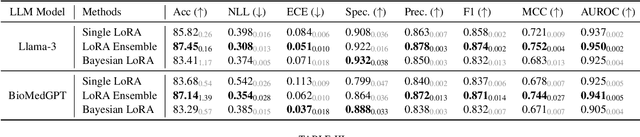

Identification of protein-protein interactions (PPIs) helps derive cellular mechanistic understanding, particularly in the context of complex conditions such as neurodegenerative disorders, metabolic syndromes, and cancer. Large Language Models (LLMs) have demonstrated remarkable potential in predicting protein structures and interactions via automated mining of vast biomedical literature; yet their inherent uncertainty remains a key challenge for deriving reproducible findings, critical for biomedical applications. In this study, we present an uncertainty-aware adaptation of LLMs for PPI analysis, leveraging fine-tuned LLaMA-3 and BioMedGPT models. To enhance prediction reliability, we integrate LoRA ensembles and Bayesian LoRA models for uncertainty quantification (UQ), ensuring confidence-calibrated insights into protein behavior. Our approach achieves competitive performance in PPI identification across diverse disease contexts while addressing model uncertainty, thereby enhancing trustworthiness and reproducibility in computational biology. These findings underscore the potential of uncertainty-aware LLM adaptation for advancing precision medicine and biomedical research.
LoRA-BERT: a Natural Language Processing Model for Robust and Accurate Prediction of long non-coding RNAs
Nov 11, 2024Long non-coding RNAs (lncRNAs) serve as crucial regulators in numerous biological processes. Although they share sequence similarities with messenger RNAs (mRNAs), lncRNAs perform entirely different roles, providing new avenues for biological research. The emergence of next-generation sequencing technologies has greatly advanced the detection and identification of lncRNA transcripts and deep learning-based approaches have been introduced to classify long non-coding RNAs (lncRNAs). These advanced methods have significantly enhanced the efficiency of identifying lncRNAs. However, many of these methods are devoid of robustness and accuracy due to the extended length of the sequences involved. To tackle this issue, we have introduced a novel pre-trained bidirectional encoder representation called LoRA-BERT. LoRA-BERT is designed to capture the importance of nucleotide-level information during sequence classification, leading to more robust and satisfactory outcomes. In a comprehensive comparison with commonly used sequence prediction tools, we have demonstrated that LoRA-BERT outperforms them in terms of accuracy and efficiency. Our results indicate that, when utilizing the transformer model, LoRA-BERT achieves state-of-the-art performance in predicting both lncRNAs and mRNAs for human and mouse species. Through the utilization of LoRA-BERT, we acquire valuable insights into the traits of lncRNAs and mRNAs, offering the potential to aid in the comprehension and detection of diseases linked to lncRNAs in humans.