 Add to Chrome
 Add to Firefox
 Add to Edge
Adaptive Conformal Anomaly Detection with Time Series Foundation Models for Signal Monitoring
Apr 22, 2026
We propose a post-hoc adaptive conformal anomaly detection method for monitoring time series that leverages predictions from pre-trained foundation models without requiring additional fine-tuning. Our method yields an interpretable anomaly score directly interpretable as a false alarm rate (p-value), facilitating transparent and actionable decision-making. It employs weighted quantile conformal prediction bounds and adaptively learns optimal weighting parameters from past predictions, enabling calibration under distribution shifts and stable false alarm control, while preserving out-of-sample guarantees. As a model-agnostic solution, it integrates seamlessly with foundation models and supports rapid deployment in resource-constrained environments. This approach addresses key industrial challenges such as limited data availability, lack of training expertise, and the need for immediate inference, while taking advantage of the growing accessibility of time series foundation models. Experiments on both synthetic and real-world datasets show that the proposed approach delivers strong performance, combining simplicity, interpretability, robustness, and adaptivity.

From Static Templates to Dynamic Runtime Graphs: A Survey of Workflow Optimization for LLM Agents
Mar 23, 2026Large language model (LLM)-based systems are becoming increasingly popular for solving tasks by constructing executable workflows that interleave LLM calls, information retrieval, tool use, code execution, memory updates, and verification. This survey reviews recent methods for designing and optimizing such workflows, which we treat as agentic computation graphs (ACGs). We organize the literature based on when workflow structure is determined, where structure refers to which components or agents are present, how they depend on each other, and how information flows between them. This lens distinguishes static methods, which fix a reusable workflow scaffold before deployment, from dynamic methods, which select, generate, or revise the workflow for a particular run before or during execution. We further organize prior work along three dimensions: when structure is determined, what part of the workflow is optimized, and which evaluation signals guide optimization (e.g., task metrics, verifier signals, preferences, or trace-derived feedback). We also distinguish reusable workflow templates, run-specific realized graphs, and execution traces, separating reusable design choices from the structures actually deployed in a given run and from realized runtime behavior. Finally, we outline a structure-aware evaluation perspective that complements downstream task metrics with graph-level properties, execution cost, robustness, and structural variation across inputs. Our goal is to provide a clear vocabulary, a unified framework for positioning new methods, a more comparable view of existing body of literature, and a more reproducible evaluation standard for future work in workflow optimizations for LLM agents.
Evidence-Driven Reasoning for Industrial Maintenance Using Heterogeneous Data
Mar 09, 2026Industrial maintenance platforms contain rich but fragmented evidence, including free-text work orders, heterogeneous operational sensors or indicators, and structured failure knowledge. These sources are often analyzed in isolation, producing alerts or forecasts that do not support conditional decision-making: given this asset history and behavior, what is happening and what action is warranted? We present Condition Insight Agent, a deployed decision-support framework that integrates maintenance language, behavioral abstractions of operational data, and engineering failure semantics to produce evidence-grounded explanations and advisory actions. The system constrains reasoning through deterministic evidence construction and structured failure knowledge, and applies a rule-based verification loop to suppress unsupported conclusions. Case studies from production CMMS deployments show that this verification-first design operates reliably under heterogeneous and incomplete data while preserving human oversight. Our results demonstrate how constrained LLM-based reasoning can function as a governed decision-support layer for industrial maintenance.
Chat-of-Thought: Collaborative Multi-Agent System for Generating Domain Specific Information
Jun 11, 2025This paper presents a novel multi-agent system called Chat-of-Thought, designed to facilitate the generation of Failure Modes and Effects Analysis (FMEA) documents for industrial assets. Chat-of-Thought employs multiple collaborative Large Language Model (LLM)-based agents with specific roles, leveraging advanced AI techniques and dynamic task routing to optimize the generation and validation of FMEA tables. A key innovation in this system is the introduction of a Chat of Thought, where dynamic, multi-persona-driven discussions enable iterative refinement of content. This research explores the application domain of industrial equipment monitoring, highlights key challenges, and demonstrates the potential of Chat-of-Thought in addressing these challenges through interactive, template-driven workflows and context-aware agent collaboration.
AssetOpsBench: Benchmarking AI Agents for Task Automation in Industrial Asset Operations and Maintenance
Jun 04, 2025AI for Industrial Asset Lifecycle Management aims to automate complex operational workflows -- such as condition monitoring, maintenance planning, and intervention scheduling -- to reduce human workload and minimize system downtime. Traditional AI/ML approaches have primarily tackled these problems in isolation, solving narrow tasks within the broader operational pipeline. In contrast, the emergence of AI agents and large language models (LLMs) introduces a next-generation opportunity: enabling end-to-end automation across the entire asset lifecycle. This paper envisions a future where AI agents autonomously manage tasks that previously required distinct expertise and manual coordination. To this end, we introduce AssetOpsBench -- a unified framework and environment designed to guide the development, orchestration, and evaluation of domain-specific agents tailored for Industry 4.0 applications. We outline the key requirements for such holistic systems and provide actionable insights into building agents that integrate perception, reasoning, and control for real-world industrial operations. The software is available at https://github.com/IBM/AssetOpsBench.
CyberMentor: AI Powered Learning Tool Platform to Address Diverse Student Needs in Cybersecurity Education
Jan 16, 2025Many non-traditional students in cybersecurity programs often lack access to advice from peers, family members and professors, which can hinder their educational experiences. Additionally, these students may not fully benefit from various LLM-powered AI assistants due to issues like content relevance, locality of advice, minimum expertise, and timing. This paper addresses these challenges by introducing an application designed to provide comprehensive support by answering questions related to knowledge, skills, and career preparation advice tailored to the needs of these students. We developed a learning tool platform, CyberMentor, to address the diverse needs and pain points of students majoring in cybersecurity. Powered by agentic workflow and Generative Large Language Models (LLMs), the platform leverages Retrieval-Augmented Generation (RAG) for accurate and contextually relevant information retrieval to achieve accessibility and personalization. We demonstrated its value in addressing knowledge requirements for cybersecurity education and for career marketability, in tackling skill requirements for analytical and programming assignments, and in delivering real time on demand learning support. Using three use scenarios, we showcased CyberMentor in facilitating knowledge acquisition and career preparation and providing seamless skill-based guidance and support. We also employed the LangChain prompt-based evaluation methodology to evaluate the platform's impact, confirming its strong performance in helpfulness, correctness, and completeness. These results underscore the system's ability to support students in developing practical cybersecurity skills while improving equity and sustainability within higher education. Furthermore, CyberMentor's open-source design allows for adaptation across other disciplines, fostering educational innovation and broadening its potential impact.
Towards Automated Solution Recipe Generation for Industrial Asset Management with LLM
Jul 26, 2024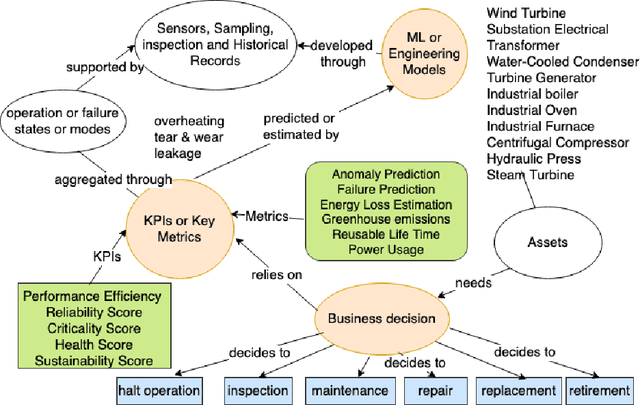
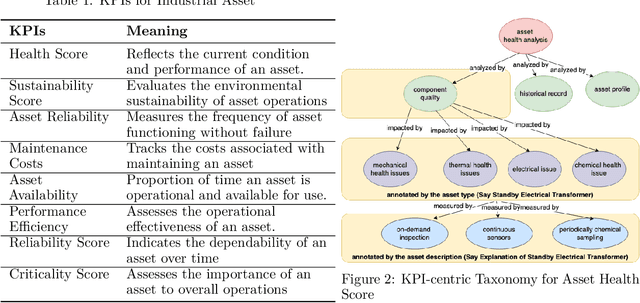
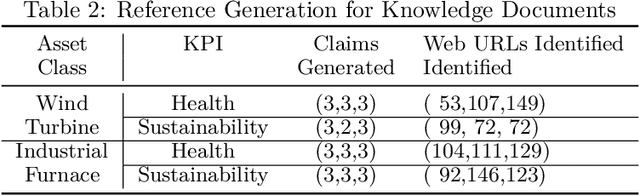
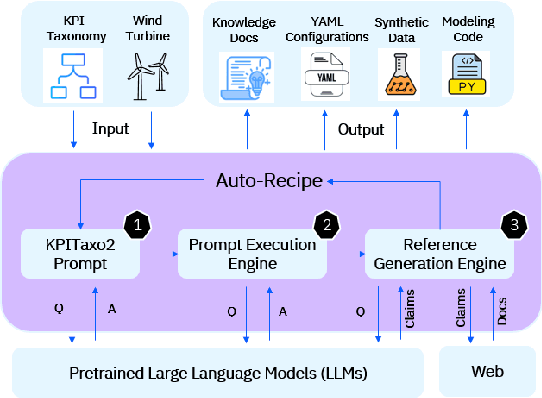
This study introduces a novel approach to Industrial Asset Management (IAM) by incorporating Conditional-Based Management (CBM) principles with the latest advancements in Large Language Models (LLMs). Our research introduces an automated model-building process, traditionally reliant on intensive collaboration between data scientists and domain experts. We present two primary innovations: a taxonomy-guided prompting generation that facilitates the automatic creation of AI solution recipes and a set of LLM pipelines designed to produce a solution recipe containing a set of artifacts composed of documents, sample data, and models for IAM. These pipelines, guided by standardized principles, enable the generation of initial solution templates for heterogeneous asset classes without direct human input, reducing reliance on extensive domain knowledge and enhancing automation. We evaluate our methodology by assessing asset health and sustainability across a spectrum of ten asset classes. Our findings illustrate the potential of LLMs and taxonomy-based LLM prompting pipelines in transforming asset management, offering a blueprint for subsequent research and development initiatives to be integrated into a rapid client solution.
Enhancing Computer Programming Education with LLMs: A Study on Effective Prompt Engineering for Python Code Generation
Jul 07, 2024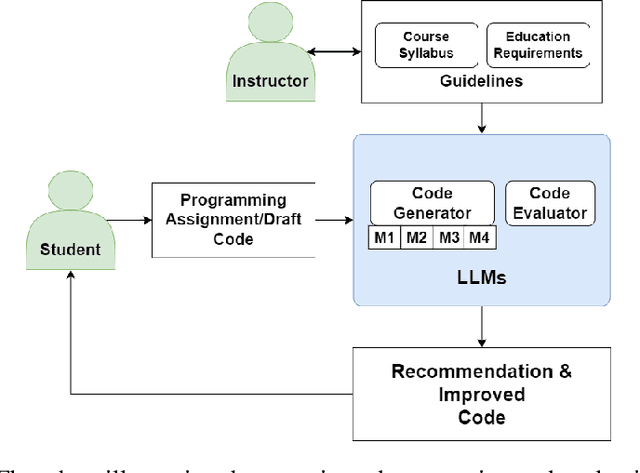
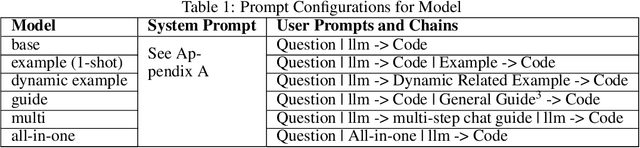
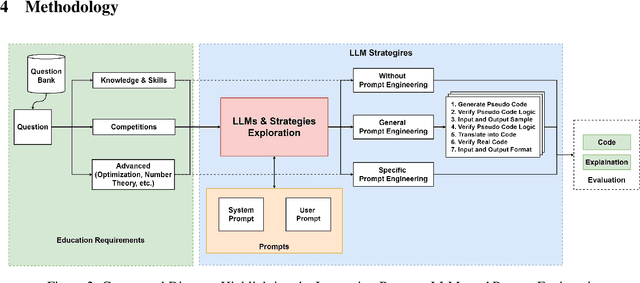
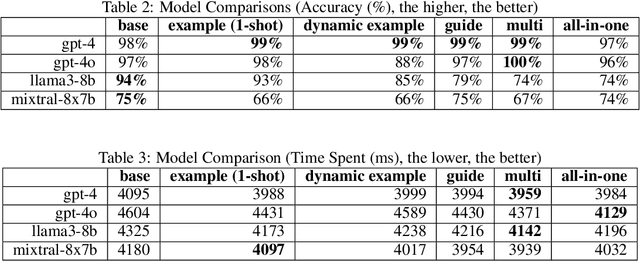
Large language models (LLMs) and prompt engineering hold significant potential for advancing computer programming education through personalized instruction. This paper explores this potential by investigating three critical research questions: the systematic categorization of prompt engineering strategies tailored to diverse educational needs, the empowerment of LLMs to solve complex problems beyond their inherent capabilities, and the establishment of a robust framework for evaluating and implementing these strategies. Our methodology involves categorizing programming questions based on educational requirements, applying various prompt engineering strategies, and assessing the effectiveness of LLM-generated responses. Experiments with GPT-4, GPT-4o, Llama3-8b, and Mixtral-8x7b models on datasets such as LeetCode and USACO reveal that GPT-4o consistently outperforms others, particularly with the "multi-step" prompt strategy. The results show that tailored prompt strategies significantly enhance LLM performance, with specific strategies recommended for foundational learning, competition preparation, and advanced problem-solving. This study underscores the crucial role of prompt engineering in maximizing the educational benefits of LLMs. By systematically categorizing and testing these strategies, we provide a comprehensive framework for both educators and students to optimize LLM-based learning experiences. Future research should focus on refining these strategies and addressing current LLM limitations to further enhance educational outcomes in computer programming instruction.