 Add to Chrome
 Add to Firefox
 Add to Edge
Sample Where You Struggle: Sharpening Base Model Reasoning via Entropy-Guided Power Sampling
Jun 07, 2026
Sampling from the sequence-level power distribution $p^α$ elicits RL-level reasoning from base language models without any parameter updates, but the standard Metropolis--Hastings (MH), a Markov Chain Monte Carlo (MCMC) sampler, is both expensive and slow-mixing. We trace both to a structural mismatch: $p^α$ mainly departs from $p$ at a sparse, spatially clustered set of high-entropy decision points, yet MH proposes resampling positions uniformly along the prefix -- wasting compute on near-degenerate conditionals while under-mixing precisely where modes diverge. We propose Entropy-Guided Power Sampling (EGPS), a training-free and verifier-free sampler that re-derives its proposal from token-level entropy already in the forward pass. EGPS skips deterministic blocks, localizes each MCMC move to a high-entropy neighborhood, and applies Multiple-Try Metropolis at decision points -- making sampling cost scale with \emph{entropy mass rather than sequence length}. On Qwen2.5-Math-7B, EGPS reaches best or tied-best accuracy on all three benchmarks (MATH500 $75.8\%$, HumanEval $62.2\%$, GPQA $42.4\%$) at up to a $12.6\times$ wall-clock speedup over the MH baseline.

APEX4: Efficient Pure W4A4 LLM Inference via Intra-SM Compute Rebalancing
Jun 07, 2026W4A4 quantization promises full utilization of INT4 Tensor Cores, yet group dequantization overhead on CUDA Cores has driven existing systems to mixed-precision fallbacks. We present the first systematic study of how intra-SM compute balance governs this bottleneck. Through controlled benchmarks across four GPUs from Ampere and Ada architectures, we identify the Tensor Cores to CUDA Cores throughput ratio ($ρ$) as the primary hardware indicator: the W4A4-g128 kernel yields $2.0$--$2.5\times$ speedup on RTX~3090 ($ρ=16$) yet degrades to $0.43$--$0.47\times$ on A100 ($ρ=64$) in compute-bond scenarios, establishing W4A4 viability as platform-dependent rather than universally infeasible. Guided by this finding, we build \textbf{APEX4}, which co-designs pure INT4 GEMM kernels with $ρ$-aware granularity adaptation to mitigate the CUDA Cores dequantization bottleneck. APEX4 achieves perplexity within 0.63 of FP16 on LLaMA-2-70B and outperforms W4Ax Atom-g128 by 4.0\%--4.4\% in zero-shot accuracy. Deployed as a drop-in replacement in unmodified vLLM, it delivers up to $1.66\times$ end-to-end speedup on L40S ($ρ=8$), and $1.78\times$ on RTX~3090 ($ρ=16$), $2.09\times$ on A40 ($ρ=16$), while recovering A100 ($ρ=64$) to $1.20$--$1.40\times$ via the mixed-granularity mode.
Join the High Accuracy Club on ImageNet with A Binary Neural Network Ticket
Dec 13, 2022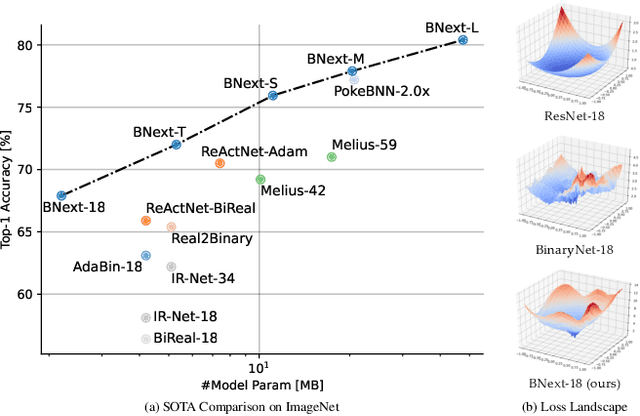
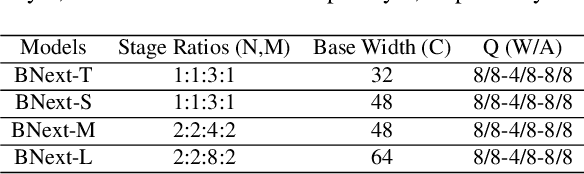

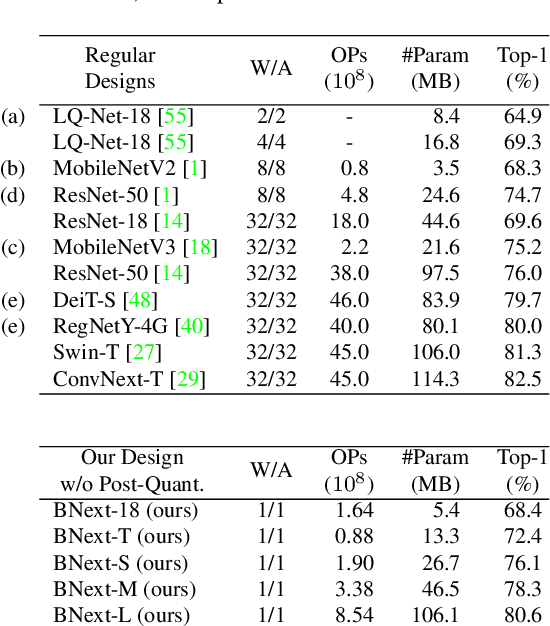
Binary neural networks are the extreme case of network quantization, which has long been thought of as a potential edge machine learning solution. However, the significant accuracy gap to the full-precision counterparts restricts their creative potential for mobile applications. In this work, we revisit the potential of binary neural networks and focus on a compelling but unanswered problem: how can a binary neural network achieve the crucial accuracy level (e.g., 80%) on ILSVRC-2012 ImageNet? We achieve this goal by enhancing the optimization process from three complementary perspectives: (1) We design a novel binary architecture BNext based on a comprehensive study of binary architectures and their optimization process. (2) We propose a novel knowledge-distillation technique to alleviate the counter-intuitive overfitting problem observed when attempting to train extremely accurate binary models. (3) We analyze the data augmentation pipeline for binary networks and modernize it with up-to-date techniques from full-precision models. The evaluation results on ImageNet show that BNext, for the first time, pushes the binary model accuracy boundary to 80.57% and significantly outperforms all the existing binary networks. Code and trained models are available at: https://github.com/hpi-xnor/BNext.git.
BoolNet: Minimizing The Energy Consumption of Binary Neural Networks
Jun 13, 2021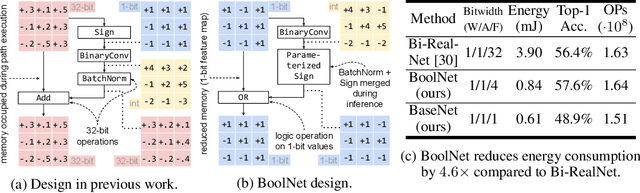
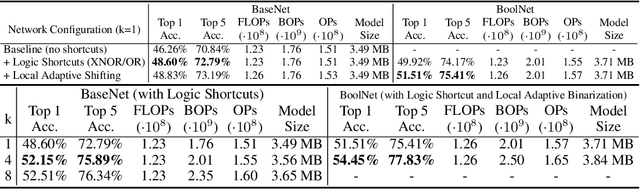
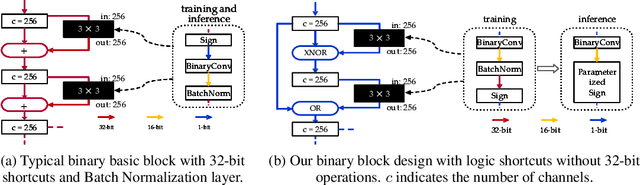
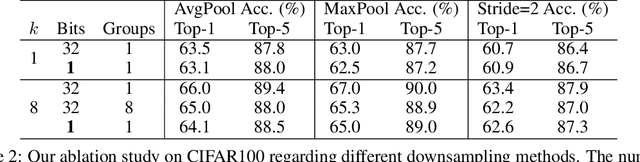
Recent works on Binary Neural Networks (BNNs) have made promising progress in narrowing the accuracy gap of BNNs to their 32-bit counterparts. However, the accuracy gains are often based on specialized model designs using additional 32-bit components. Furthermore, almost all previous BNNs use 32-bit for feature maps and the shortcuts enclosing the corresponding binary convolution blocks, which helps to effectively maintain the accuracy, but is not friendly to hardware accelerators with limited memory, energy, and computing resources. Thus, we raise the following question: How can accuracy and energy consumption be balanced in a BNN network design? We extensively study this fundamental problem in this work and propose a novel BNN architecture without most commonly used 32-bit components: \textit{BoolNet}. Experimental results on ImageNet demonstrate that BoolNet can achieve 4.6x energy reduction coupled with 1.2\% higher accuracy than the commonly used BNN architecture Bi-RealNet. Code and trained models are available at: https://github.com/hpi-xnor/BoolNet.