 Add to Chrome
 Add to Firefox
 Add to Edge
To See the Unseen: on the Generalization Ability of Transformers in Symbolic Reasoning
Apr 23, 2026
We investigate the ability of decoder-only transformer models to perform abstract symbolic reasoning; specifically solving propositional logic reasoning problems given in-context. Previous work demonstrated that models fail to generalize to problems involving variable names that were not observed during training, and it was shown that one reason behind this is the difficulty of copying (or generating) unseen tokens. We show both theoretically and empirically that a particular representational collapse also has a crucial role: the unembeddings (last-layer weights) of unseen tokens collapse to nearly the same vector during training. The collapse makes distinguishing multiple unseen variables difficult for the model (especially when the embedding and unembedding parameters are shared), and provides a mechanistic explanation for the effectiveness of existing heuristic interventions like "active forgetting", which periodically reset the token (un)embeddings. Based on these observations, we devise a combination of techniques, involving a small architecture change facilitating copying, data diversity, and freezing or resetting (un)embeddings, that achieves generalization to unseen tokens. We support our claims with extensive controlled experiments on propositional logic reasoning problems. Beyond synthetic experiments, we also observe evidence of (un)embedding collapse in the open-weight models in the Gemma 3 family, which includes 99 unused tokens reserved for downstream use. Empirically we find that the correlated embeddings of these tokens are a poor initialization for finetuning applications.

Efficient Local Planning with Linear Function Approximation
Aug 12, 2021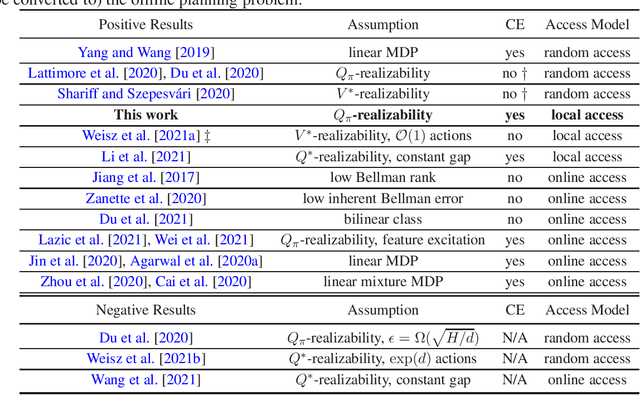
We study query and computationally efficient planning algorithms with linear function approximation and a simulator. We assume that the agent only has local access to the simulator, meaning that the agent can only query the simulator at states that have been visited before. This setting is more practical than many prior works on reinforcement learning with a generative model. We propose an algorithm named confident Monte Carlo least square policy iteration (Confident MC-LSPI) for this setting. Under the assumption that the Q-functions of all deterministic policies are linear in known features of the state-action pairs, we show that our algorithm has polynomial query and computational complexities in the dimension of the features, the effective planning horizon and the targeted sub-optimality, while these complexities are independent of the size of the state space. One technical contribution of our work is the introduction of a novel proof technique that makes use of a virtual policy iteration algorithm. We use this method to leverage existing results on $\ell_\infty$-bounded approximate policy iteration to show that our algorithm can learn the optimal policy for the given initial state even only with local access to the simulator. We believe that this technique can be extended to broader settings beyond this work.
Optimization Issues in KL-Constrained Approximate Policy Iteration
Feb 11, 2021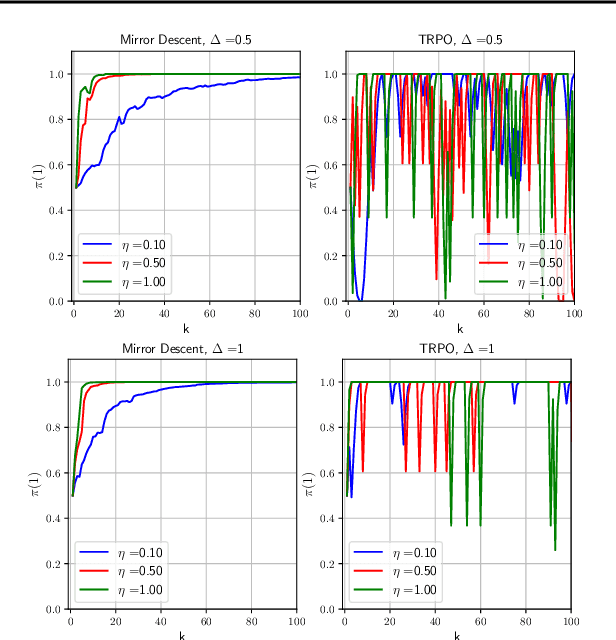
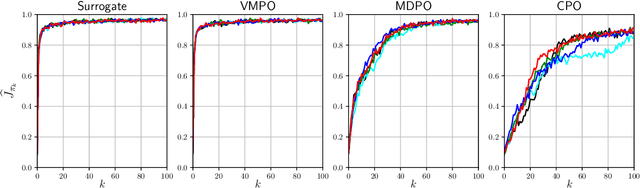
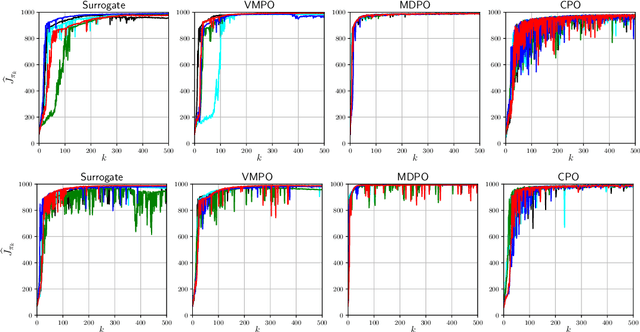
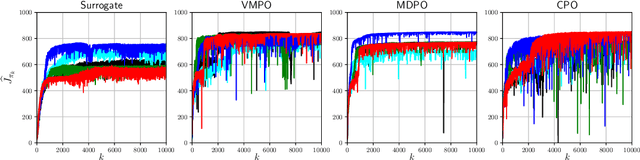
Many reinforcement learning algorithms can be seen as versions of approximate policy iteration (API). While standard API often performs poorly, it has been shown that learning can be stabilized by regularizing each policy update by the KL-divergence to the previous policy. Popular practical algorithms such as TRPO, MPO, and VMPO replace regularization by a constraint on KL-divergence of consecutive policies, arguing that this is easier to implement and tune. In this work, we study this implementation choice in more detail. We compare the use of KL divergence as a constraint vs. as a regularizer, and point out several optimization issues with the widely-used constrained approach. We show that the constrained algorithm is not guaranteed to converge even on simple problem instances where the constrained problem can be solved exactly, and in fact incurs linear expected regret. With approximate implementation using softmax policies, we show that regularization can improve the optimization landscape of the original objective. We demonstrate these issues empirically on several bandit and RL environments.