 Add to Chrome
 Add to Firefox
 Add to Edge
Adaptive RAN Slicing Control via Reward-Free Self-Finetuning Agents
Mar 11, 2026
The integration of Generative AI models into AI-native network systems offers a transformative path toward achieving autonomous and adaptive control. However, the application of such models to continuous control tasks is impeded by intrinsic architectural limitations, including finite context windows, the lack of explicit reward signals, and the degradation of the long context. This paper posits that the key to unlocking robust continuous control is enabling agents to internalize experience by distilling it into their parameters, rather than relying on prompt-based memory. To this end, we propose a novel self-finetuning framework that enables agentic systems to learn continuously through direct interaction with the environment, bypassing the need for handcrafted rewards. Our framework implements a bi-perspective reflection mechanism that generates autonomous linguistic feedback to construct preference datasets from interaction history. A subsequent preference-based fine-tuning process distills long-horizon experiences into the model's parameters. We evaluate our approach on a dynamic Radio Access Network (RAN) slicing task, a challenging multi-objective control problem that requires the resolution of acute trade-offs between spectrum efficiency, service quality, and reconfiguration stability under volatile network conditions. Experimental results show that our framework outperforms standard Reinforcement Learning (RL) baselines and existing Large Language Model (LLM)-based agents in sample efficiency, stability, and multi-metric optimization. These findings demonstrate the potential of self-improving generative agents for continuous control tasks, paving the way for future AI-native network infrastructure.

Fast Adaptive Task Offloading in Edge Computing based on Meta Reinforcement Learning
Sep 14, 2020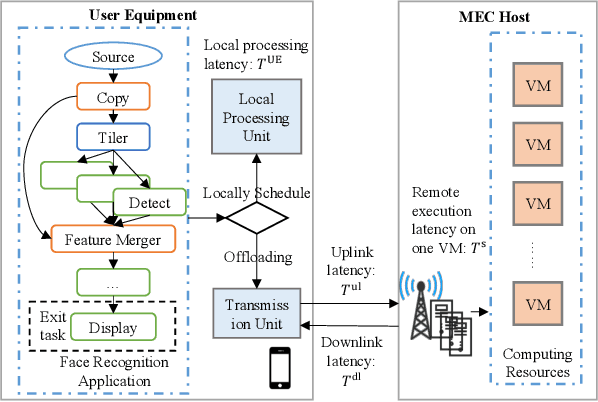
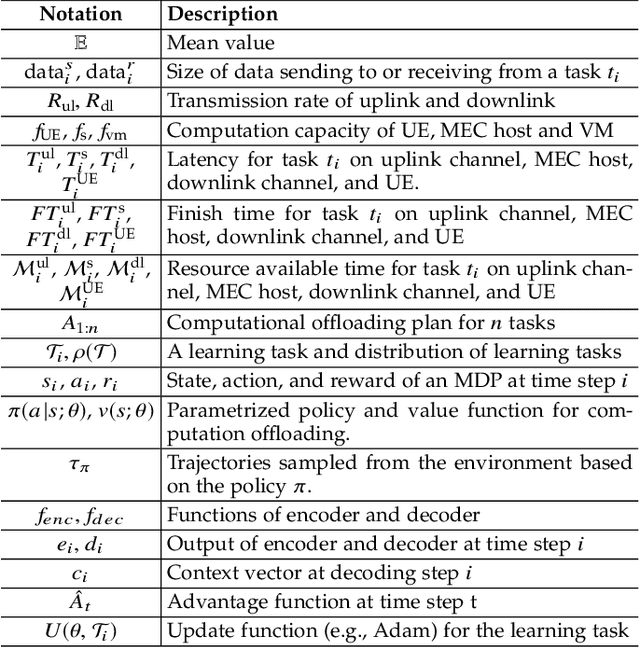
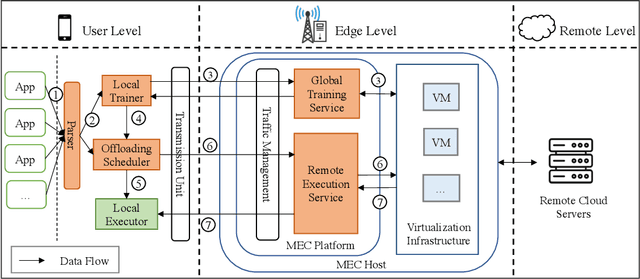
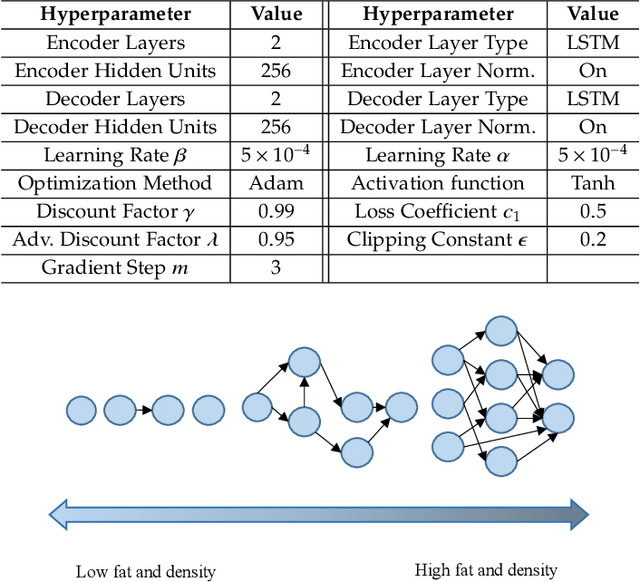
Multi-access edge computing (MEC) aims to extend cloud service to the network edge to reduce network traffic and service latency. A fundamental problem in MEC is how to efficiently offload heterogeneous tasks of mobile applications from user equipment (UE) to MEC hosts. Recently, many deep reinforcement learning (DRL) based methods have been proposed to learn offloading policies through interacting with the MEC environment that consists of UE, wireless channels, and MEC hosts. However, these methods have weak adaptability to new environments because they have low sample efficiency and need full retraining to learn updated policies for new environments. To overcome this weakness, we propose a task offloading method based on meta reinforcement learning, which can adapt fast to new environments with a small number of gradient updates and samples. We model mobile applications as Directed Acyclic Graphs (DAGs) and the offloading policy by a custom sequence-to-sequence (seq2seq) neural network. To efficiently train the seq2seq network, we propose a method that synergizes the first order approximation and clipped surrogate objective. The experimental results demonstrate that this new offloading method can reduce the latency by up to 25% compared to three baselines while being able to adapt fast to new environments.
Routing-Led Placement of VNFs in Arbitrary Networks
Jan 30, 2020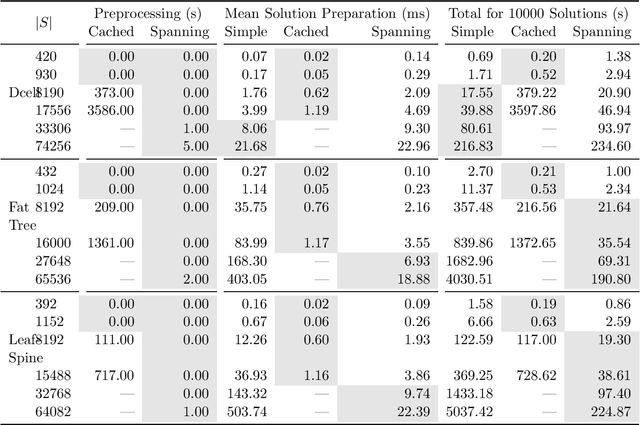
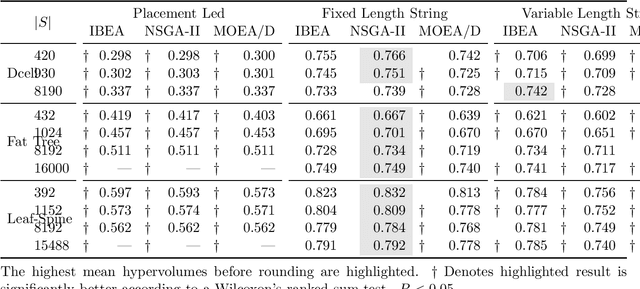
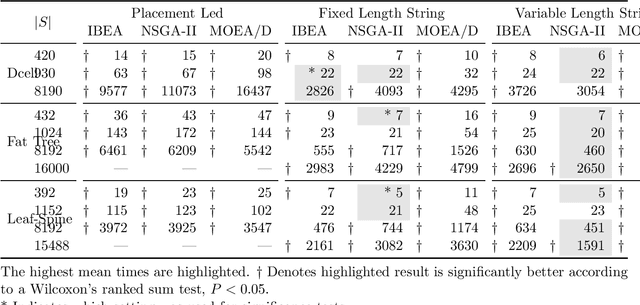
The ever increasing demand for computing resources has led to the creation of hyperscale datacentres with tens of thousands of servers. As demand continues to rise, new technologies must be incorporated to ensure high quality services can be provided without the damaging environmental impact of high energy consumption. Virtualisation technology such as network function virtualisation (NFV) allows for the creation of services by connecting component parts known as virtual network functions (VNFs). VNFs cam be used to maximally utilise available datacentre resources by optimising the placement and routes of VNFs, to maintain a high quality of service whilst minimising energy costs. Current research on this problem has focussed on placing VNFs and considered routing as a secondary concern. In this work we argue that the opposite approach, a routing-led approach is preferable. We propose a novel routing-led algorithm and analyse each of the component parts over a range of different topologies on problems with up to 16000 variables and compare its performance against a traditional placement based algorithm. Empirical results show that our routing-led algorithm can produce significantly better, faster solutions to large problem instances on a range of datacentre topologies.