 Add to Chrome
 Add to Firefox
 Add to Edge
PropLLM: Propagation-Aware Scene Reconstruction for Network Fault Diagnosis
May 30, 2026
Network faults propagate layer by layer along topology and protocol dependencies, yet operations systems typically observe only symptomatic alerts at the tail end of propagation chains, where distinct root-cause faults may produce highly similar end-point symptoms. Existing approaches, whether rule-based, machine learning (ML)-based, or large language model (LLM)-based, fundamentally map the alert set to a diagnosis in a single pass and are structurally incapable of resolving this end-point ambiguity. This paper proposes PropLLM, which is the first to integrate the hop-by-hop scene reconstruction paradigm with the generative reasoning capabilities of LLMs. Starting from end-point alerts, PropLLM traces back hop-by-hop along the propagation path, retrieving verifiable factual evidence from a dual-layer knowledge graph (KG) at each hop, while the proposed Temporal Causal Propagation Attention (TCPA) mechanism encodes known topological causal priors directly into the attention computation to guide the model along the correct causal direction, ultimately localizing the root cause and determining the fault type through a fully evidenced causal chain. On a real-world Wi-Fi multimodal fault dataset, PropLLM improves fault type diagnosis accuracy by 3.9\% and root cause localization accuracy by 4.7\% over the strongest baseline, while reducing the hallucination rate by 50.8\%. Supplementary experiments on the TeleLogs 5G dataset further demonstrate the effectiveness of the proposed method across different network scenarios.

Large Language Model assisted End-to-End Network Health Management based on Multi-Scale Semanticization
Jun 12, 2024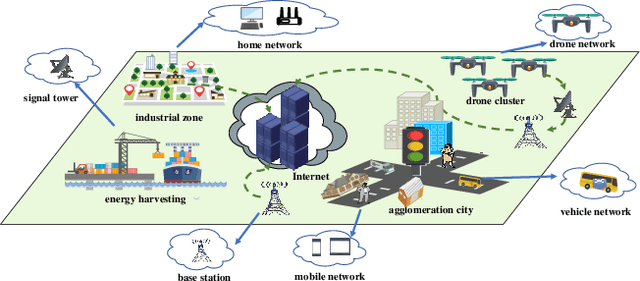


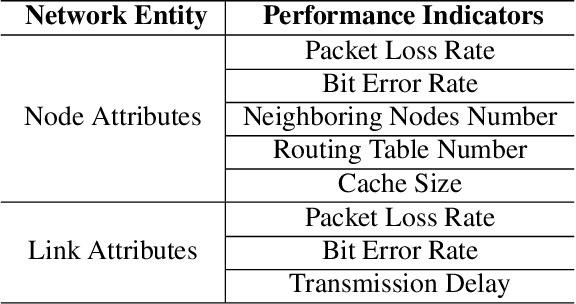
Network device and system health management is the foundation of modern network operations and maintenance. Traditional health management methods, relying on expert identification or simple rule-based algorithms, struggle to cope with the dynamic heterogeneous networks (DHNs) environment. Moreover, current state-of-the-art distributed anomaly detection methods, which utilize specific machine learning techniques, lack multi-scale adaptivity for heterogeneous device information, resulting in unsatisfactory diagnostic accuracy for DHNs. In this paper, we develop an LLM-assisted end-to-end intelligent network health management framework. The framework first proposes a Multi-Scale Semanticized Anomaly Detection Model (MSADM), incorporating semantic rule trees with an attention mechanism to address the multi-scale anomaly detection problem in DHNs. Secondly, a chain-of-thought-based large language model is embedded in downstream to adaptively analyze the fault detection results and produce an analysis report with detailed fault information and optimization strategies. Experimental results show that the accuracy of our proposed MSADM for heterogeneous network entity anomaly detection is as high as 91.31\%.
Differentiated Federated Reinforcement Learning for Dynamic and Heterogeneous Network
Dec 05, 2022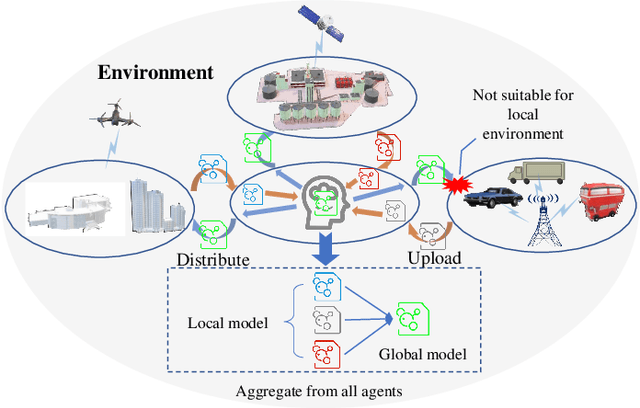
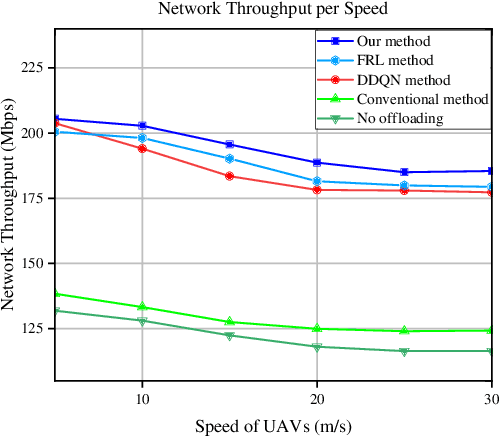
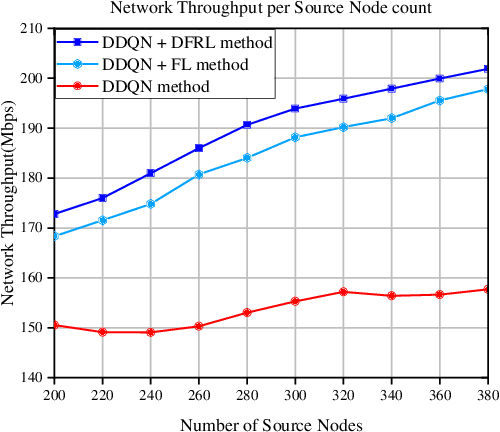
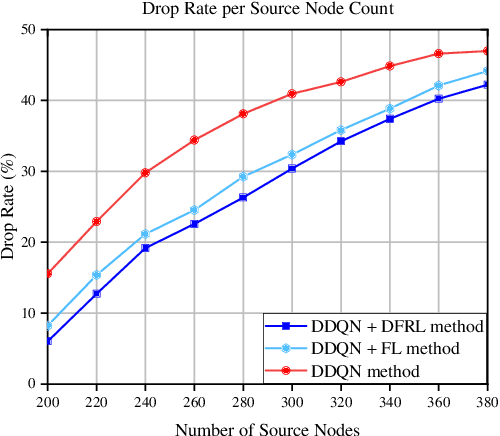
The modern dynamic and heterogeneous network brings differential environments with respective state transition probability to agents, which leads to the local strategy trap problem of traditional federated reinforcement learning (FRL) based network optimization algorithm. To solve this problem, we propose a novel Differentiated Federated Reinforcement Learning (DFRL), which evolves the global policy model integration and local inference with the global policy model in traditional FRL to a collaborative learning process with parallel global trends learning and differential local policy model learning. In the DFRL, the local policy learning model is adaptively updated with the global trends model and local environment and achieves better differentiated adaptation. We evaluate the outperformance of the proposal compared with the state-of-the-art FRL in a classical CartPole game with heterogeneous environments. Furthermore, we implement the proposal in the heterogeneous Space-air-ground Integrated Network (SAGIN) for the classical traffic offloading problem in network. The simulation result shows that the proposal shows better global performance and fairness than baselines in terms of throughput, delay, and packet drop rate.