 Add to Chrome
 Add to Firefox
 Add to Edge
PhysGuard: Fisher-Guided Gradient Projection for Sim-to-Real Neural PDE Surrogates
Jun 15, 2026
Neural operator models trained on simulation data often lose accuracy when applied to experimental measurements due to the sim-to-real gap. Standard fine-tuning with limited real data can reduce this gap, but it may also damage the core physics-relevant representations learned during pretraining. Although knowledge-preserving adaptation has been widely investigated in vision or language tasks, it remains unclear whether these methods are suitable for neural operators whose architectures and protected knowledge are fundamentally different. Neural operators need to preserve core-scale physical structures rather than semantic or visual features. We propose PhysGuard, a physics-preserving framework for accurate sim-to-real adaptation of neural operators. Specifically, PhysGuard uses the empirical Fisher Information Matrix computed on simulation data to identify physics-critical parameter directions, then restricts fine-tuning updates to directions that do not interfere with them. A layer-wise Gram-matrix formulation makes this efficient for models with millions of parameters, while an adaptive threshold automatically determines the protected subspace size. A spectral probe experiment shows that the dominant Fisher directions are strongly associated with low-frequency output structures. Experiments on benchmark across four neural operator architectures and different physical systems show that PhysGuard performs strongly on most evaluation metrics compared to baselines. The benefits are most evident under severe domain shift, where it reduces low-frequency error by up to 32\% compared to standard fine-tuning while maintaining adaptability. Our code is available at https://github.com/ZhouChaunge/PhysGuard.

Introducing a Physics-informed Deep Learning Framework for Bridge Scour Prediction
Jul 02, 2024This paper introduces scour physics-informed neural networks (SPINNs), a hybrid physics-data-driven framework for bridge scour prediction using deep learning. SPINNs are developed based on historical scour monitoring data and integrate physics-based empirical equations into neural networks as supplementary loss components. We incorporated three architectures: LSTM, CNN, and NLinear as the base data-driven model. Despite varying performance across different base models and bridges, SPINNs overall outperformed pure data-driven models. In some bridge cases, SPINN reduced forecasting errors by up to 50 percent. In this study, we also explored general models for bridge clusters, trained by aggregating datasets across multiple bridges in a region. The pure data-driven models mostly benefited from this approach, in particular bridges with limited data. However, bridge-specific SPINNs provided more accurate predictions than general SPINNs for almost all case studies. Also, the time-dependent empirical equations derived from SPINNs showed reasonable accuracy in estimating maximum scour depth, providing more accurate predictions compared to HEC-18. Comparing both SPINNs and pure deep learning models with traditional HEC-18 equation indicates substantial improvements in scour prediction accuracy. This study can pave the way for hybrid physics-machine learning methodologies to be implemented for bridge scour design and maintenance.
Towards an AI-based Early Warning System for Bridge Scour
Aug 22, 2022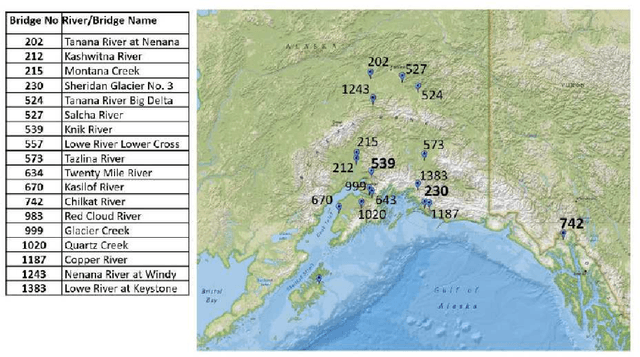
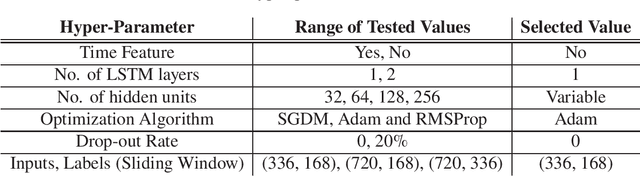
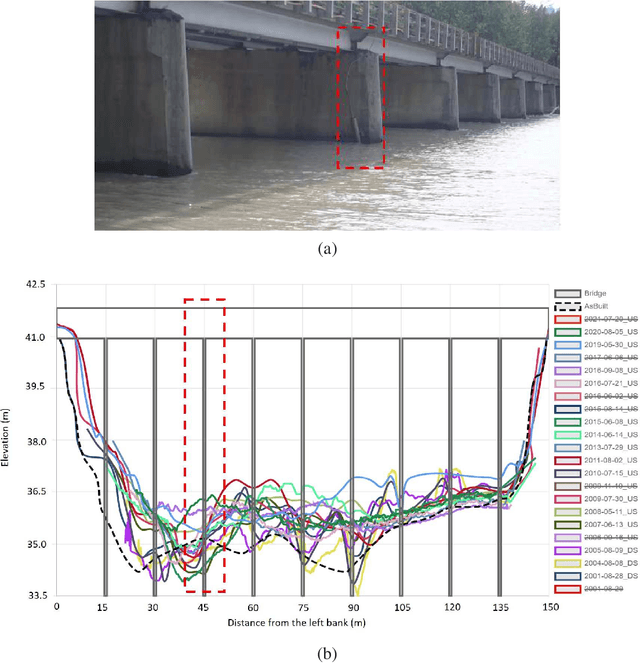

Scour is the number one cause of bridge failure in many parts of the world. Considering the lack of reliability in existing empirical equations for scour depth estimation and the complexity and uncertainty of scour as a physical phenomenon, it is essential to develop more reliable solutions for scour risk assessment. This study introduces a novel AI approach for early forecast of scour based on real-time monitoring data obtained from sonar and stage sensors installed at bridge piers. Long-short Term Memory networks (LSTMs), a prominent Deep Learning algorithm successfully used for time-series forecasting in other fields, were developed and trained using river stage and bed elevation readings for more than 11 years obtained from Alaska scour monitoring program. The capability of the AI models in scour prediction is shown for three case-study bridges. Results show that LSTMs can capture the temporal and seasonal patterns of both flow and river bed variations around bridge piers, through cycles of scour and filling and can provide reasonable predictions of upcoming scour depth as early as seven days in advance. It is expected that the proposed solution can be implemented by transportation authorities for development of emerging AI-based early warning systems, enabling superior bridge scour management.