 Add to Chrome
 Add to Firefox
 Add to Edge
Reeling It In: Flexible Needle Pick Up via Thread Manipulation for Autonomous Suturing
Jul 28, 2026
Suture-needle pickup is necessary for autonomous suturing, as a needle can be unexpectedly dropped or strategically released to adjust the grasping configuration. Current methods for autonomous needle pickup typically guide a robot to move straight toward the needle and grasp it, limited to conditions where the needle is observable and directly approachable. In addition, grasping the needle lying on tissue can lead to the robot pinching nearby tissue or the needle jumping around due to its slippery surface, posing potential safety issues. This work proposes an autonomous framework that uses a suture thread as an assistive tool for indirect needle pickup, avoiding unnecessary tool-tissue contact and enabling pickup even when the needle is occluded or inaccessible. The framework spans the entire workflow, including thread and tissue reconstruction, safe grasp-point selection, stable thread lifting, and bimanual thread-following until securing needle grasping. The robot policies account for visual uncertainty to maximize robustness in real-world environments. We evaluate the proposed framework on a da Vinci Research Kit under various real-world conditions. The results demonstrate robust performance even with a challenging thread configuration or a non-approachable needle, closing the gap in applying autonomous robot policies to unstructured suturing environments.

Autonomous Image-to-Grasp Robotic Suturing Using Reliability-Driven Suture Thread Reconstruction
Aug 29, 2024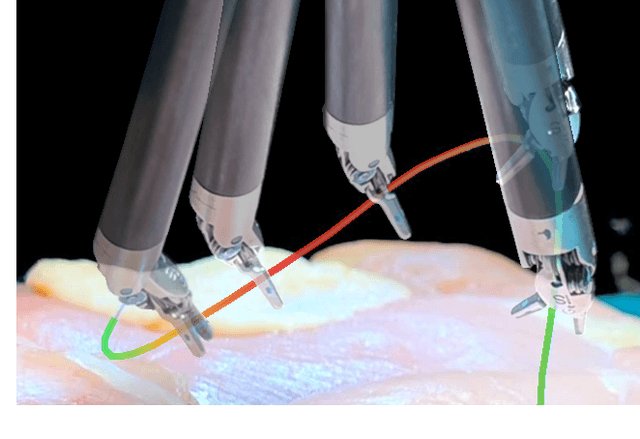
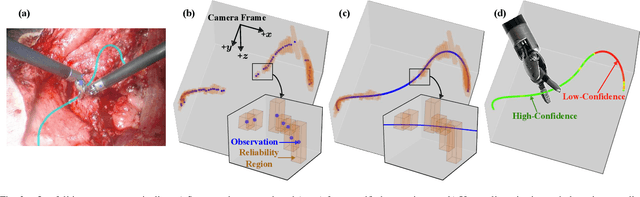
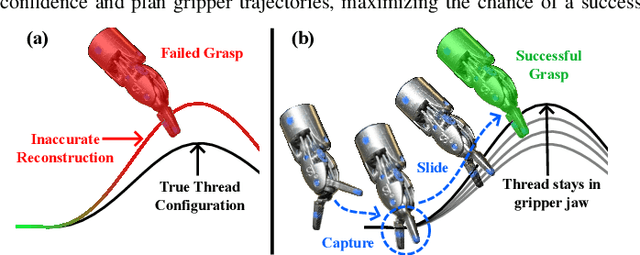
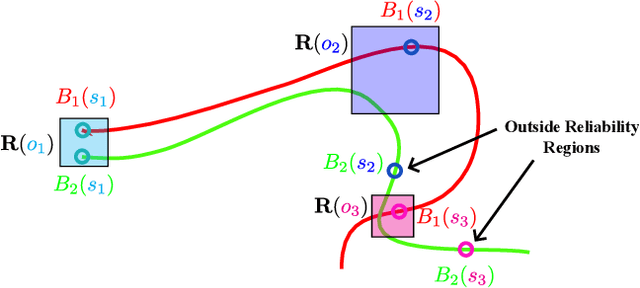
Automating suturing during robotically-assisted surgery reduces the burden on the operating surgeon, enabling them to focus on making higher-level decisions rather than fatiguing themselves in the numerous intricacies of a surgical procedure. Accurate suture thread reconstruction and grasping are vital prerequisites for suturing, particularly for avoiding entanglement with surgical tools and performing complex thread manipulation. However, such methods must be robust to heavy perceptual degradation resulting from heavy noise and thread feature sparsity from endoscopic images. We develop a reconstruction algorithm that utilizes quadratic programming optimization to fit smooth splines to thread observations, satisfying reliability bounds estimated from measured observation noise. Additionally, we craft a grasping policy that generates gripper trajectories that maximize the probability of a successful grasp. Our full image-to-grasp pipeline is rigorously evaluated with over 400 grasping trials, exhibiting state-of-the-art accuracy. We show that this strategy can be applied to the various techniques in autonomous suture needle manipulation to achieve autonomous surgery in a generalizable way.
Suture Thread Spline Reconstruction from Endoscopic Images for Robotic Surgery with Reliability-driven Keypoint Detection
Sep 27, 2022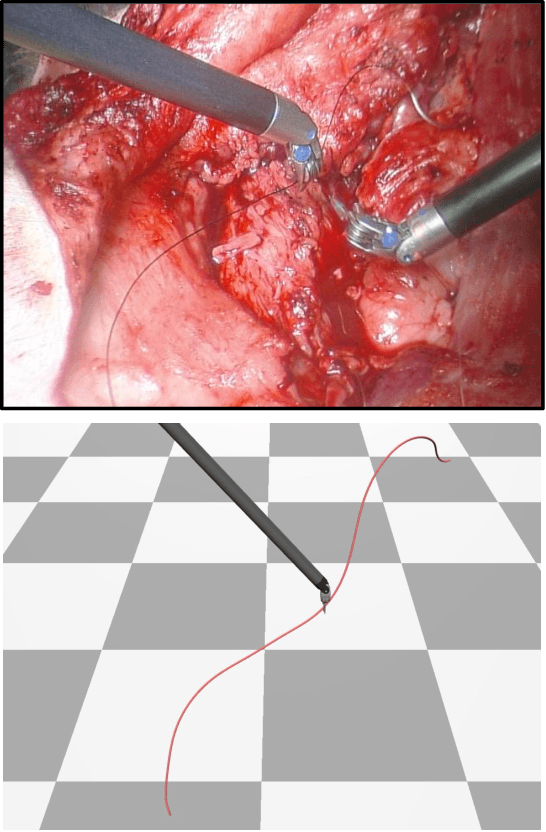
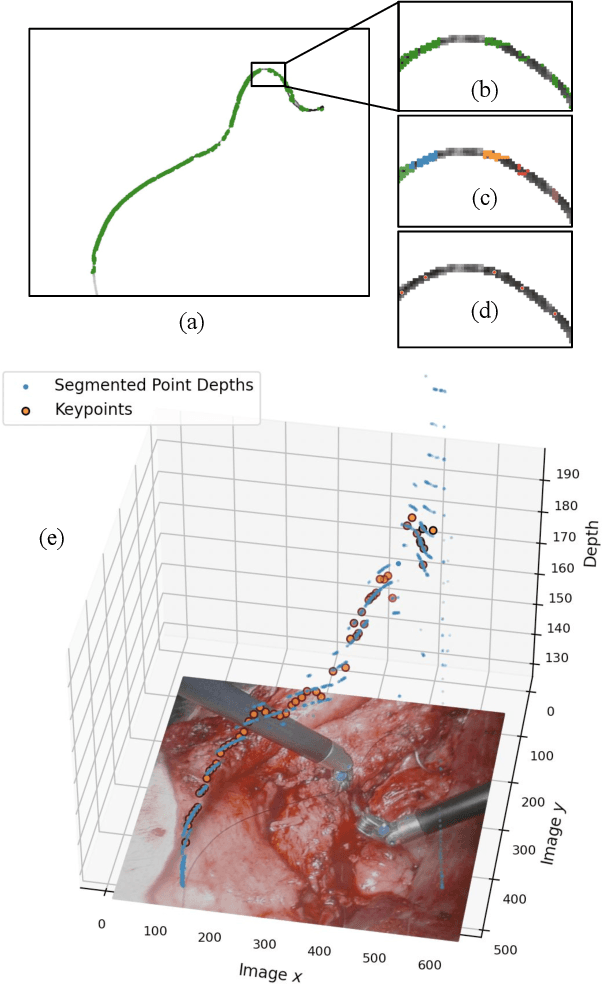
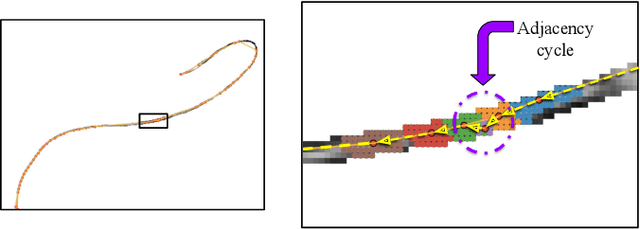
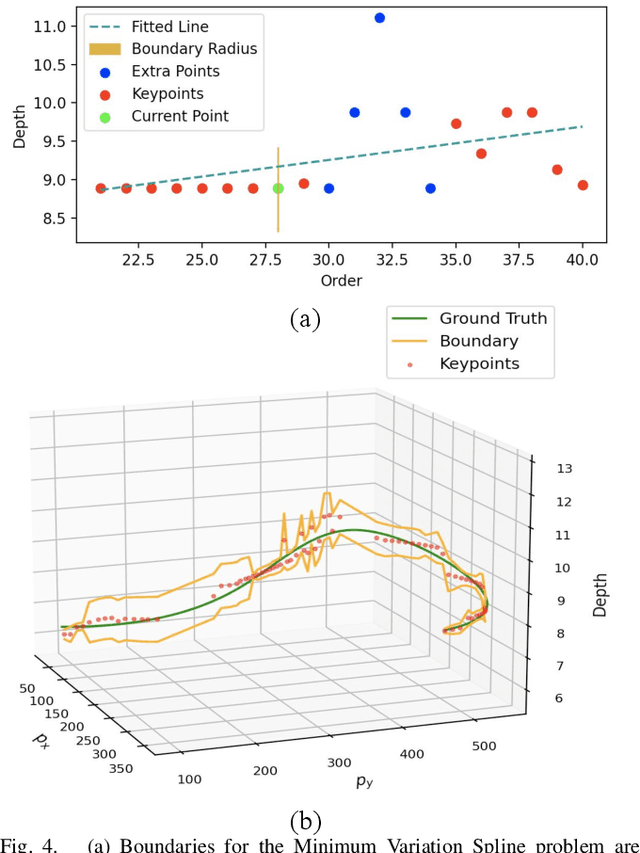
Automating the process of manipulating and delivering sutures during robotic surgery is a prominent problem at the frontier of surgical robotics, as automating this task can significantly reduce surgeons' fatigue during tele-operated surgery and allow them to spend more time addressing higher-level clinical decision making. Accomplishing autonomous suturing and suture manipulation in the real world requires accurate suture thread localization and reconstruction, the process of creating a 3D shape representation of suture thread from 2D stereo camera surgical image pairs. This is a very challenging problem due to how limited pixel information is available for the threads, as well as their sensitivity to lighting and specular reflection. We present a suture thread reconstruction work that uses reliable keypoints and a Minimum Variation Spline (MVS) smoothing optimization to construct a 3D centerline from a segmented surgical image pair. This method is comparable to previous suture thread reconstruction works, with the possible benefit of increased accuracy of grasping point estimation. Our code and datasets will be available at: https://github.com/ucsdarclab/thread-reconstruction.