 Add to Chrome
 Add to Firefox
 Add to Edge
Trust as Monitoring: Evolutionary Dynamics of User Trust and AI Developer Behaviour
Mar 25, 2026
AI safety is an increasingly urgent concern as the capabilities and adoption of AI systems grow. Existing evolutionary models of AI governance have primarily examined incentives for safe development and effective regulation, typically representing users' trust as a one-shot adoption choice rather than as a dynamic, evolving process shaped by repeated interactions. We instead model trust as reduced monitoring in a repeated, asymmetric interaction between users and AI developers, where checking AI behaviour is costly. Using evolutionary game theory, we study how user trust strategies and developer choices between safe (compliant) and unsafe (non-compliant) AI co-evolve under different levels of monitoring cost and institutional regimes. We complement the infinite-population replicator analysis with stochastic finite-population dynamics and reinforcement learning (Q-learning) simulations. Across these approaches, we find three robust long-run regimes: no adoption with unsafe development, unsafe but widely adopted systems, and safe systems that are widely adopted. Only the last is desirable, and it arises when penalties for unsafe behaviour exceed the extra cost of safety and users can still afford to monitor at least occasionally. Our results formally support governance proposals that emphasise transparency, low-cost monitoring, and meaningful sanctions, and they show that neither regulation alone nor blind user trust is sufficient to prevent evolutionary drift towards unsafe or low-adoption outcomes.

Do LLMs trust AI regulation? Emerging behaviour of game-theoretic LLM agents
Apr 11, 2025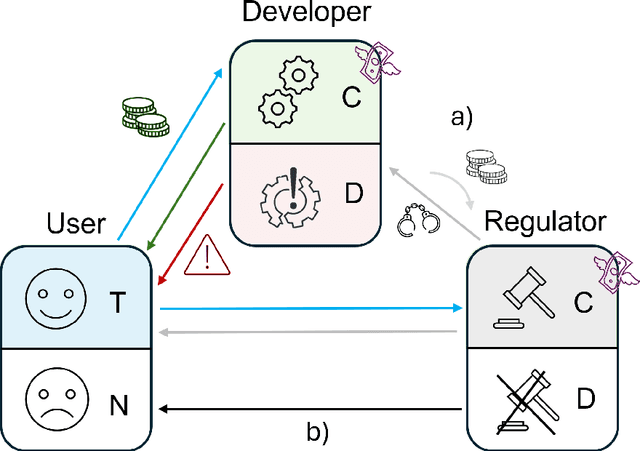
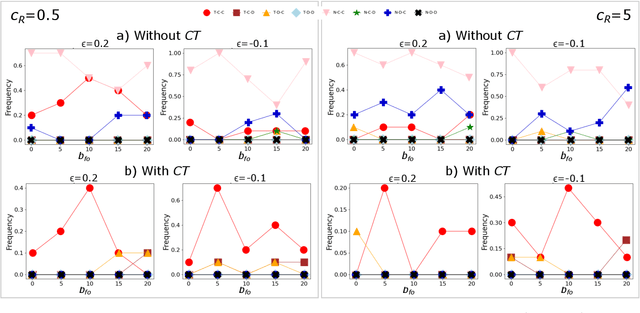
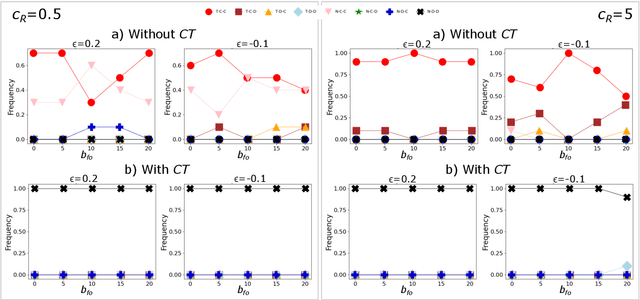
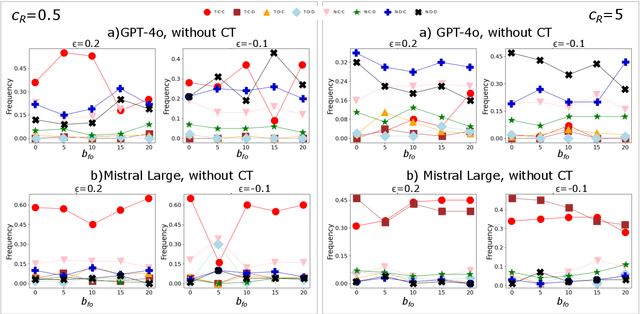
There is general agreement that fostering trust and cooperation within the AI development ecosystem is essential to promote the adoption of trustworthy AI systems. By embedding Large Language Model (LLM) agents within an evolutionary game-theoretic framework, this paper investigates the complex interplay between AI developers, regulators and users, modelling their strategic choices under different regulatory scenarios. Evolutionary game theory (EGT) is used to quantitatively model the dilemmas faced by each actor, and LLMs provide additional degrees of complexity and nuances and enable repeated games and incorporation of personality traits. Our research identifies emerging behaviours of strategic AI agents, which tend to adopt more "pessimistic" (not trusting and defective) stances than pure game-theoretic agents. We observe that, in case of full trust by users, incentives are effective to promote effective regulation; however, conditional trust may deteriorate the "social pact". Establishing a virtuous feedback between users' trust and regulators' reputation thus appears to be key to nudge developers towards creating safe AI. However, the level at which this trust emerges may depend on the specific LLM used for testing. Our results thus provide guidance for AI regulation systems, and help predict the outcome of strategic LLM agents, should they be used to aid regulation itself.
Media and responsible AI governance: a game-theoretic and LLM analysis
Mar 12, 2025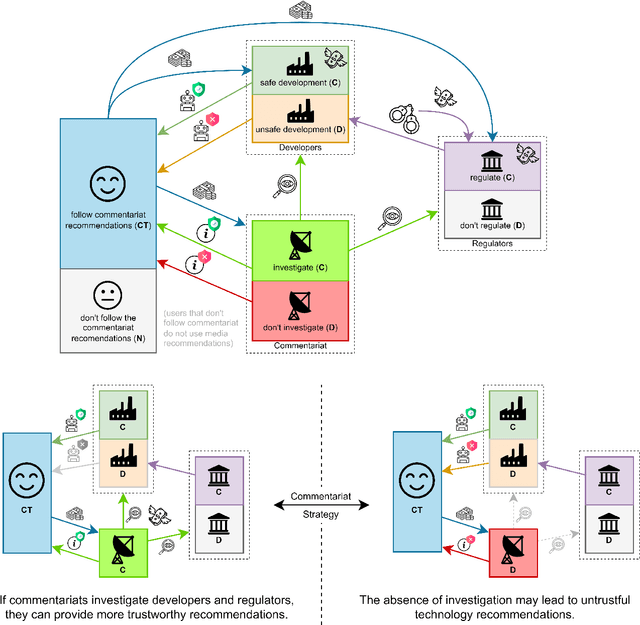
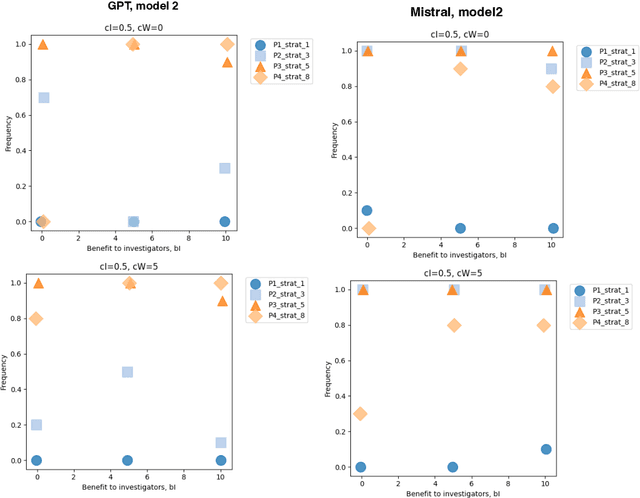
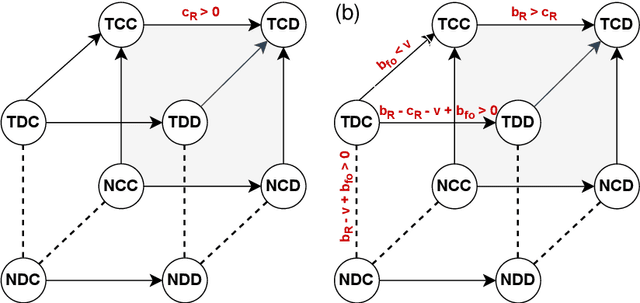
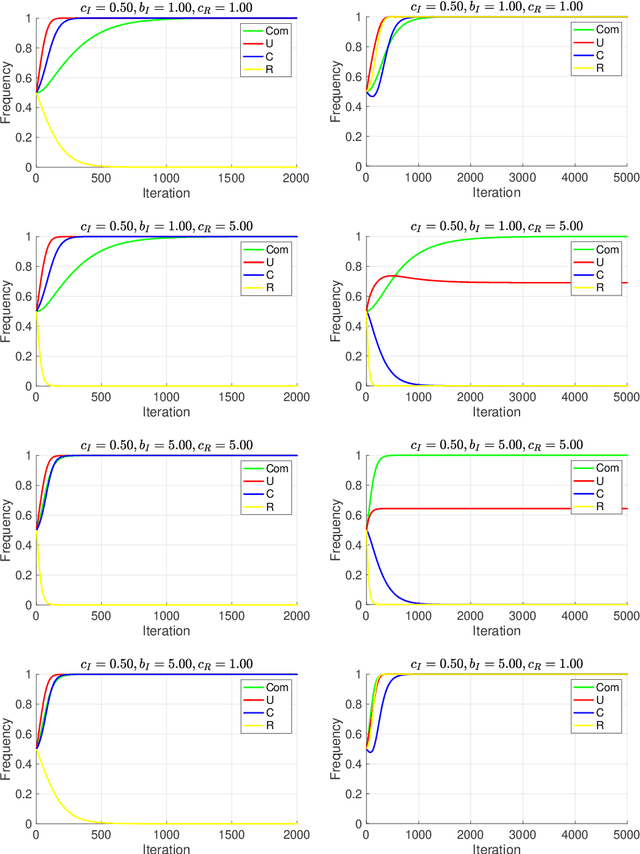
This paper investigates the complex interplay between AI developers, regulators, users, and the media in fostering trustworthy AI systems. Using evolutionary game theory and large language models (LLMs), we model the strategic interactions among these actors under different regulatory regimes. The research explores two key mechanisms for achieving responsible governance, safe AI development and adoption of safe AI: incentivising effective regulation through media reporting, and conditioning user trust on commentariats' recommendation. The findings highlight the crucial role of the media in providing information to users, potentially acting as a form of "soft" regulation by investigating developers or regulators, as a substitute to institutional AI regulation (which is still absent in many regions). Both game-theoretic analysis and LLM-based simulations reveal conditions under which effective regulation and trustworthy AI development emerge, emphasising the importance of considering the influence of different regulatory regimes from an evolutionary game-theoretic perspective. The study concludes that effective governance requires managing incentives and costs for high quality commentaries.