 Add to Chrome
 Add to Firefox
 Add to Edge
Anthropogenic Regional Adaptation in Multimodal Vision-Language Model
Apr 13, 2026
While the field of vision-language (VL) has achieved remarkable success in integrating visual and textual information across multiple languages and domains, there is still no dedicated framework for assessing human-centric alignment in vision-language systems. We offer two contributions to address this gap. First, we introduce Anthropogenic Regional Adaptation: a novel paradigm that aims to optimize model relevance to specific regional contexts while ensuring the retention of global generalization capabilities. Second, we present a simple, but effective adaptation method named Geographical-generalization-made-easy (GG-EZ), which utilizes regional data filtering and model merging. Through comprehensive experiments on 3 VL architectures: large vision-language models, text-to-image diffusion models, and vision-language embedding models, and a case study in Southeast Asia (SEA) regional adaptation, we demonstrate the importance of Anthropogenic Regional Adaptation and the effectiveness of GG-EZ, showing 5-15% gains in cultural relevance metrics across SEA while maintaining over 98% of global performance and even occasionally surpassing it. Our findings establish Anthropogenic Regional Alignment as a foundational paradigm towards applicability of multimodal vision-language models in diverse regions and demonstrate a simple-yet-effective baseline method that optimizes regional value alignment while preserving global generalization.

CLIP the Landscape: Automated Tagging of Crowdsourced Landscape Images
Jun 13, 2025We present a CLIP-based, multi-modal, multi-label classifier for predicting geographical context tags from landscape photos in the Geograph dataset--a crowdsourced image archive spanning the British Isles, including remote regions lacking POIs and street-level imagery. Our approach addresses a Kaggle competition\footnote{https://www.kaggle.com/competitions/predict-geographic-context-from-landscape-photos} task based on a subset of Geograph's 8M images, with strict evaluation: exact match accuracy is required across 49 possible tags. We show that combining location and title embeddings with image features improves accuracy over using image embeddings alone. We release a lightweight pipeline\footnote{https://github.com/SpaceTimeLab/ClipTheLandscape} that trains on a modest laptop, using pre-trained CLIP image and text embeddings and a simple classification head. Predicted tags can support downstream tasks such as building location embedders for GeoAI applications, enriching spatial understanding in data-sparse regions.
V-RoAst: A New Dataset for Visual Road Assessment
Aug 21, 2024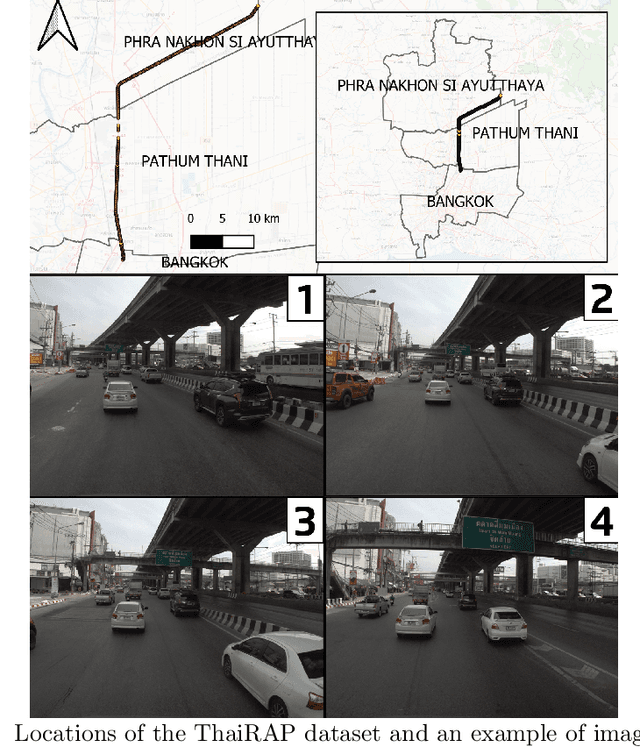
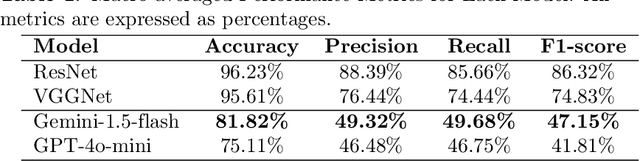
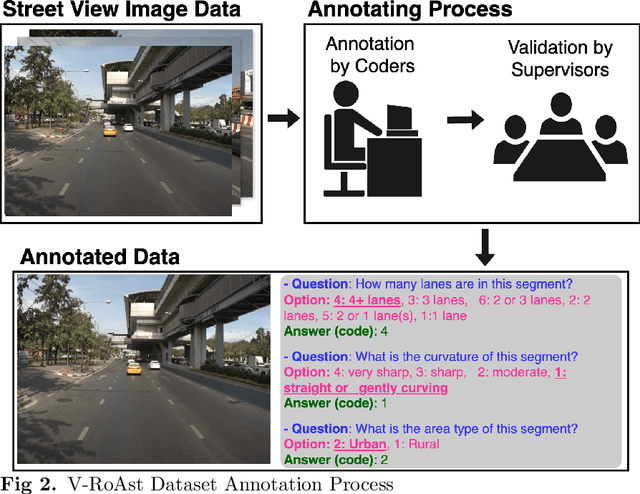
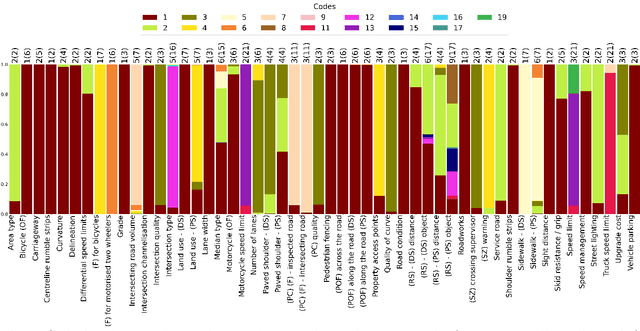
Road traffic crashes cause millions of deaths annually and have a significant economic impact, particularly in low- and middle-income countries (LMICs). This paper presents an approach using Vision Language Models (VLMs) for road safety assessment, overcoming the limitations of traditional Convolutional Neural Networks (CNNs). We introduce a new task ,V-RoAst (Visual question answering for Road Assessment), with a real-world dataset. Our approach optimizes prompt engineering and evaluates advanced VLMs, including Gemini-1.5-flash and GPT-4o-mini. The models effectively examine attributes for road assessment. Using crowdsourced imagery from Mapillary, our scalable solution influentially estimates road safety levels. In addition, this approach is designed for local stakeholders who lack resources, as it does not require training data. It offers a cost-effective and automated methods for global road safety assessments, potentially saving lives and reducing economic burdens.
Multiple Object Detection and Tracking in Panoramic Videos for Cycling Safety Analysis
Jul 21, 2024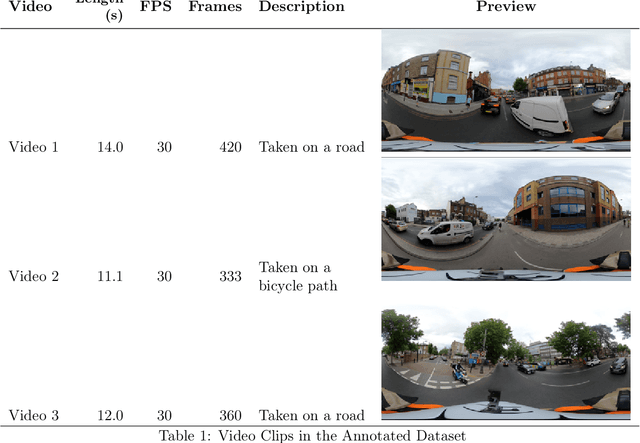
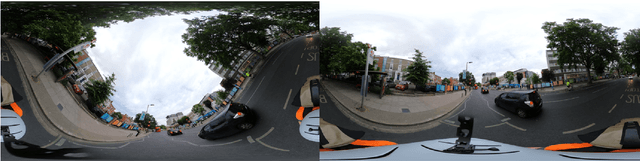
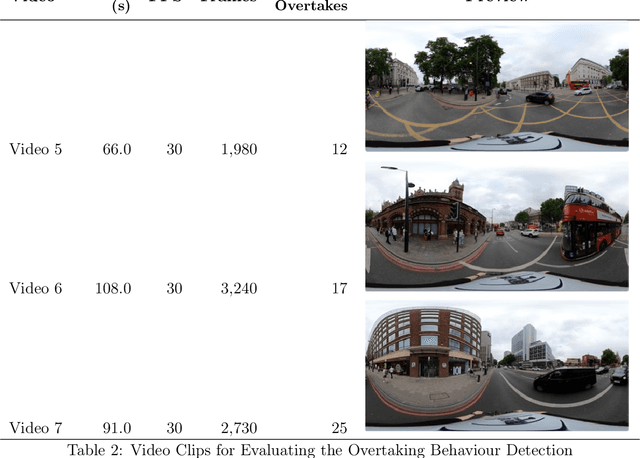
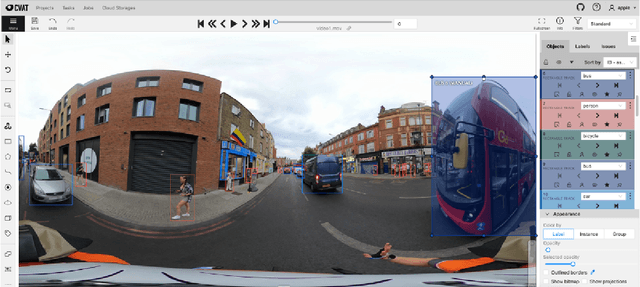
Panoramic cycling videos can record 360{\deg} views around the cyclists. Thus, it is essential to conduct automatic road user analysis on them using computer vision models to provide data for studies on cycling safety. However, the features of panoramic data such as severe distortions, large number of small objects and boundary continuity have brought great challenges to the existing CV models, including poor performance and evaluation methods that are no longer applicable. In addition, due to the lack of data with annotations, it is not easy to re-train the models. In response to these problems, the project proposed and implemented a three-step methodology: (1) improve the prediction performance of the pre-trained object detection models on panoramic data by projecting the original image into 4 perspective sub-images; (2) introduce supports for boundary continuity and category information into DeepSORT, a commonly used multiple object tracking model, and set an improved detection model as its detector; (3) using the tracking results, develop an application for detecting the overtaking behaviour of the surrounding vehicles. Evaluated on the panoramic cycling dataset built by the project, the proposed methodology improves the average precision of YOLO v5m6 and Faster RCNN-FPN under any input resolution setting. In addition, it raises MOTA and IDF1 of DeepSORT by 7.6\% and 9.7\% respectively. When detecting the overtakes in the test videos, it achieves the F-score of 0.88. The code is available on GitHub at github.com/cuppp1998/360_object_tracking to ensure the reproducibility and further improvements of results.