 Add to Chrome
 Add to Firefox
 Add to Edge
Human Identification at a Distance: Challenges, Methods and Results on the Competition HID 2025
Feb 07, 2026
Human identification at a distance (HID) is challenging because traditional biometric modalities such as face and fingerprints are often difficult to acquire in real-world scenarios. Gait recognition provides a practical alternative, as it can be captured reliably at a distance. To promote progress in gait recognition and provide a fair evaluation platform, the International Competition on Human Identification at a Distance (HID) has been organized annually since 2020. Since 2023, the competition has adopted the challenging SUSTech-Competition dataset, which features substantial variations in clothing, carried objects, and view angles. No dedicated training data are provided, requiring participants to train their models using external datasets. Each year, the competition applies a different random seed to generate distinct evaluation splits, which reduces the risk of overfitting and supports a fair assessment of cross-domain generalization. While HID 2023 and HID 2024 already used this dataset, HID 2025 explicitly examined whether algorithmic advances could surpass the accuracy limits observed previously. Despite the heightened difficulty, participants achieved further improvements, and the best-performing method reached 94.2% accuracy, setting a new benchmark on this dataset. We also analyze key technical trends and outline potential directions for future research in gait recognition.

A Human-Centered Risk Evaluation of Biometric Systems Using Conjoint Analysis
Sep 17, 2024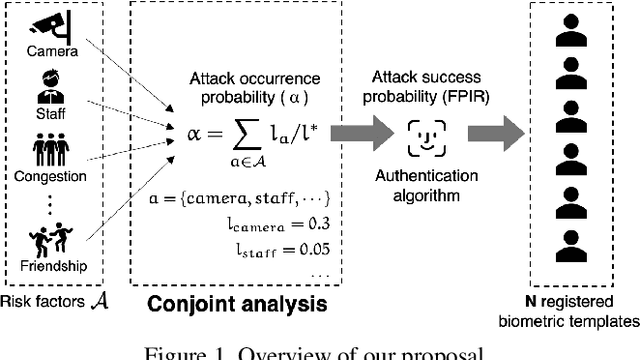
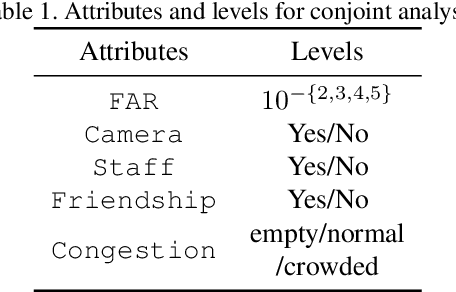
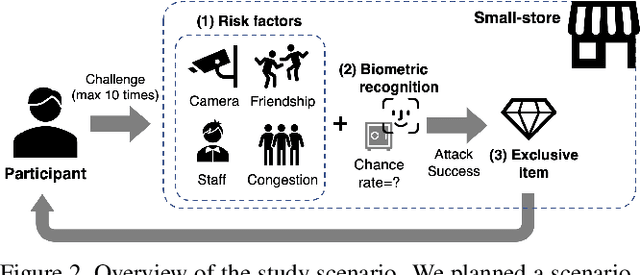
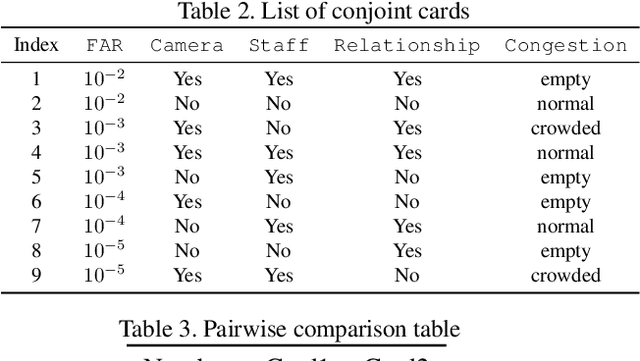
Biometric recognition systems, known for their convenience, are widely adopted across various fields. However, their security faces risks depending on the authentication algorithm and deployment environment. Current risk assessment methods faces significant challenges in incorporating the crucial factor of attacker's motivation, leading to incomplete evaluations. This paper presents a novel human-centered risk evaluation framework using conjoint analysis to quantify the impact of risk factors, such as surveillance cameras, on attacker's motivation. Our framework calculates risk values incorporating the False Acceptance Rate (FAR) and attack probability, allowing comprehensive comparisons across use cases. A survey of 600 Japanese participants demonstrates our method's effectiveness, showing how security measures influence attacker's motivation. This approach helps decision-makers customize biometric systems to enhance security while maintaining usability.
RTAT: A Robust Two-stage Association Tracker for Multi-Object Tracking
Aug 14, 2024

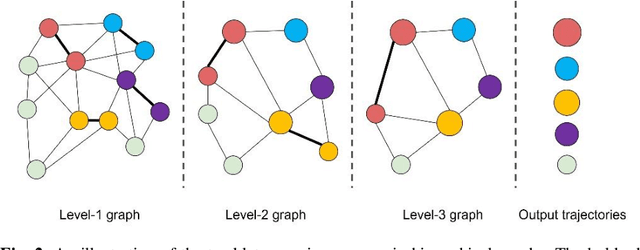

Data association is an essential part in the tracking-by-detection based Multi-Object Tracking (MOT). Most trackers focus on how to design a better data association strategy to improve the tracking performance. The rule-based handcrafted association methods are simple and highly efficient but lack generalization capability to deal with complex scenes. While the learnt association methods can learn high-order contextual information to deal with various complex scenes, but they have the limitations of higher complexity and cost. To address these limitations, we propose a Robust Two-stage Association Tracker, named RTAT. The first-stage association is performed between tracklets and detections to generate tracklets with high purity, and the second-stage association is performed between tracklets to form complete trajectories. For the first-stage association, we use a simple data association strategy to generate tracklets with high purity by setting a low threshold for the matching cost in the assignment process. We conduct the tracklet association in the second-stage based on the framework of message-passing GNN. Our method models the tracklet association as a series of edge classification problem in hierarchical graphs, which can recursively merge short tracklets into longer ones. Our tracker RTAT ranks first on the test set of MOT17 and MOT20 benchmarks in most of the main MOT metrics: HOTA, IDF1, and AssA. We achieve 67.2 HOTA, 84.7 IDF1, and 69.7 AssA on MOT17, and 66.2 HOTA, 82.5 IDF1, and 68.1 AssA on MOT20.