 Add to Chrome
 Add to Firefox
 Add to Edge
Linear Strategic Classification with Endogenous Improvements
May 31, 2026
Strategic classification studies settings in which agents respond to a deployed classifier by modifying observable features at a cost. Classical models typically treat such responses as cosmetic: features may change, but true labels remain fixed. We study an improvement-aware variant in which strategic responses can induce genuine changes in outcome-relevant features. Agents choose post-deployment feature vectors strategically, and labels are then generated according to a stable conditional outcome law that preserves the relationship between features and outcomes. We formalize this problem for linear classifiers under a single-index qualification model and linear-decomposable costs. We show that the strategic-optimal classifier is obtained by a parallel shift of the Bayes-optimal decision boundary, and that it provides a better surrogate for the improvement-aware objective than the Bayes classifier. Since improvement-aware learning requires post-deployment labels, which are typically unavailable before deployment, we provide PAC-style guar- antees under an oracle model, propose a practical plug-in algorithm, establish its generalization bound, and evaluate it on synthetic and real-world datasets.

Training-Free Cross-Architecture Merging for Graph Neural Networks
Feb 22, 2026Model merging has emerged as a powerful paradigm for combining the capabilities of distinct expert models without the high computational cost of retraining, yet current methods are fundamentally constrained to homogeneous architectures. For GNNs, however, message passing is topology-dependent and sensitive to misalignment, making direct parameter-space merging unreliable. To bridge this gap, we introduce H-GRAMA (Heterogeneous Graph Routing and Message Alignment), a training-free framework that lifts merging from parameter space to operator space. We formalize Universal Message Passing Mixture (UMPM), a shared operator family that expresses heterogeneous GNN layers in a common functional language. H-GRAMA enables cross-architecture GNN merging (e.g., GCN to GAT) without retraining, retaining high specialist accuracy in most cases in compatible depth settings and achieving inference speedups of 1.2x to 1.9x over ensembles.
EdgeMask-DG*: Learning Domain-Invariant Graph Structures via Adversarial Edge Masking
Feb 05, 2026Structural shifts pose a significant challenge for graph neural networks, as graph topology acts as a covariate that can vary across domains. Existing domain generalization methods rely on fixed structural augmentations or training on globally perturbed graphs, mechanisms that do not pinpoint which specific edges encode domain-invariant information. We argue that domain-invariant structural information is not rigidly tied to a single topology but resides in the consensus across multiple graph structures derived from topology and feature similarity. To capture this, we first propose EdgeMask-DG, a novel min-max algorithm where an edge masker learns to find worst-case continuous masks subject to a sparsity constraint, compelling a task GNN to perform effectively under these adversarial structural perturbations. Building upon this, we introduce EdgeMask-DG*, an extension that applies this adversarial masking principle to an enriched graph. This enriched graph combines the original topology with feature-derived edges, allowing the model to discover invariances even when the original topology is noisy or domain-specific. EdgeMask-DG* is the first to systematically combine adaptive adversarial topology search with feature-enriched graphs. We provide a formal justification for our approach from a robust optimization perspective. We demonstrate that EdgeMask-DG* achieves new state-of-the-art performance on diverse graph domain generalization benchmarks, including citation networks, social networks, and temporal graphs. Notably, on the Cora OOD benchmark, EdgeMask-DG* lifts the worst-case domain accuracy to 78.0\%, a +3.8 pp improvement over the prior state of the art (74.2\%). The source code for our experiments can be found here: https://anonymous.4open.science/r/TMLR-EAEF/
DFORD: Directional Feedback based Online Ordinal Regression Learning
Dec 22, 2025In this paper, we introduce directional feedback in the ordinal regression setting, in which the learner receives feedback on whether the predicted label is on the left or the right side of the actual label. This is a weak supervision setting for ordinal regression compared to the full information setting, where the learner can access the labels. We propose an online algorithm for ordinal regression using directional feedback. The proposed algorithm uses an exploration-exploitation scheme to learn from directional feedback efficiently. Furthermore, we introduce its kernel-based variant to learn non-linear ordinal regression models in an online setting. We use a truncation trick to make the kernel implementation more memory efficient. The proposed algorithm maintains the ordering of the thresholds in the expected sense. Moreover, it achieves the expected regret of $\mathcal{O}(\log T)$. We compare our approach with a full information and a weakly supervised algorithm for ordinal regression on synthetic and real-world datasets. The proposed approach, which learns using directional feedback, performs comparably (sometimes better) to its full information counterpart.
Robust Object Detection with Pseudo Labels from VLMs using Per-Object Co-teaching
Nov 13, 2025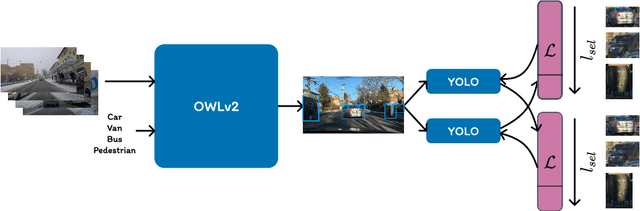
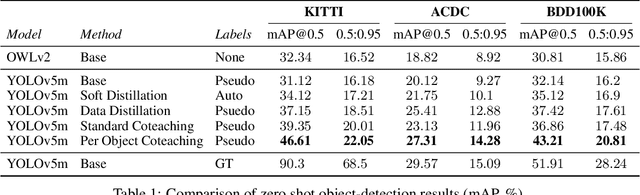
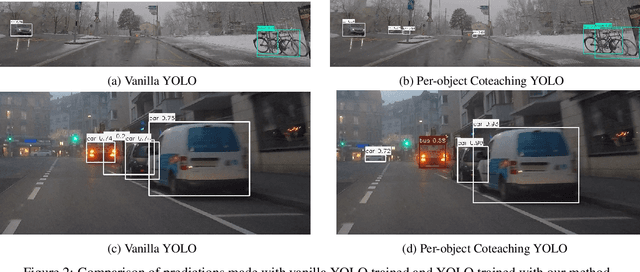
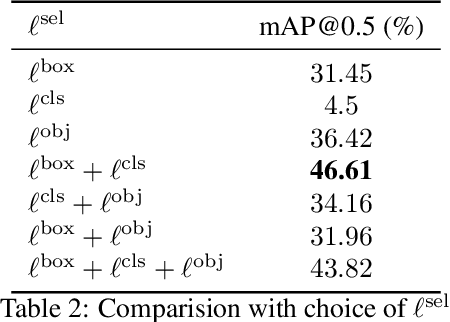
Foundation models, especially vision-language models (VLMs), offer compelling zero-shot object detection for applications like autonomous driving, a domain where manual labelling is prohibitively expensive. However, their detection latency and tendency to hallucinate predictions render them unsuitable for direct deployment. This work introduces a novel pipeline that addresses this challenge by leveraging VLMs to automatically generate pseudo-labels for training efficient, real-time object detectors. Our key innovation is a per-object co-teaching-based training strategy that mitigates the inherent noise in VLM-generated labels. The proposed per-object coteaching approach filters noisy bounding boxes from training instead of filtering the entire image. Specifically, two YOLO models learn collaboratively, filtering out unreliable boxes from each mini-batch based on their peers' per-object loss values. Overall, our pipeline provides an efficient, robust, and scalable approach to train high-performance object detectors for autonomous driving, significantly reducing reliance on costly human annotation. Experimental results on the KITTI dataset demonstrate that our method outperforms a baseline YOLOv5m model, achieving a significant mAP@0.5 boost ($31.12\%$ to $46.61\%$) while maintaining real-time detection latency. Furthermore, we show that supplementing our pseudo-labelled data with a small fraction of ground truth labels ($10\%$) leads to further performance gains, reaching $57.97\%$ mAP@0.5 on the KITTI dataset. We observe similar performance improvements for the ACDC and BDD100k datasets.
Achieving Fair PCA Using Joint Eigenvalue Decomposition
Feb 24, 2025Principal Component Analysis (PCA) is a widely used method for dimensionality reduction, but it often overlooks fairness, especially when working with data that includes demographic characteristics. This can lead to biased representations that disproportionately affect certain groups. To address this issue, our approach incorporates Joint Eigenvalue Decomposition (JEVD), a technique that enables the simultaneous diagonalization of multiple matrices, ensuring fair and efficient representations. We formally show that the optimal solution of JEVD leads to a fair PCA solution. By integrating JEVD with PCA, we strike an optimal balance between preserving data structure and promoting fairness across diverse groups. We demonstrate that our method outperforms existing baseline approaches in fairness and representational quality on various datasets. It retains the core advantages of PCA while ensuring that sensitive demographic attributes do not create disparities in the reduced representation.
Optimal Strategies for Federated Learning Maintaining Client Privacy
Jan 24, 2025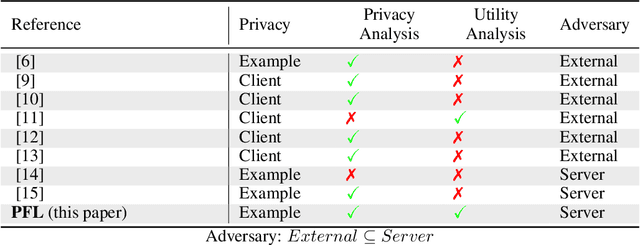
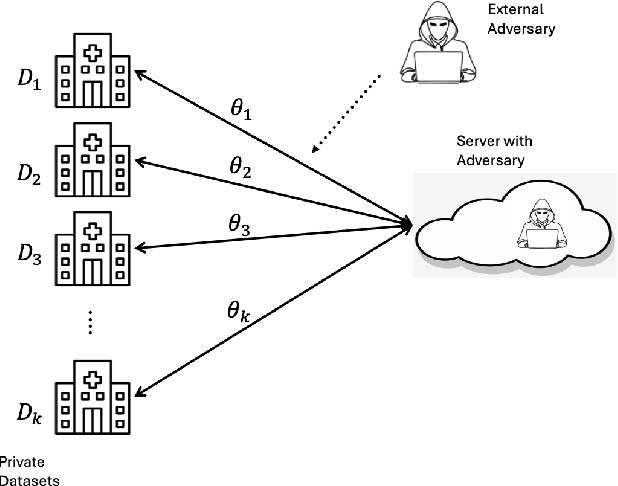
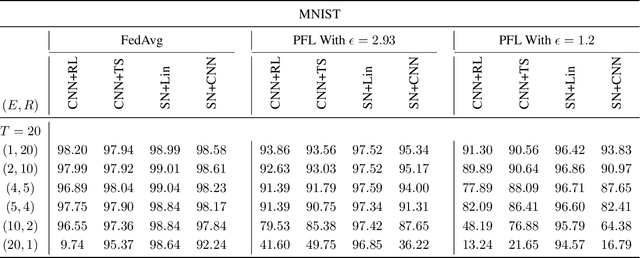
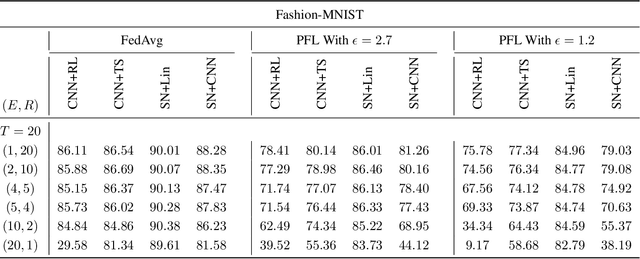
Federated Learning (FL) emerged as a learning method to enable the server to train models over data distributed among various clients. These clients are protective about their data being leaked to the server, any other client, or an external adversary, and hence, locally train the model and share it with the server rather than sharing the data. The introduction of sophisticated inferencing attacks enabled the leakage of information about data through access to model parameters. To tackle this challenge, privacy-preserving federated learning aims to achieve differential privacy through learning algorithms like DP-SGD. However, such methods involve adding noise to the model, data, or gradients, reducing the model's performance. This work provides a theoretical analysis of the tradeoff between model performance and communication complexity of the FL system. We formally prove that training for one local epoch per global round of training gives optimal performance while preserving the same privacy budget. We also investigate the change of utility (tied to privacy) of FL models with a change in the number of clients and observe that when clients are training using DP-SGD and argue that for the same privacy budget, the utility improved with increased clients. We validate our findings through experiments on real-world datasets. The results from this paper aim to improve the performance of privacy-preserving federated learning systems.
Predict Confidently, Predict Right: Abstention in Dynamic Graph Learning
Jan 14, 2025Many real-world systems can be modeled as dynamic graphs, where nodes and edges evolve over time, requiring specialized models to capture their evolving dynamics in risk-sensitive applications effectively. Temporal graph neural networks (GNNs) are one such category of specialized models. For the first time, our approach integrates a reject option strategy within the framework of GNNs for continuous-time dynamic graphs. This allows the model to strategically abstain from making predictions when the uncertainty is high and confidence is low, thus minimizing the risk of critical misclassification and enhancing the results and reliability. We propose a coverage-based abstention prediction model to implement the reject option that maximizes prediction within a specified coverage. It improves the prediction score for link prediction and node classification tasks. Temporal GNNs deal with extremely skewed datasets for the next state prediction or node classification task. In the case of class imbalance, our method can be further tuned to provide a higher weightage to the minority class. Exhaustive experiments are presented on four datasets for dynamic link prediction and two datasets for dynamic node classification tasks. This demonstrates the effectiveness of our approach in improving the reliability and area under the curve (AUC)/ average precision (AP) scores for predictions in dynamic graph scenarios. The results highlight our model's ability to efficiently handle the trade-offs between prediction confidence and coverage, making it a dependable solution for applications requiring high precision in dynamic and uncertain environments.
Node Classification With Integrated Reject Option
Dec 04, 2024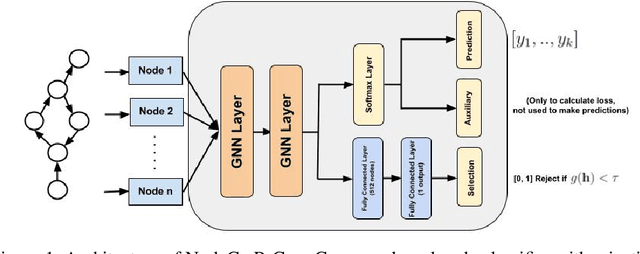
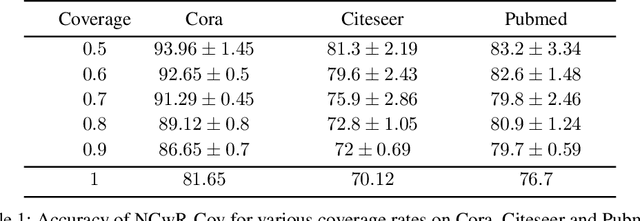
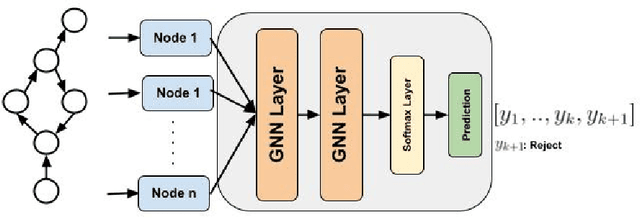
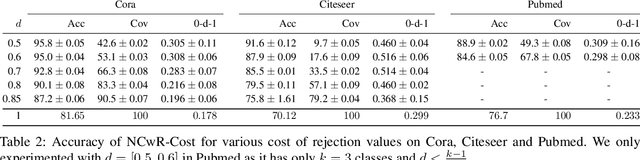
One of the key tasks in graph learning is node classification. While Graph neural networks have been used for various applications, their adaptivity to reject option setting is not previously explored. In this paper, we propose NCwR, a novel approach to node classification in Graph Neural Networks (GNNs) with an integrated reject option, which allows the model to abstain from making predictions when uncertainty is high. We propose both cost-based and coverage-based methods for classification with abstention in node classification setting using GNNs. We perform experiments using our method on three standard citation network datasets Cora, Citeseer and Pubmed and compare with relevant baselines. We also model the Legal judgment prediction problem on ILDC dataset as a node classification problem where nodes represent legal cases and edges represent citations. We further interpret the model by analyzing the cases that the model abstains from predicting by visualizing which part of the input features influenced this decision.
ILAEDA: An Imitation Learning Based Approach for Automatic Exploratory Data Analysis
Oct 15, 2024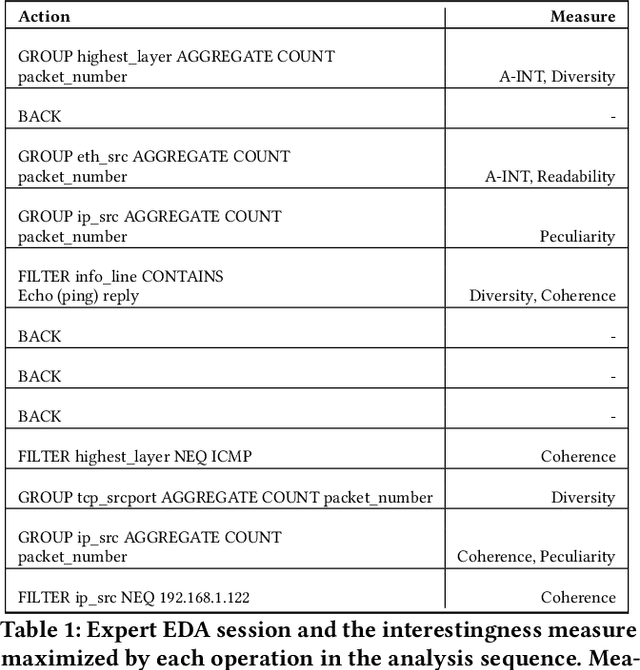
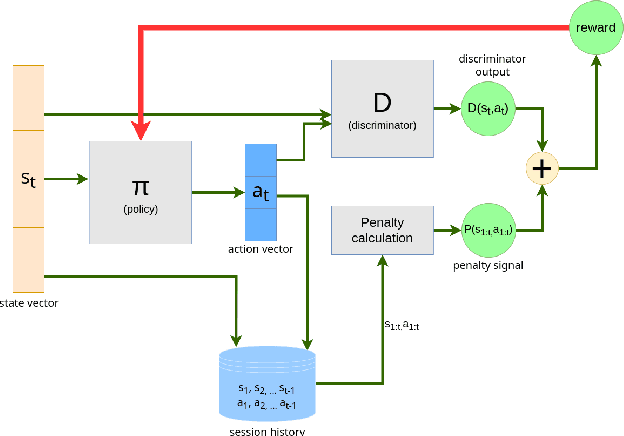
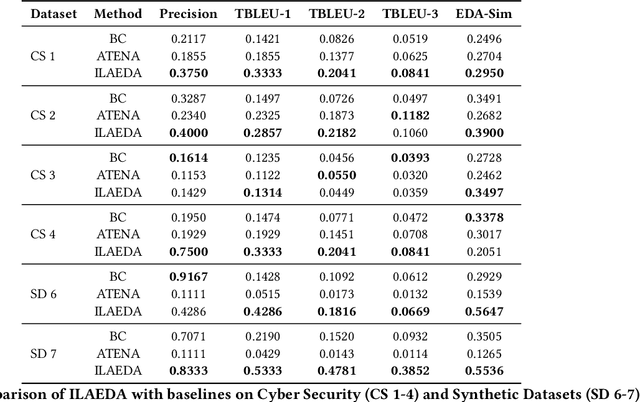

Automating end-to-end Exploratory Data Analysis (AutoEDA) is a challenging open problem, often tackled through Reinforcement Learning (RL) by learning to predict a sequence of analysis operations (FILTER, GROUP, etc). Defining rewards for each operation is a challenging task and existing methods rely on various \emph{interestingness measures} to craft reward functions to capture the importance of each operation. In this work, we argue that not all of the essential features of what makes an operation important can be accurately captured mathematically using rewards. We propose an AutoEDA model trained through imitation learning from expert EDA sessions, bypassing the need for manually defined interestingness measures. Our method, based on generative adversarial imitation learning (GAIL), generalizes well across datasets, even with limited expert data. We also introduce a novel approach for generating synthetic EDA demonstrations for training. Our method outperforms the existing state-of-the-art end-to-end EDA approach on benchmarks by upto 3x, showing strong performance and generalization, while naturally capturing diverse interestingness measures in generated EDA sessions.