 Add to Chrome
 Add to Firefox
 Add to Edge
DevoTG: Temporal Graph Neural Networks for Modeling C. elegans Developmental Connectomics
Jun 20, 2026
Understanding how a nervous system wires itself from birth to adulthood is a fundamental challenge in developmental neuroscience. We present DevoTG, a temporal graph framework that applies Temporal Graph Neural Networks (TGNs) to two complementary representations of C. elegans neural development: a Continuous-Time Dynamic Graph (CTDG) of cell division events derived from cell lineage data, and a Discrete-Time Dynamic Graph (DTDG) of the developing synaptic connectome spanning eight reconstructed electron-microscopy datasets. On the lineage prediction task, our TGN achieves a mean test AUC of 0.839 +/- 0.007 (5 seeds; validation AUC 0.937 +/- 0.001), outperforming a static GNN with the identical architecture by 26 AUC points (0.577 +/- 0.080), demonstrating that temporal memory is the decisive factor. Applied to the connectome DTDG, DevoTG identifies three connection stability classes (stable, developmental, and variable) across 225 neurons and 858 to 2,496 connections over development (L1 birth to adult), providing a temporal-graph-theoretic complement to the individual-variability classification of Witvliet et al. Analysis of hub command interneurons AVA, AVB, and AVE reveals their persistent centrality and how their integration roles are progressively reinforced across larval stages. Accompanying interactive visualizations (3D animated networks, centrality heatmaps, and a spatiotemporal lineage graph) make developmental dynamics accessible for biological hypothesis generation. DevoTG is open-source and designed for extension to other developing nervous systems. Code is publicly available at https://github.com/DevoLearn/DevoGraph/tree/main/DevoTG.

Predict Confidently, Predict Right: Abstention in Dynamic Graph Learning
Jan 14, 2025Many real-world systems can be modeled as dynamic graphs, where nodes and edges evolve over time, requiring specialized models to capture their evolving dynamics in risk-sensitive applications effectively. Temporal graph neural networks (GNNs) are one such category of specialized models. For the first time, our approach integrates a reject option strategy within the framework of GNNs for continuous-time dynamic graphs. This allows the model to strategically abstain from making predictions when the uncertainty is high and confidence is low, thus minimizing the risk of critical misclassification and enhancing the results and reliability. We propose a coverage-based abstention prediction model to implement the reject option that maximizes prediction within a specified coverage. It improves the prediction score for link prediction and node classification tasks. Temporal GNNs deal with extremely skewed datasets for the next state prediction or node classification task. In the case of class imbalance, our method can be further tuned to provide a higher weightage to the minority class. Exhaustive experiments are presented on four datasets for dynamic link prediction and two datasets for dynamic node classification tasks. This demonstrates the effectiveness of our approach in improving the reliability and area under the curve (AUC)/ average precision (AP) scores for predictions in dynamic graph scenarios. The results highlight our model's ability to efficiently handle the trade-offs between prediction confidence and coverage, making it a dependable solution for applications requiring high precision in dynamic and uncertain environments.
Node Classification With Integrated Reject Option
Dec 04, 2024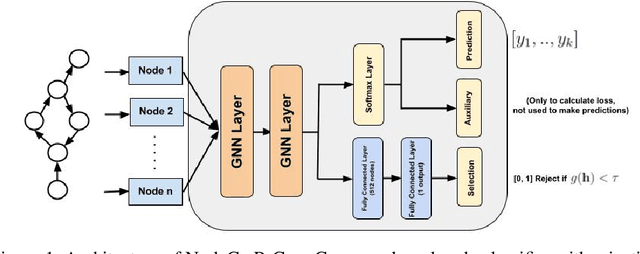
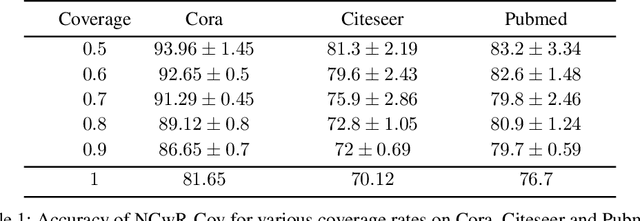
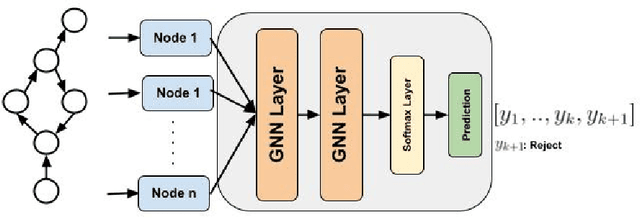
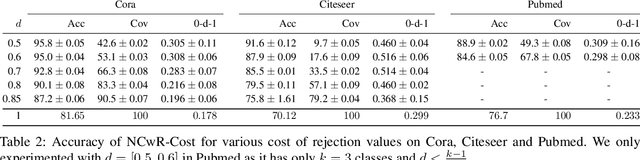
One of the key tasks in graph learning is node classification. While Graph neural networks have been used for various applications, their adaptivity to reject option setting is not previously explored. In this paper, we propose NCwR, a novel approach to node classification in Graph Neural Networks (GNNs) with an integrated reject option, which allows the model to abstain from making predictions when uncertainty is high. We propose both cost-based and coverage-based methods for classification with abstention in node classification setting using GNNs. We perform experiments using our method on three standard citation network datasets Cora, Citeseer and Pubmed and compare with relevant baselines. We also model the Legal judgment prediction problem on ILDC dataset as a node classification problem where nodes represent legal cases and edges represent citations. We further interpret the model by analyzing the cases that the model abstains from predicting by visualizing which part of the input features influenced this decision.