 Add to Chrome
 Add to Firefox
 Add to Edge
Training-Free Cross-Architecture Merging for Graph Neural Networks
Feb 22, 2026
Model merging has emerged as a powerful paradigm for combining the capabilities of distinct expert models without the high computational cost of retraining, yet current methods are fundamentally constrained to homogeneous architectures. For GNNs, however, message passing is topology-dependent and sensitive to misalignment, making direct parameter-space merging unreliable. To bridge this gap, we introduce H-GRAMA (Heterogeneous Graph Routing and Message Alignment), a training-free framework that lifts merging from parameter space to operator space. We formalize Universal Message Passing Mixture (UMPM), a shared operator family that expresses heterogeneous GNN layers in a common functional language. H-GRAMA enables cross-architecture GNN merging (e.g., GCN to GAT) without retraining, retaining high specialist accuracy in most cases in compatible depth settings and achieving inference speedups of 1.2x to 1.9x over ensembles.

EdgeMask-DG*: Learning Domain-Invariant Graph Structures via Adversarial Edge Masking
Feb 05, 2026Structural shifts pose a significant challenge for graph neural networks, as graph topology acts as a covariate that can vary across domains. Existing domain generalization methods rely on fixed structural augmentations or training on globally perturbed graphs, mechanisms that do not pinpoint which specific edges encode domain-invariant information. We argue that domain-invariant structural information is not rigidly tied to a single topology but resides in the consensus across multiple graph structures derived from topology and feature similarity. To capture this, we first propose EdgeMask-DG, a novel min-max algorithm where an edge masker learns to find worst-case continuous masks subject to a sparsity constraint, compelling a task GNN to perform effectively under these adversarial structural perturbations. Building upon this, we introduce EdgeMask-DG*, an extension that applies this adversarial masking principle to an enriched graph. This enriched graph combines the original topology with feature-derived edges, allowing the model to discover invariances even when the original topology is noisy or domain-specific. EdgeMask-DG* is the first to systematically combine adaptive adversarial topology search with feature-enriched graphs. We provide a formal justification for our approach from a robust optimization perspective. We demonstrate that EdgeMask-DG* achieves new state-of-the-art performance on diverse graph domain generalization benchmarks, including citation networks, social networks, and temporal graphs. Notably, on the Cora OOD benchmark, EdgeMask-DG* lifts the worst-case domain accuracy to 78.0\%, a +3.8 pp improvement over the prior state of the art (74.2\%). The source code for our experiments can be found here: https://anonymous.4open.science/r/TMLR-EAEF/
Robust Object Detection with Pseudo Labels from VLMs using Per-Object Co-teaching
Nov 13, 2025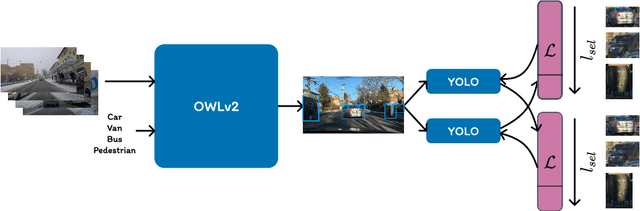
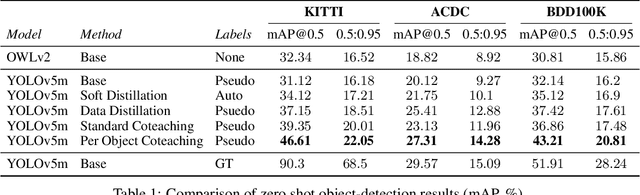
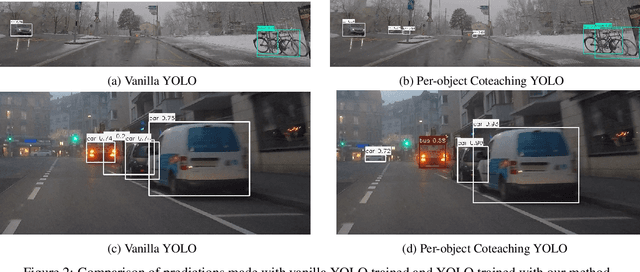
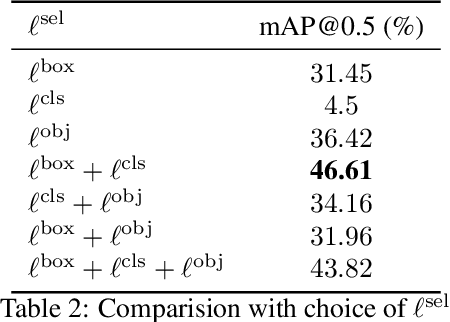
Foundation models, especially vision-language models (VLMs), offer compelling zero-shot object detection for applications like autonomous driving, a domain where manual labelling is prohibitively expensive. However, their detection latency and tendency to hallucinate predictions render them unsuitable for direct deployment. This work introduces a novel pipeline that addresses this challenge by leveraging VLMs to automatically generate pseudo-labels for training efficient, real-time object detectors. Our key innovation is a per-object co-teaching-based training strategy that mitigates the inherent noise in VLM-generated labels. The proposed per-object coteaching approach filters noisy bounding boxes from training instead of filtering the entire image. Specifically, two YOLO models learn collaboratively, filtering out unreliable boxes from each mini-batch based on their peers' per-object loss values. Overall, our pipeline provides an efficient, robust, and scalable approach to train high-performance object detectors for autonomous driving, significantly reducing reliance on costly human annotation. Experimental results on the KITTI dataset demonstrate that our method outperforms a baseline YOLOv5m model, achieving a significant mAP@0.5 boost ($31.12\%$ to $46.61\%$) while maintaining real-time detection latency. Furthermore, we show that supplementing our pseudo-labelled data with a small fraction of ground truth labels ($10\%$) leads to further performance gains, reaching $57.97\%$ mAP@0.5 on the KITTI dataset. We observe similar performance improvements for the ACDC and BDD100k datasets.
MetaGMT: Improving Actionable Interpretability of Graph Multilinear Networks via Meta-Learning Filtration
May 26, 2025The growing adoption of Graph Neural Networks (GNNs) in high-stakes domains like healthcare and finance demands reliable explanations of their decision-making processes. While inherently interpretable GNN architectures like Graph Multi-linear Networks (GMT) have emerged, they remain vulnerable to generating explanations based on spurious correlations, potentially undermining trust in critical applications. We present MetaGMT, a meta-learning framework that enhances explanation fidelity through a novel bi-level optimization approach. We demonstrate that MetaGMT significantly improves both explanation quality (AUC-ROC, Precision@K) and robustness to spurious patterns, across BA-2Motifs, MUTAG, and SP-Motif benchmarks. Our approach maintains competitive classification accuracy while producing more faithful explanations (with an increase up to 8% of Explanation ROC on SP-Motif 0.5) compared to baseline methods. These advancements in interpretability could enable safer deployment of GNNs in sensitive domains by (1) facilitating model debugging through more reliable explanations, (2) supporting targeted retraining when biases are identified, and (3) enabling meaningful human oversight. By addressing the critical challenge of explanation reliability, our work contributes to building more trustworthy and actionable GNN systems for real-world applications.