 Add to Chrome
 Add to Firefox
 Add to Edge
Resourced Authority A Mechanism-Design Model for Participatory Governance of Deployed AI Agents
Aug 06, 2026
We give a formal mechanism design model for the continuous participatory governance of a deployed AI agent. The mechanism is built on the principle that governance should control an AI agent through resource allocation so as to make authorization self enforcing via compute budgets. The mechanism seeks to establish the Safe AI paradigm that compute is an effective governance lever. We situate our work as a compliance or commons overlay on a deployer. One governance period is an extensive form game in which verified human stakeholders arrive sequentially and contribute, on a provision or a rejection market, in a governance currency that is deliberately distinct from the agents compute. A funding aggregator turns raw contributions into breadth weighted effective supports - a two threshold gate with hysteresis converts net support into a binary authorization that, through a coupling map bounded by an exogenously certified safety ceiling, releases a metered compute budget - realized in hardware as a signed compute license so that the decision is self-enforcing. We characterize the class of agents the mechanism can govern and isolate manipulation of the governing electorate by the governed agent as the central open problem. We also introduce several challenges addressing manipulation of governing electorate by the governed agents.

Fairness Auditing: Lower Bounds on Company Manipulation
Aug 01, 2026Fairness audits are increasingly mandated in high-stakes applications such as hiring, lending, and automated decision-making. Recent work has established fundamental impossibility results for black-box fairness auditing, showing that sufficiently expressive models can evade any auditing strategy. We complement these results by quantifying the extent of unavoidable post-audit manipulation under finite audit resources. We formulate fairness auditing as a min-max optimization between a computationally unbounded company and a budget-constrained auditor. We study two auditing regimes: (i) a budgeted auditor that certifies fairness using a fixed-size audit set, and (ii) a budgeted α-tolerant auditor that additionally requires the audit set to estimate the fairness of the certified model within an α approximation. For both settings, we derive explicit lower bounds on the worst-case post-audit demographic parity deviation as functions of the audit budget, group imbalance, and fairness tolerance. Finally, we empirically illustrate these theoretical limits using simple audit-set construction heuristics with linear and neural network classifiers. Our results demonstrate that increasing audit resources reduces, but does not eliminate, the scope for post-audit manipulation, highlighting fundamental limitations of finite-budget fairness certification.
Linear Strategic Classification with Endogenous Improvements
May 31, 2026Strategic classification studies settings in which agents respond to a deployed classifier by modifying observable features at a cost. Classical models typically treat such responses as cosmetic: features may change, but true labels remain fixed. We study an improvement-aware variant in which strategic responses can induce genuine changes in outcome-relevant features. Agents choose post-deployment feature vectors strategically, and labels are then generated according to a stable conditional outcome law that preserves the relationship between features and outcomes. We formalize this problem for linear classifiers under a single-index qualification model and linear-decomposable costs. We show that the strategic-optimal classifier is obtained by a parallel shift of the Bayes-optimal decision boundary, and that it provides a better surrogate for the improvement-aware objective than the Bayes classifier. Since improvement-aware learning requires post-deployment labels, which are typically unavailable before deployment, we provide PAC-style guar- antees under an oracle model, propose a practical plug-in algorithm, establish its generalization bound, and evaluate it on synthetic and real-world datasets.
Optimal Strategies for Federated Learning Maintaining Client Privacy
Jan 24, 2025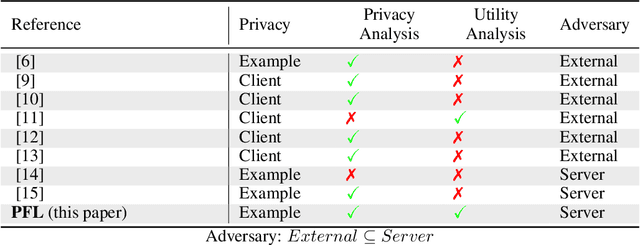
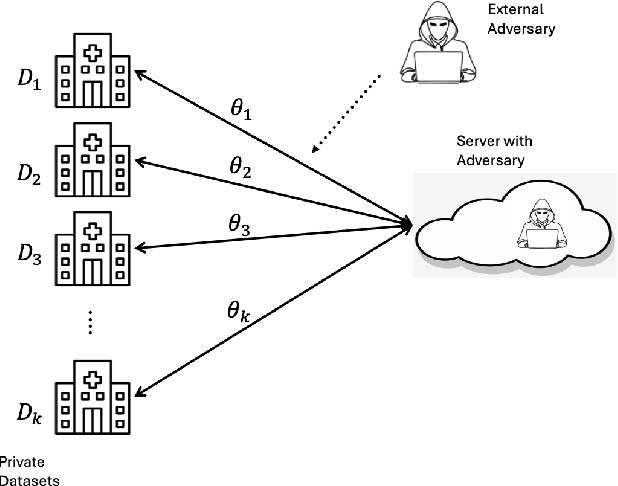
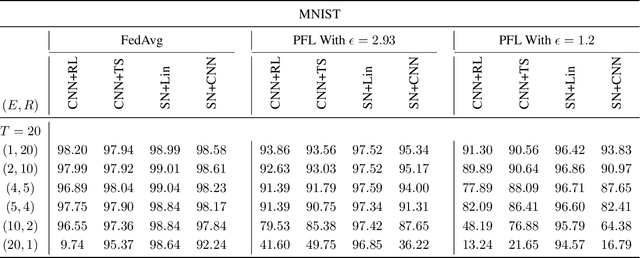
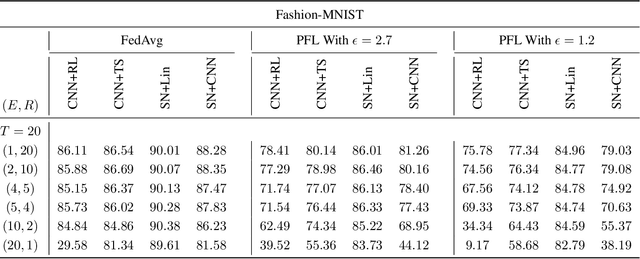
Federated Learning (FL) emerged as a learning method to enable the server to train models over data distributed among various clients. These clients are protective about their data being leaked to the server, any other client, or an external adversary, and hence, locally train the model and share it with the server rather than sharing the data. The introduction of sophisticated inferencing attacks enabled the leakage of information about data through access to model parameters. To tackle this challenge, privacy-preserving federated learning aims to achieve differential privacy through learning algorithms like DP-SGD. However, such methods involve adding noise to the model, data, or gradients, reducing the model's performance. This work provides a theoretical analysis of the tradeoff between model performance and communication complexity of the FL system. We formally prove that training for one local epoch per global round of training gives optimal performance while preserving the same privacy budget. We also investigate the change of utility (tied to privacy) of FL models with a change in the number of clients and observe that when clients are training using DP-SGD and argue that for the same privacy budget, the utility improved with increased clients. We validate our findings through experiments on real-world datasets. The results from this paper aim to improve the performance of privacy-preserving federated learning systems.
FROC: Building Fair ROC from a Trained Classifier
Dec 19, 2024


This paper considers the problem of fair probabilistic binary classification with binary protected groups. The classifier assigns scores, and a practitioner predicts labels using a certain cut-off threshold based on the desired trade-off between false positives vs. false negatives. It derives these thresholds from the ROC of the classifier. The resultant classifier may be unfair to one of the two protected groups in the dataset. It is desirable that no matter what threshold the practitioner uses, the classifier should be fair to both the protected groups; that is, the $\mathcal{L}_p$ norm between FPRs and TPRs of both the protected groups should be at most $\varepsilon$. We call such fairness on ROCs of both the protected attributes $\varepsilon_p$-Equalized ROC. Given a classifier not satisfying $\varepsilon_1$-Equalized ROC, we aim to design a post-processing method to transform the given (potentially unfair) classifier's output (score) to a suitable randomized yet fair classifier. That is, the resultant classifier must satisfy $\varepsilon_1$-Equalized ROC. First, we introduce a threshold query model on the ROC curves for each protected group. The resulting classifier is bound to face a reduction in AUC. With the proposed query model, we provide a rigorous theoretical analysis of the minimal AUC loss to achieve $\varepsilon_1$-Equalized ROC. To achieve this, we design a linear time algorithm, namely \texttt{FROC}, to transform a given classifier's output to a probabilistic classifier that satisfies $\varepsilon_1$-Equalized ROC. We prove that under certain theoretical conditions, \texttt{FROC}\ achieves the theoretical optimal guarantees. We also study the performance of our \texttt{FROC}\ on multiple real-world datasets with many trained classifiers.
Fairness of Exposure in Online Restless Multi-armed Bandits
Feb 09, 2024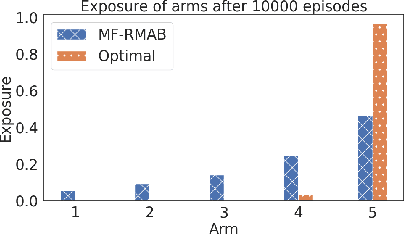
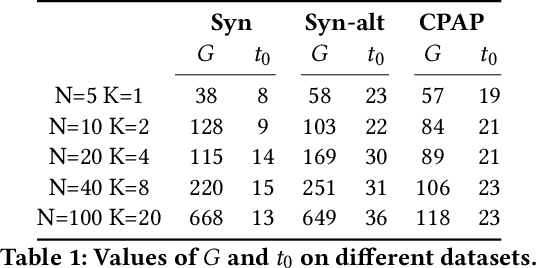


Restless multi-armed bandits (RMABs) generalize the multi-armed bandits where each arm exhibits Markovian behavior and transitions according to their transition dynamics. Solutions to RMAB exist for both offline and online cases. However, they do not consider the distribution of pulls among the arms. Studies have shown that optimal policies lead to unfairness, where some arms are not exposed enough. Existing works in fairness in RMABs focus heavily on the offline case, which diminishes their application in real-world scenarios where the environment is largely unknown. In the online scenario, we propose the first fair RMAB framework, where each arm receives pulls in proportion to its merit. We define the merit of an arm as a function of its stationary reward distribution. We prove that our algorithm achieves sublinear fairness regret in the single pull case $O(\sqrt{T\ln T})$, with $T$ being the total number of episodes. Empirically, we show that our algorithm performs well in the multi-pull scenario as well.
Simultaneously Achieving Group Exposure Fairness and Within-Group Meritocracy in Stochastic Bandits
Feb 08, 2024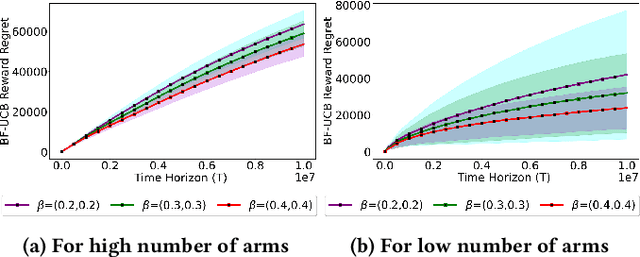
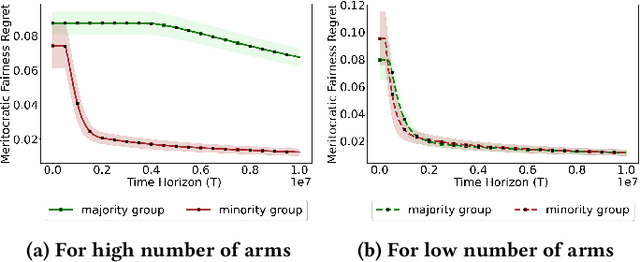
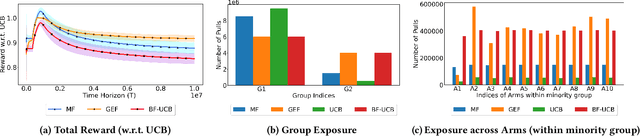
Existing approaches to fairness in stochastic multi-armed bandits (MAB) primarily focus on exposure guarantee to individual arms. When arms are naturally grouped by certain attribute(s), we propose Bi-Level Fairness, which considers two levels of fairness. At the first level, Bi-Level Fairness guarantees a certain minimum exposure to each group. To address the unbalanced allocation of pulls to individual arms within a group, we consider meritocratic fairness at the second level, which ensures that each arm is pulled according to its merit within the group. Our work shows that we can adapt a UCB-based algorithm to achieve a Bi-Level Fairness by providing (i) anytime Group Exposure Fairness guarantees and (ii) ensuring individual-level Meritocratic Fairness within each group. We first show that one can decompose regret bounds into two components: (a) regret due to anytime group exposure fairness and (b) regret due to meritocratic fairness within each group. Our proposed algorithm BF-UCB balances these two regrets optimally to achieve the upper bound of $O(\sqrt{T})$ on regret; $T$ being the stopping time. With the help of simulated experiments, we further show that BF-UCB achieves sub-linear regret; provides better group and individual exposure guarantees compared to existing algorithms; and does not result in a significant drop in reward with respect to UCB algorithm, which does not impose any fairness constraint.
Fairness and Privacy Guarantees in Federated Contextual Bandits
Feb 05, 2024This paper considers the contextual multi-armed bandit (CMAB) problem with fairness and privacy guarantees in a federated environment. We consider merit-based exposure as the desired fair outcome, which provides exposure to each action in proportion to the reward associated. We model the algorithm's effectiveness using fairness regret, which captures the difference between fair optimal policy and the policy output by the algorithm. Applying fair CMAB algorithm to each agent individually leads to fairness regret linear in the number of agents. We propose that collaborative -- federated learning can be more effective and provide the algorithm Fed-FairX-LinUCB that also ensures differential privacy. The primary challenge in extending the existing privacy framework is designing the communication protocol for communicating required information across agents. A naive protocol can either lead to weaker privacy guarantees or higher regret. We design a novel communication protocol that allows for (i) Sub-linear theoretical bounds on fairness regret for Fed-FairX-LinUCB and comparable bounds for the private counterpart, Priv-FairX-LinUCB (relative to single-agent learning), (ii) Effective use of privacy budget in Priv-FairX-LinUCB. We demonstrate the efficacy of our proposed algorithm with extensive simulations-based experiments. We show that both Fed-FairX-LinUCB and Priv-FairX-LinUCB achieve near-optimal fairness regret.
Designing Redistribution Mechanisms for Reducing Transaction Fees in Blockchains
Jan 24, 2024Blockchains deploy Transaction Fee Mechanisms (TFMs) to determine which user transactions to include in blocks and determine their payments (i.e., transaction fees). Increasing demand and scarce block resources have led to high user transaction fees. As these blockchains are a public resource, it may be preferable to reduce these transaction fees. To this end, we introduce Transaction Fee Redistribution Mechanisms (TFRMs) -- redistributing VCG payments collected from such TFM as rebates to minimize transaction fees. Classic redistribution mechanisms (RMs) achieve this while ensuring Allocative Efficiency (AE) and User Incentive Compatibility (UIC). Our first result shows the non-triviality of applying RM in TFMs. More concretely, we prove that it is impossible to reduce transaction fees when (i) transactions that are not confirmed do not receive rebates and (ii) the miner can strategically manipulate the mechanism. Driven by this, we propose \emph{Robust} TFRM (\textsf{R-TFRM}): a mechanism that compromises on an honest miner's individual rationality to guarantee strictly positive rebates to the users. We then introduce \emph{robust} and \emph{rational} TFRM (\textsf{R}$^2$\textsf{-TFRM}) that uses trusted on-chain randomness that additionally guarantees miner's individual rationality (in expectation) and strictly positive rebates. Our results show that TFRMs provide a promising new direction for reducing transaction fees in public blockchains.
A Novel Demand Response Model and Method for Peak Reduction in Smart Grids -- PowerTAC
Feb 24, 2023One of the widely used peak reduction methods in smart grids is demand response, where one analyzes the shift in customers' (agents') usage patterns in response to the signal from the distribution company. Often, these signals are in the form of incentives offered to agents. This work studies the effect of incentives on the probabilities of accepting such offers in a real-world smart grid simulator, PowerTAC. We first show that there exists a function that depicts the probability of an agent reducing its load as a function of the discounts offered to them. We call it reduction probability (RP). RP function is further parametrized by the rate of reduction (RR), which can differ for each agent. We provide an optimal algorithm, MJS--ExpResponse, that outputs the discounts to each agent by maximizing the expected reduction under a budget constraint. When RRs are unknown, we propose a Multi-Armed Bandit (MAB) based online algorithm, namely MJSUCB--ExpResponse, to learn RRs. Experimentally we show that it exhibits sublinear regret. Finally, we showcase the efficacy of the proposed algorithm in mitigating demand peaks in a real-world smart grid system using the PowerTAC simulator as a test bed.