 Add to Chrome
 Add to Firefox
 Add to Edge
MJ: Multi-turn LLM Jailbreaking via Decomposed Credit Assignment
Jul 13, 2026
Modern large language models (LLMs) operate in interactive multi-turn settings, making multi-turn jailbreaking a realistic threat model and an important setting for automated red teaming. A core challenge in learning multi-turn jailbreak attackers is credit assignment: different turns contribute differently to the final outcome, yet existing learning signals are often too coarse to identify their individual contributions. We propose decomposed credit GRPO (DC-GRPO), a unified turn-level credit assignment framework for Group Relative Policy Optimization in multi-turn jailbreak learning. DC-GRPO assigns a separate group-relative learning signal to each turn by combining immediate and future credit, avoiding the credit misassignment induced by broadcasting a single trajectory-level score across the dialogue. We instantiate this framework with static and dynamic weighting rules that differ in how the two credit sources are balanced while sharing the same turn-level structure. Across multiple victim LLMs and benchmarks, the dynamic- and static-weighted variants achieve average ASR5@3 scores of 98.26% and 97.88%, respectively, substantially outperforming the state-of-the-art methods, including SEMA (86.58%) and TROJail (86.23%). Their consistently strong performance indicates that the central empirical benefit comes from turn-level group-relative credit assignment rather than a particular weighting rule. Warning: This paper contains examples of harmful content.

Detecting Audio Adversarial Examples with Logit Noising
Dec 13, 2021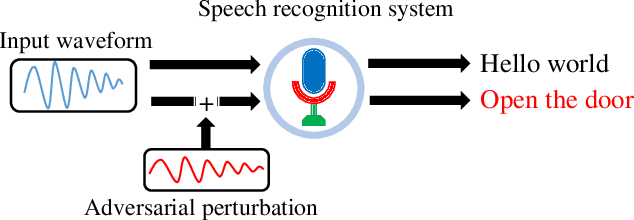
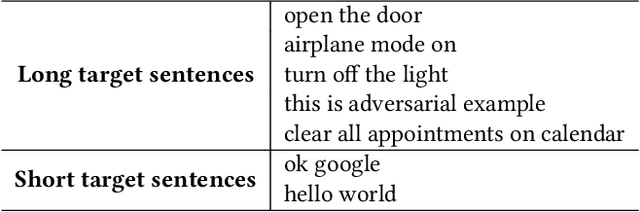

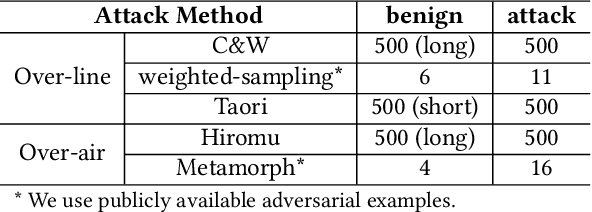
Automatic speech recognition (ASR) systems are vulnerable to audio adversarial examples that attempt to deceive ASR systems by adding perturbations to benign speech signals. Although an adversarial example and the original benign wave are indistinguishable to humans, the former is transcribed as a malicious target sentence by ASR systems. Several methods have been proposed to generate audio adversarial examples and feed them directly into the ASR system (over-line). Furthermore, many researchers have demonstrated the feasibility of robust physical audio adversarial examples(over-air). To defend against the attacks, several studies have been proposed. However, deploying them in a real-world situation is difficult because of accuracy drop or time overhead. In this paper, we propose a novel method to detect audio adversarial examples by adding noise to the logits before feeding them into the decoder of the ASR. We show that carefully selected noise can significantly impact the transcription results of the audio adversarial examples, whereas it has minimal impact on the transcription results of benign audio waves. Based on this characteristic, we detect audio adversarial examples by comparing the transcription altered by logit noising with its original transcription. The proposed method can be easily applied to ASR systems without any structural changes or additional training. The experimental results show that the proposed method is robust to over-line audio adversarial examples as well as over-air audio adversarial examples compared with state-of-the-art detection methods.