 Add to Chrome
 Add to Firefox
 Add to Edge
PUF: Plug-and-Play Uncertainty-Aware Fusion for Online 3D Scene Graph Generation
Jul 08, 2026
Online 3D scene graph generation builds a persistent, structured representation of a scene by incrementally fusing 2D observations into a global 3D graph. Existing online methods treat this fusion as a fully deterministic pipeline, where we identify three sources of uncertainty that are overlooked: observation, 2D model, and 3D representation. We propose PUF: a Plug-and-play, Uncertainty-aware, and training-free Fusion framework. Scene graph node association is reformulated as a probabilistic likelihood over semantic and spatial factors, replacing binary accept/reject gates. Dirichlet evidence accumulation distributes class and relationship evidence across plausible candidates proportional to association likelihood. An optional class-conditional prior completes edges for sparsely or never co-observed object pairs. We instantiate PUF with both a 3D Gaussian and a 3D voxel backend and observe consistent improvements, demonstrating its ability to generalize across different representations. Experiments on the 3DSSG and ReplicaSSG benchmarks show that our method substantially outperforms existing approaches while maintaining real-time latency. These results establish uncertainty-aware fusion as a principled and effective paradigm for online 3D scene understanding. The source code is publicly available at https://github.com/yyyyangyi/PUF.

Gaussian Heritage: 3D Digitization of Cultural Heritage with Integrated Object Segmentation
Sep 27, 2024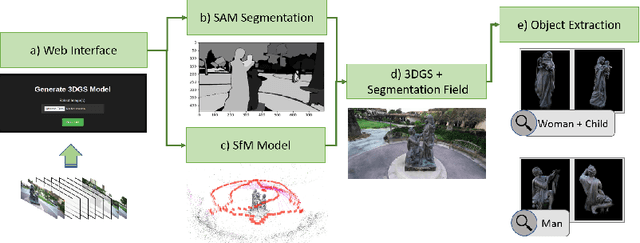

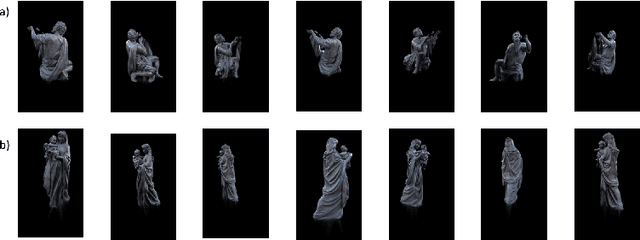
The creation of digital replicas of physical objects has valuable applications for the preservation and dissemination of tangible cultural heritage. However, existing methods are often slow, expensive, and require expert knowledge. We propose a pipeline to generate a 3D replica of a scene using only RGB images (e.g. photos of a museum) and then extract a model for each item of interest (e.g. pieces in the exhibit). We do this by leveraging the advancements in novel view synthesis and Gaussian Splatting, modified to enable efficient 3D segmentation. This approach does not need manual annotation, and the visual inputs can be captured using a standard smartphone, making it both affordable and easy to deploy. We provide an overview of the method and baseline evaluation of the accuracy of object segmentation. The code is available at https://mahtaabdn.github.io/gaussian_heritage.github.io/.