 Add to Chrome
 Add to Firefox
 Add to Edge
Safety-Critical Whole-Body Control for Humanoid Robots via Input-to-State Safe Control Barrier Functions
May 25, 2026
Safety-critical control is essential for humanoid robots operating in complex human-centered environments, where physical safety constraints such as joint limits, self-collision avoidance, obstacle avoidance, and workspace boundaries must be satisfied during real-robot operation. However, existing approaches remain limited because kinematic safety guarantees can be degraded in the presence of unknown disturbances, such as model uncertainties, trajectory-tracking errors, and external perturbations. This paper presents a hierarchical safety-critical whole-body control framework for humanoid robots based on input-to-state safe control barrier functions (ISSf-CBFs). The proposed architecture integrates a kinematic-level whole-body controller (KinWBC), an ISSf-CBF safety filter, and a dynamic-level whole-body controller (DynWBC). KinWBC generates nominal joint-motion references from prioritized tasks; the ISSf-CBF filter minimally modifies these references to satisfy kinematic safety constraints under bounded disturbances; and DynWBC tracks the filtered references while enforcing full-body dynamic feasibility and contact stability. Safety constraints are imposed on a whole-body kinematic model, and the ISSf-CBF parameters are conservatively tuned so that the resulting kinematic safety guarantees can be transferred to full-order humanoid dynamics under unknown disturbances. Simulation and real-robot experiments demonstrate that the proposed framework improves safety margins under model mismatch and reliably enforces multiple safety constraints in real time during locomotion, teleoperation, and single-leg balancing with hand control. Project website: https://kwlee365.github.io/SafeWBC-Website/

MOB-Net: Limb-modularized Uncertainty Torque Learning of Humanoids for Sensorless External Torque Estimation
Feb 17, 2024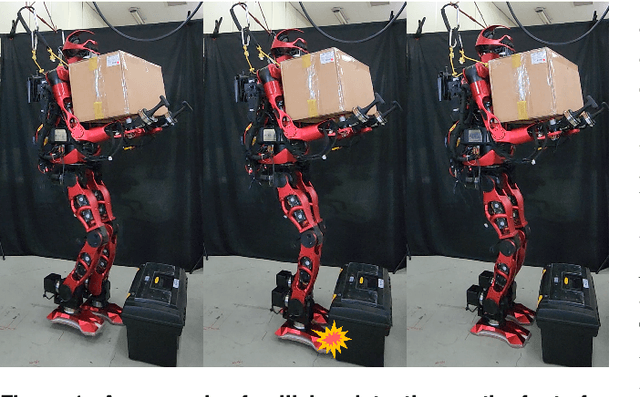

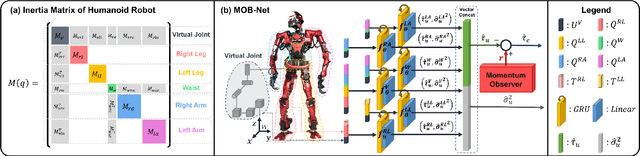
Momentum observer (MOB) can estimate external joint torque without requiring additional sensors, such as force/torque or joint torque sensors. However, the estimation performance of MOB deteriorates due to the model uncertainty which encompasses the modeling errors and the joint friction. Moreover, the estimation error is significant when MOB is applied to high-dimensional floating-base humanoids, which prevents the estimated external joint torque from being used for force control or collision detection in the real humanoid robot. In this paper, the pure external joint torque estimation method named MOB-Net, is proposed for humanoids. MOB-Net learns the model uncertainty torque and calibrates the estimated signal of MOB. The external joint torque can be estimated in the generalized coordinate including whole-body and virtual joints of the floating-base robot with only internal sensors (an IMU on the pelvis and encoders in the joints). Our method substantially reduces the estimation errors of MOB, and the robust performance of MOB-Net for the unseen data is validated through extensive simulations, real robot experiments, and ablation studies. Finally, various collision handling scenarios are presented using the estimated external joint torque from MOB-Net: contact wrench feedback control for locomotion, collision detection, and collision reaction for safety.
Proprioceptive External Torque Learning for Floating Base Robot and its Applications to Humanoid Locomotion
Sep 08, 2023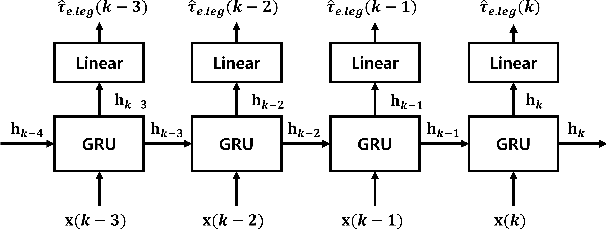
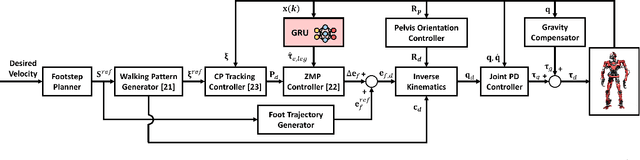
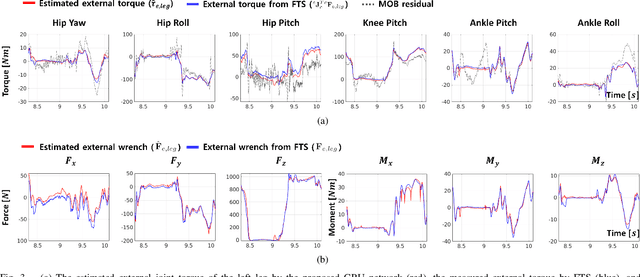
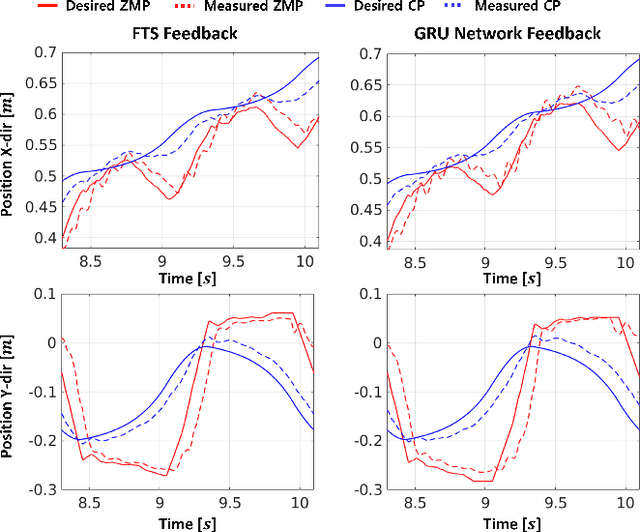
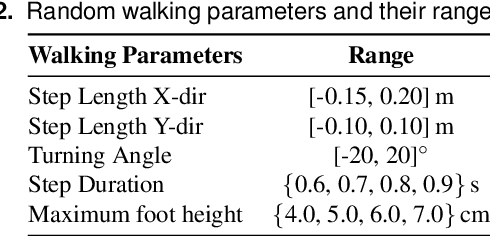
The estimation of external joint torque and contact wrench is essential for achieving stable locomotion of humanoids and safety-oriented robots. Although the contact wrench on the foot of humanoids can be measured using a force-torque sensor (FTS), FTS increases the cost, inertia, complexity, and failure possibility of the system. This paper introduces a method for learning external joint torque solely using proprioceptive sensors (encoders and IMUs) for a floating base robot. For learning, the GRU network is used and random walking data is collected. Real robot experiments demonstrate that the network can estimate the external torque and contact wrench with significantly smaller errors compared to the model-based method, momentum observer (MOB) with friction modeling. The study also validates that the estimated contact wrench can be utilized for zero moment point (ZMP) feedback control, enabling stable walking. Moreover, even when the robot's feet and the inertia of the upper body are changed, the trained network shows consistent performance with a model-based calibration. This result demonstrates the possibility of removing FTS on the robot, which reduces the disadvantages of hardware sensors. The summary video is available at https://youtu.be/gT1D4tOiKpo.
A Model Predictive Capture Point Control Framework for Robust Humanoid Balancing via Ankle, Hip, and Stepping Strategies
Jul 25, 2023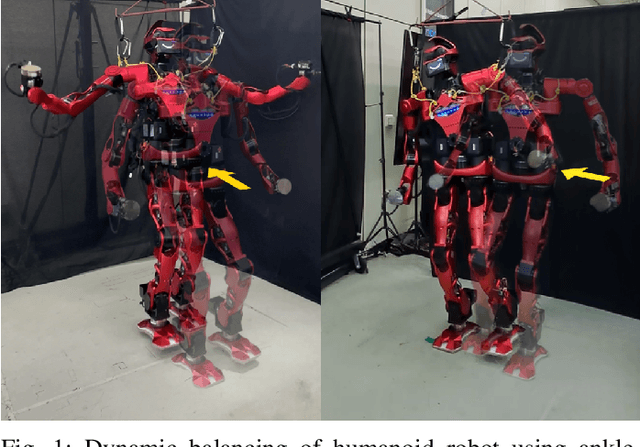
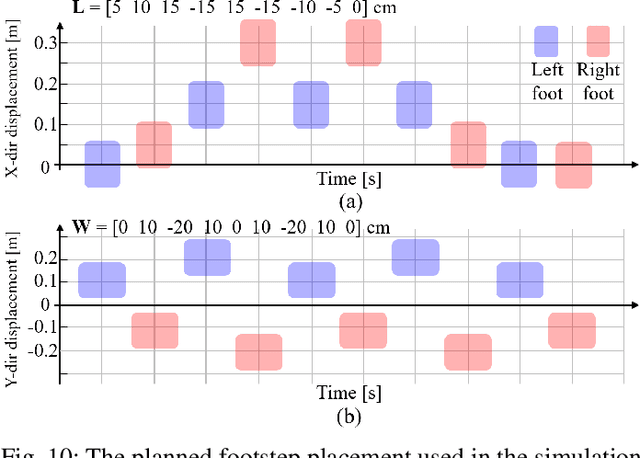
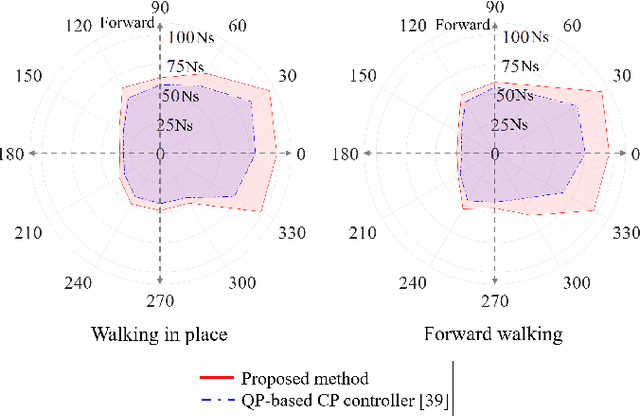
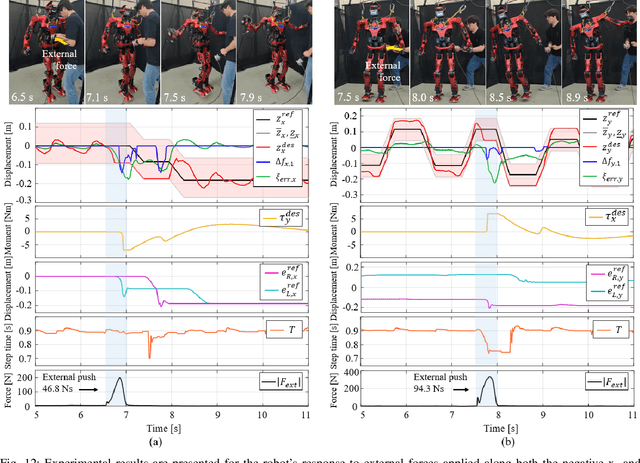
The robust balancing capability of humanoid robots against disturbances has been considered as one of the crucial requirements for their practical mobility in real-world environments. In particular, many studies have been devoted to the efficient implementation of the three balance strategies, inspired by human balance strategies involving ankle, hip, and stepping strategies, to endow humanoid robots with human-level balancing capability. In this paper, a robust balance control framework for humanoid robots is proposed. Firstly, a novel Model Predictive Control (MPC) framework is proposed for Capture Point (CP) tracking control, enabling the integration of ankle, hip, and stepping strategies within a single framework. Additionally, a variable weighting method is introduced that adjusts the weighting parameters of the Centroidal Angular Momentum (CAM) damping control over the time horizon of MPC to improve the balancing performance. Secondly, a hierarchical structure of the MPC and a stepping controller was proposed, allowing for the step time optimization. The robust balancing performance of the proposed method is validated through extensive simulations and real robot experiments. Furthermore, a superior balancing performance is demonstrated, particularly in the presence of disturbances, compared to a state-of-the-art Quadratic Programming (QP)-based CP controller that employs the ankle, hip, and stepping strategies. The supplementary video is available at https://youtu.be/CrD75UbYzdc