 Add to Chrome
 Add to Firefox
 Add to Edge
Training One Model to Master Cross-Level Agentic Actions via Reinforcement Learning
Dec 10, 2025
The paradigm of agentic AI is shifting from engineered complex workflows to post-training native models. However, existing agents are typically confined to static, predefined action spaces--such as exclusively using APIs, GUI events, or robotic commands. This rigidity limits their adaptability in dynamic environments where the optimal granularity of interaction varies contextually. To bridge this gap, we propose CrossAgent, a unified agentic model that masters heterogeneous action spaces and autonomously selects the most effective interface for each step of a trajectory. We introduce a comprehensive training pipeline that integrates cold-start supervised fine-tuning with a Multi-Turn Group Relative Policy Optimization (GRPO) algorithm. This approach enables the agent to learn adaptive action switching--balancing high-level efficiency with low-level precision--without human-specified rules. Extensive experiments on over 800 tasks in the open-world Minecraft environment demonstrate that CrossAgent achieves state-of-the-art performance. By dynamically leveraging the strengths of diverse action spaces, our model significantly outperforms fixed-action baselines, exhibiting superior generalization and efficiency in long-horizon reasoning. All code and models are available at https://github.com/CraftJarvis/OpenHA

JARVIS-VLA: Post-Training Large-Scale Vision Language Models to Play Visual Games with Keyboards and Mouse
Mar 20, 2025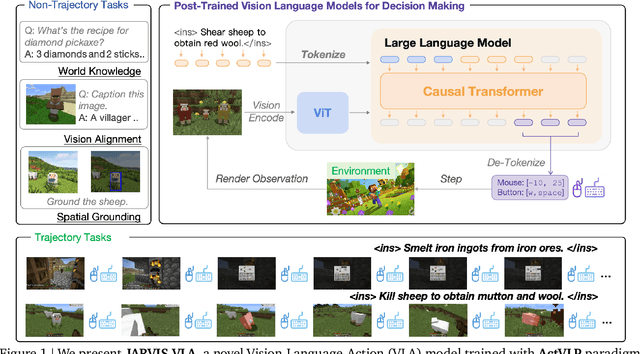
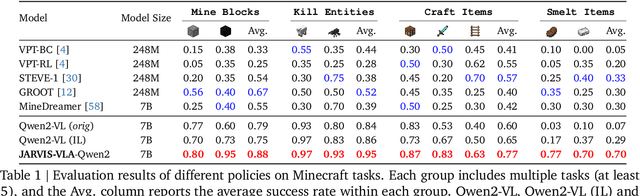
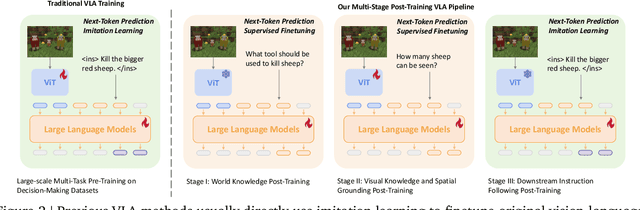
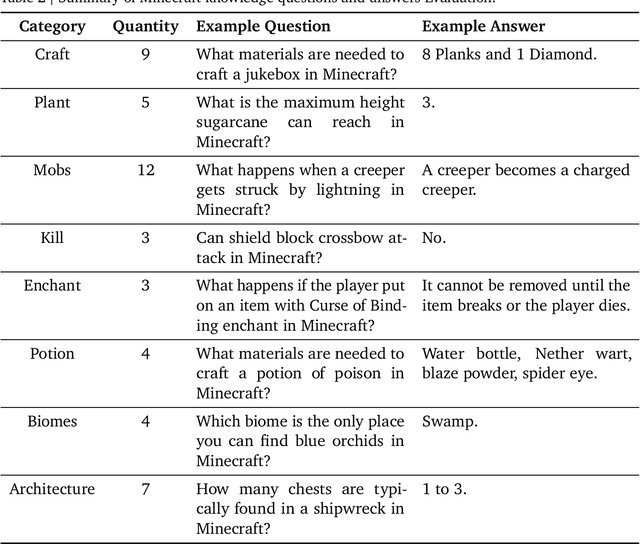
Recently, action-based decision-making in open-world environments has gained significant attention. Visual Language Action (VLA) models, pretrained on large-scale web datasets, have shown promise in decision-making tasks. However, previous work has primarily focused on action post-training, often neglecting enhancements to the foundational model itself. In response, we introduce a novel approach, Act from Visual Language Post-Training, which refines Visual Language Models (VLMs) through visual and linguistic guidance in a self-supervised manner. This enhancement improves the models' capabilities in world knowledge, visual recognition, and spatial grounding in open-world environments. Following the above post-training paradigms, we obtain the first VLA models in Minecraft that can follow human instructions on over 1k different atomic tasks, including crafting, smelting, cooking, mining, and killing. Our experiments demonstrate that post-training on non-trajectory tasks leads to a significant 40% improvement over the best agent baseline on a diverse set of atomic tasks. Furthermore, we demonstrate that our approach surpasses traditional imitation learning-based policies in Minecraft, achieving state-of-the-art performance. We have open-sourced the code, models, and datasets to foster further research. The project page can be found in https://craftjarvis.github.io/JarvisVLA.