 Add to Chrome
 Add to Firefox
 Add to Edge
Multilingual Reference Need Assessment System for Wikipedia
Mar 17, 2026
Wikipedia is a critical source of information for millions of users across the Web. It serves as a key resource for large language models, search engines, question-answering systems, and other Web-based applications. In Wikipedia, content needs to be verifiable, meaning that readers can check that claims are backed by references to reliable sources. This depends on manual verification by editors, an effective but labor-intensive process, especially given the high volume of daily edits. To address this challenge, we introduce a multilingual machine learning system to assist editors in identifying claims requiring citations. Our approach is tested in 10 language editions of Wikipedia, outperforming existing benchmarks for reference need assessment. We not only consider machine learning evaluation metrics but also system requirements, allowing us to explore the trade-offs between model accuracy and computational efficiency under real-world infrastructure constraints. We deploy our system in production and release data and code to support further research.
* Accepted for publication at the Proceedings of the ACM Web Conference 2026 (WWW '26). Author's copy

Fair multilingual vandalism detection system for Wikipedia
Jun 02, 2023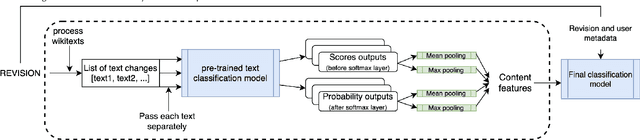
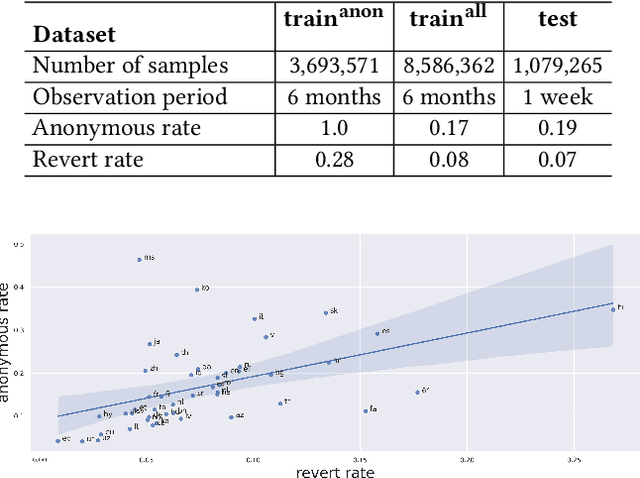
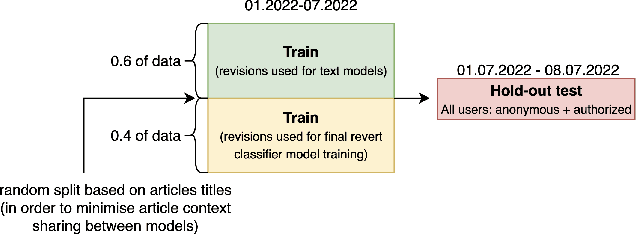
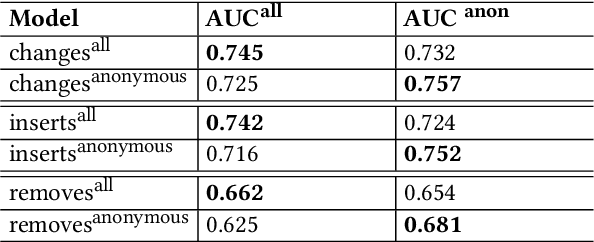
This paper presents a novel design of the system aimed at supporting the Wikipedia community in addressing vandalism on the platform. To achieve this, we collected a massive dataset of 47 languages, and applied advanced filtering and feature engineering techniques, including multilingual masked language modeling to build the training dataset from human-generated data. The performance of the system was evaluated through comparison with the one used in production in Wikipedia, known as ORES. Our research results in a significant increase in the number of languages covered, making Wikipedia patrolling more efficient to a wider range of communities. Furthermore, our model outperforms ORES, ensuring that the results provided are not only more accurate but also less biased against certain groups of contributors.