 Add to Chrome
 Add to Firefox
 Add to Edge
Curvature-Weighted Gradient Diversity: A Noise Measure for Geometry-Adaptive SGD Schedules
Jun 29, 2026
The standard convergence analysis of mini-batch stochastic gradient descent (SGD) models gradient noise using a single variance term that treats all parameter directions equally, ignoring the fact that noise in high-curvature directions has less impact because learning rates are already constrained there. We introduce Curvature-Weighted Gradient Diversity (CWGD), a geometry-aware measure that weights per-sample gradient diversity by the inverse square root of the Hessian, providing a tighter proxy for the effective optimization noise. For strongly convex quadratic objectives with diagonal Hessians and isotropic noise, we prove that a CWGD-modulated cosine learning-rate schedule can reduce the asymptotic optimization error floor by up to a factor of two compared with standard cosine annealing. We implement this idea as CWGD-Cosine using a Hutchinson-based diagonal Hessian estimator that is exact for quadratic objectives. Across a range of condition numbers, batch sizes, and noise structures, CWGD-Cosine consistently achieves approximately 20% lower final optimization error than standard cosine annealing while incurring negligible overhead in the quadratic setting. We also identify and correct a degenerate curvature estimator, analyze the robustness of the proposed estimator, and explicitly discuss the limitations of the method, including Hessian staleness in non-convex optimization. These results establish CWGD as a principled geometry-aware measure of optimization noise and motivate future extensions to more general learning problems.

Criticality-Constrained Iterative Pruning for Energy-Efficient Spiking Neural Networks via Combined Importance Scoring
Jun 26, 2026Deploying spiking neural networks (SNNs) on neuromorphic hardware demands aggressive synaptic pruning while preserving temporal computation integrity. Existing strategies either neglect neuronal criticality or rely on convex relaxations of the inherently combinatorial pruning problem whose fractional masks, upon binarisation, destroy accuracy at moderate-to-high sparsity. We present Criticality-Constrained Quadratic Pruning (CQP), a native PyTorch pipeline that fuses weight magnitude with surrogate-gradient criticality into an analytically exact importance metric, eliminating the rounding artefacts endemic to solver-based approaches. We formally characterise a continuous-relaxation trap wherein OSQP-solver fractional masks overshoot the intended sparsity by up to 12 percentage points (pp), precipitating a 44 pp accuracy collapse. We identify and remediate a zombie-weight failure mode in which Adam's first-moment tensors resurrect pruned synapses, violating the binary sparsity guarantee. An iterative schedule - prune, fine-tune with gradient masking, recompute criticality, and repeat - eliminates gradient staleness at high sparsity. A KL-divergence temporal analysis identifies a redundant simulation timestep, enabling a free 10% theoretical energy reduction without weight modification. On MNIST (60,000 training examples), CQP yields 95.6% accuracy at 90% sparsity versus 93.4% for magnitude pruning (+2.2 pp). A criticality-threshold sweep reveals an empirical criticality cliff: accuracy falls from 87.0% to 14.4% as the threshold reaches tau = 0.9, constituting a quantitative SNN-level analogue of the Critical Brain Hypothesis. Combined weight sparsification and temporal truncation yield a compound 73% reduction in per-inference energy at 70% sparsity, confirming the practical value of the proposed pipeline for neuromorphic deployment.
Toward Gripper-Integrated Active Electrosense for Pre-Contact Sensing in Underwater Soft Grippers
Jun 02, 2026Underwater manipulation often occurs under degraded visibility due to turbidity, glare, and gripper occlusion, limiting the reliability of vision-based perception during approach and grasping. In such settings, soft grippers are well suited for compliant interaction, but they typically lack an onboard pre-contact cue that can guide approach and closure when vision is unreliable. This extended abstract explores active electrosense as a lightweight sensing modality that can provide a proximity-like signal prior to contact by measuring perturbations of an applied electric field in conductive media. We instrument an octopus-inspired gripper with a discrete electrode layout and record multi-channel sensing voltages using off-the-shelf hardware. Simulation and tank experiments with a suspended conductive sphere show structured, object-dependent changes in the multi-electrode voltage readout relative to empty-water baselines, with detectability varying across excitation of 5 to 20 V and frequencies from 1 mHz to 1 kHz. These findings motivate systematic investigation of gripper-integrated electrosense as a complementary pre-contact cue for underwater soft manipulation.
Feature Attention Network (FA-Net): A Deep-Learning Based Approach for Underwater Single Image Enhancement
Aug 30, 2023Underwater image processing and analysis have been a hotspot of study in recent years, as more emphasis has been focused to underwater monitoring and usage of marine resources. Compared with the open environment, underwater image encountered with more complicated conditions such as light abortion, scattering, turbulence, nonuniform illumination and color diffusion. Although considerable advances and enhancement techniques achieved in resolving these issues, they treat low-frequency information equally across the entire channel, which results in limiting the network's representativeness. We propose a deep learning and feature-attention-based end-to-end network (FA-Net) to solve this problem. In particular, we propose a Residual Feature Attention Block (RFAB), containing the channel attention, pixel attention, and residual learning mechanism with long and short skip connections. RFAB allows the network to focus on learning high-frequency information while skipping low-frequency information on multi-hop connections. The channel and pixel attention mechanism considers each channel's different features and the uneven distribution of haze over different pixels in the image. The experimental results shows that the FA-Net propose by us provides higher accuracy, quantitatively and qualitatively and superiority to previous state-of-the-art methods.
* Fourteenth International Conference on Digital Image Processing (ICDIP 2022), 2022, Wuhan, China, May 20-23, 2022.8 pages.5 Figures.doi: 10.1117/12.2644516
Forecasting sales with Bayesian networks: a case study of a supermarket product in the presence of promotions
Dec 16, 2021
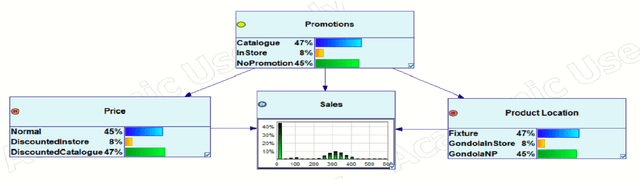
Sales forecasting is the prerequisite for a lot of managerial decisions such as production planning, material resource planning and budgeting in the supply chain. Promotions are one of the most important business strategies that are often used to boost sales. While promotions are attractive for generating demand, it is often difficult to forecast demand in their presence. In the past few decades, several quantitative models have been developed to forecast sales including statistical and machine learning models. However, these methods may not be adequate to account for all the internal and external factors that may impact sales. As a result, qualitative models have been adopted along with quantitative methods as consulting experts has been proven to improve forecast accuracy by providing contextual information. Such models are being used extensively to account for factors that can lead to a rapid change in sales, such as during promotions. In this paper, we aim to use Bayesian Networks to forecast promotional sales where a combination of factors such as price, type of promotions, and product location impacts sales. We choose to develop a BN model because BN models essentially have the capability to combine various qualitative and quantitative factors with causal forms, making it an attractive tool for sales forecasting during promotions. This can be used to adjust a company's promotional strategy in the context of this case study. We gather sales data for a particular product from a retailer that sells products in Australia. We develop a Bayesian Network for this product and validate our results by empirical analysis. This paper confirms that BNs can be effectively used to forecast sales, especially during promotions. In the end, we provide some research avenues for using BNs in forecasting sales.