 Add to Chrome
 Add to Firefox
 Add to Edge
Curvature-Weighted Gradient Diversity: A Noise Measure for Geometry-Adaptive SGD Schedules
Jun 29, 2026
The standard convergence analysis of mini-batch stochastic gradient descent (SGD) models gradient noise using a single variance term that treats all parameter directions equally, ignoring the fact that noise in high-curvature directions has less impact because learning rates are already constrained there. We introduce Curvature-Weighted Gradient Diversity (CWGD), a geometry-aware measure that weights per-sample gradient diversity by the inverse square root of the Hessian, providing a tighter proxy for the effective optimization noise. For strongly convex quadratic objectives with diagonal Hessians and isotropic noise, we prove that a CWGD-modulated cosine learning-rate schedule can reduce the asymptotic optimization error floor by up to a factor of two compared with standard cosine annealing. We implement this idea as CWGD-Cosine using a Hutchinson-based diagonal Hessian estimator that is exact for quadratic objectives. Across a range of condition numbers, batch sizes, and noise structures, CWGD-Cosine consistently achieves approximately 20% lower final optimization error than standard cosine annealing while incurring negligible overhead in the quadratic setting. We also identify and correct a degenerate curvature estimator, analyze the robustness of the proposed estimator, and explicitly discuss the limitations of the method, including Hessian staleness in non-convex optimization. These results establish CWGD as a principled geometry-aware measure of optimization noise and motivate future extensions to more general learning problems.

In-Context Learning in Linear vs. Quadratic Attention Models: An Empirical Study on Regression Tasks
Feb 19, 2026Recent work has demonstrated that transformers and linear attention models can perform in-context learning (ICL) on simple function classes, such as linear regression. In this paper, we empirically study how these two attention mechanisms differ in their ICL behavior on the canonical linear-regression task of Garg et al. We evaluate learning quality (MSE), convergence, and generalization behavior of each architecture. We also analyze how increasing model depth affects ICL performance. Our results illustrate both the similarities and limitations of linear attention relative to quadratic attention in this setting.
An Empirical Review of Adversarial Defenses
Dec 10, 2020
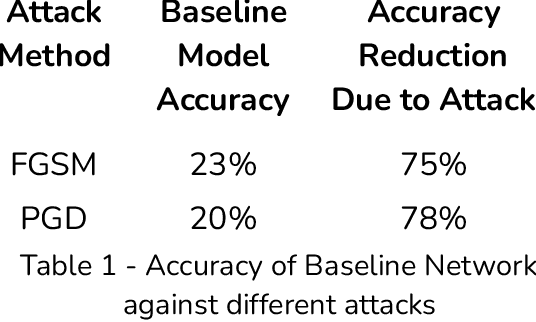


From face recognition systems installed in phones to self-driving cars, the field of AI is witnessing rapid transformations and is being integrated into our everyday lives at an incredible pace. Any major failure in these system's predictions could be devastating, leaking sensitive information or even costing lives (as in the case of self-driving cars). However, deep neural networks, which form the basis of such systems, are highly susceptible to a specific type of attack, called adversarial attacks. A hacker can, even with bare minimum computation, generate adversarial examples (images or data points that belong to another class, but consistently fool the model to get misclassified as genuine) and crumble the basis of such algorithms. In this paper, we compile and test numerous approaches to defend against such adversarial attacks. Out of the ones explored, we found two effective techniques, namely Dropout and Denoising Autoencoders, and show their success in preventing such attacks from fooling the model. We demonstrate that these techniques are also resistant to both higher noise levels as well as different kinds of adversarial attacks (although not tested against all). We also develop a framework for deciding the suitable defense technique to use against attacks, based on the nature of the application and resource constraints of the Deep Neural Network.