 Add to Chrome
 Add to Firefox
 Add to Edge
Diff-DDoS: Realistic Cyber-Physical Attack Synthesis and Robust Detection for 5G-Enabled CPS Using Tabular Diffusion Models
Aug 18, 2026
Deep learning-based DDoS detectors for 5G-enabled cyber-physical systems face scarce labeled attack data and unrealistic synthetic substitutes, which limit robustness against adaptive adversaries. Detectors trained on hand-crafted attacks with fixed scaling multipliers degrade catastrophically (F1-score drops of about 47 percent to 100 percent, depending on scenario) when confronted with realistic, distribution-preserving samples. We propose Diff-DDoS, a three-phase framework for realistic attack synthesis and robust detection using tabular diffusion models. Phase 1 trains a baseline CNN cell-level detector on spatiotemporal grids from call detail records (CDRs). Phase 2 trains a tabular denoising diffusion probabilistic model (TabDDPM) on normal CDR aggregates to generate realistic attacks and expose detector vulnerabilities. Phase 3 introduces adversarial diffusion training (ADT), using inverse classifier guidance to generate hard yet distribution-preserving samples until the detector converges. On a Milano CDR dataset across SMS-flooding, silent-call, Internet-signaling, and blended scenarios, ResNet50 with ADT recovers F1-scores of 79.62 percent (silent-call), 100 percent (Internet), and 92.79 percent (blended). After validation-based threshold calibration, ADT reaches 100 percent SMS F1 versus 47.3 percent for CTGAN, and matches the strongest gradient-based adversarial-training baseline on silent-call. These results support tabular diffusion models for stress-testing and hardening intrusion detectors in data-scarce 5G cyber-physical deployments.

AI-Native Closed-Loop Security for 6G-Enabled Cyber-Physical Systems: From Edge Detection to Network-Wide Mitigation
Jun 06, 2026In sixth-generation (6G) networks, billions of cyber-physical systems (CPSs) - autonomous vehicles, smart grids, industrial robots, and remote-surgical equipment - will run over ultra-reliable low-latency slices, collapsing the gap between a remote breach and physical harm to milliseconds, a budget perimeter firewalls and centralised security operations centres cannot meet. This survey reframes 6G CPS security as a closed-loop, AI-native pipeline that senses at the multi-access edge computing (MEC) tier, using minute-scale call-detail records (CDRs) for baseline learning and sub-millisecond RAN/Open-RAN (O-RAN) telemetry for the latency-critical path. It decides locally with compressed deep models, mitigates network-wide via SDN, NFV, and O-RAN controllers, and retrains through federated learning (FL) and digital-twin (DT) replay. We formalise a per-slice, tail-bounded latency contract on the sense, detect, and mitigate stages, enforced at a slice-dependent tail percentile (p99 for safety-critical URLLC slices). Organising 128 peer-reviewed studies (2017-2026) under a PRISMA 2020 protocol, we (i) map the 6G/CPS threat surface to MITRE ATT&CK and a CDR-observable feature space; (ii) unify edge anomaly detection and DDoS classification across twelve datasets and statistical, graph, and transformer models; (iii) synthesise SDN/NFV/O-RAN primitives into one closed-loop reference architecture; (iv) treat FL, large language models (LLMs), DT, post-quantum cryptography (PQC), zero-trust architecture (ZTA), and explainable AI as cross-cutting enablers, not parallel pillars; and (v) consolidate open problems into five directions spanning data, latency, trust, standardisation, and evaluation.
An Image captioning algorithm based on the Hybrid Deep Learning Technique
Jan 06, 2023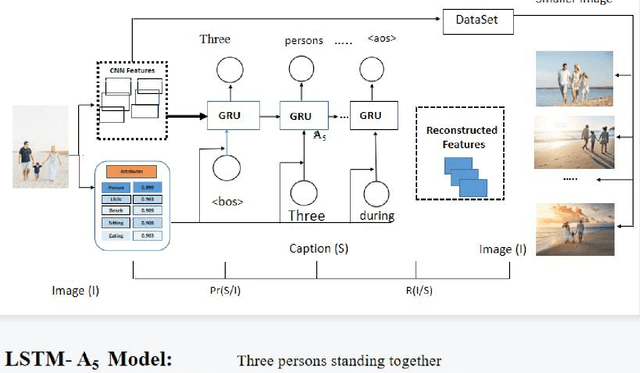
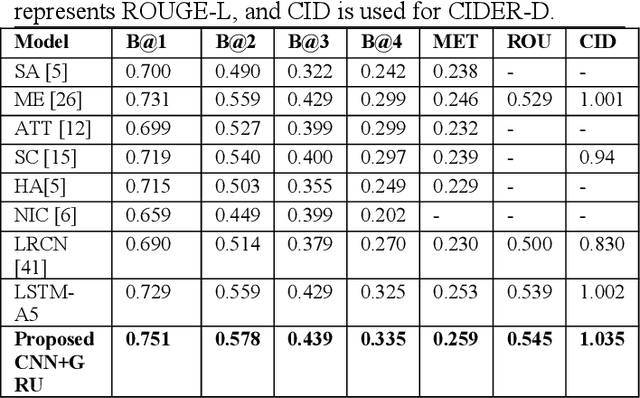
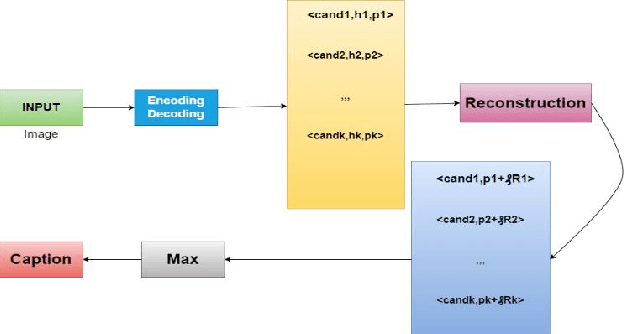
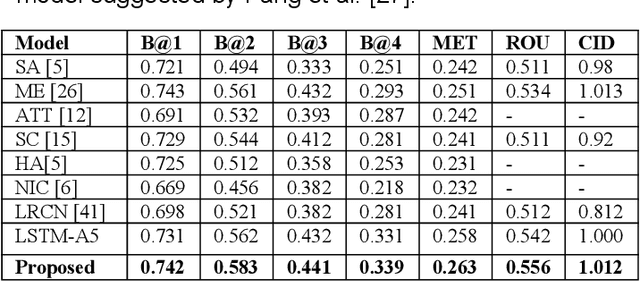
Image captioning by the encoder-decoder framework has shown tremendous advancement in the last decade where CNN is mainly used as encoder and LSTM is used as a decoder. Despite such an impressive achievement in terms of accuracy in simple images, it lacks in terms of time complexity and space complexity efficiency. In addition to this, in case of complex images with a lot of information and objects, the performance of this CNN-LSTM pair downgraded exponentially due to the lack of semantic understanding of the scenes presented in the images. Thus, to take these issues into consideration, we present CNN-GRU encoder decode framework for caption-to-image reconstructor to handle the semantic context into consideration as well as the time complexity. By taking the hidden states of the decoder into consideration, the input image and its similar semantic representations is reconstructed and reconstruction scores from a semantic reconstructor are used in conjunction with likelihood during model training to assess the quality of the generated caption. As a result, the decoder receives improved semantic information, enhancing the caption production process. During model testing, combining the reconstruction score and the log-likelihood is also feasible to choose the most appropriate caption. The suggested model outperforms the state-of-the-art LSTM-A5 model for picture captioning in terms of time complexity and accuracy.