 Add to Chrome
 Add to Firefox
 Add to Edge
World Narrative Model for Highly Controllable Video Generation: A Paradigm Shift from Pixel Sampling to Physical World Orchestration
Jun 30, 2026
The fundamental obstacle to industrial grade video generation is the lack of controllability: existing models treat video as a pixel distribution sampling problem, bypassing the explicit, instance level $4D$ $(3D + T)$ physical world. Consequently, content creators cannot specify geometry, motion, camera parameters, or lighting in a deterministic, quantitative way, leading to the infamous ''gacha'' loop that makes professional content creation prohibitively inefficient and expensive. To address this, we introduce the World Narrative Model (WNM), a paradigm that decouples what to render -- the structured physical narrative -- from how to render -- the pixel generation process. WNM replaces end-to-end black-box sampling with orchestrated $4D$ pre-visualization for media generation. Collaborative agents translate sparse multimodal inputs, including text, reference videos, and sketches, into a fully editable world representation with scene geometry, object layouts, character/animal skeleton motion, trajectories, camera motion, and lighting at quantitative, physically meaningful granularity. This representation acts as a deterministic structural blueprint that drives existing video foundation models, either frozen or lightly adapted, to render final footage, turning the base model into a faithful neural shader. Built on this engine, our human-AI platform supports automatic world generation and pre-visualization aligned with professional filmmaking pipelines, while director consoles enable seamless human refinement. Experiments show that WNM greatly reduces probabilistic ``gacha'' calls and produces videos whose layout, motion, and cinematography closely follow creator intent. The framework is open and modular, allowing each component, such as world representation, control agents, and adapters, to be independently improved. Project website: https://glassroom.sjtu.edu.cn/WNM/.

CartoonRenderer: An Instance-based Multi-Style Cartoon Image Translator
Nov 14, 2019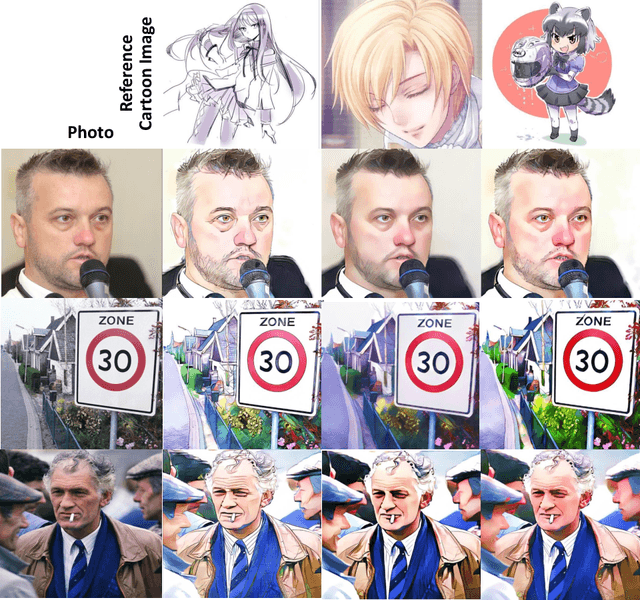
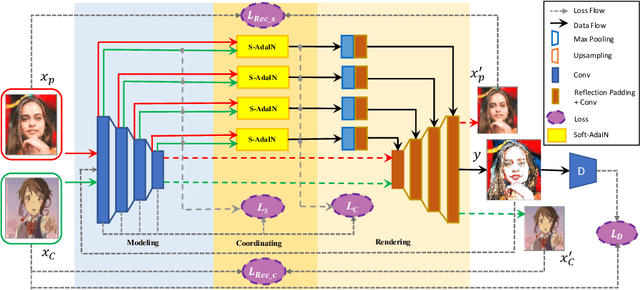
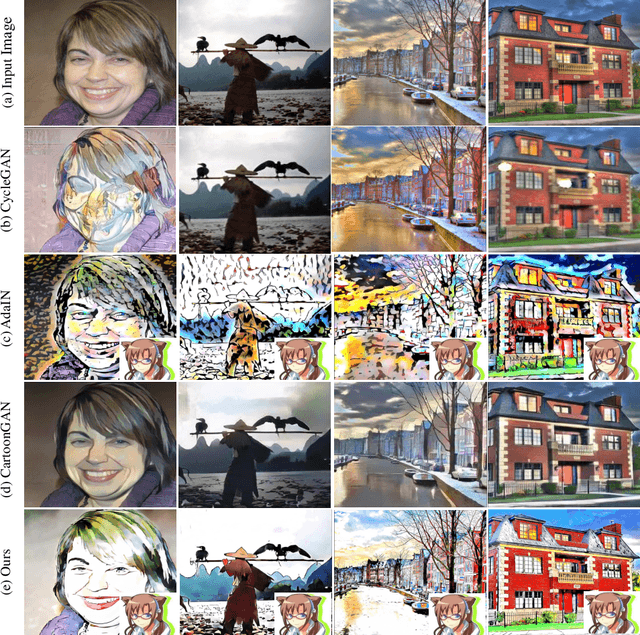
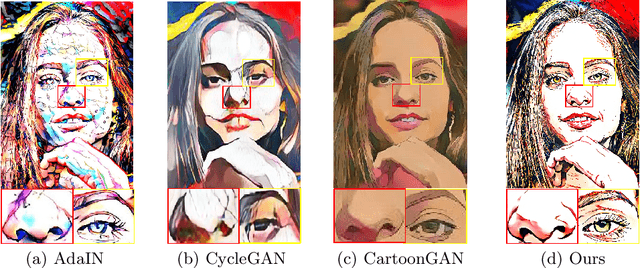
Instance based photo cartoonization is one of the challenging image stylization tasks which aim at transforming realistic photos into cartoon style images while preserving the semantic contents of the photos. State-of-the-art Deep Neural Networks (DNNs) methods still fail to produce satisfactory results with input photos in the wild, especially for photos which have high contrast and full of rich textures. This is due to that: cartoon style images tend to have smooth color regions and emphasized edges which are contradict to realistic photos which require clear semantic contents, i.e., textures, shapes etc. Previous methods have difficulty in satisfying cartoon style textures and preserving semantic contents at the same time. In this work, we propose a novel "CartoonRenderer" framework which utilizing a single trained model to generate multiple cartoon styles. In a nutshell, our method maps photo into a feature model and renders the feature model back into image space. In particular, cartoonization is achieved by conducting some transformation manipulation in the feature space with our proposed Soft-AdaIN. Extensive experimental results show our method produces higher quality cartoon style images than prior arts, with accurate semantic content preservation. In addition, due to the decoupling of whole generating process into "Modeling-Coordinating-Rendering" parts, our method could easily process higher resolution photos, which is intractable for existing methods.