 Add to Chrome
 Add to Firefox
 Add to Edge
An engine not a camera: Measuring performative power of online search
May 29, 2024
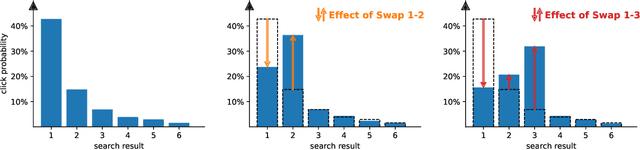
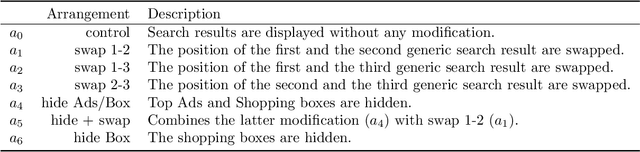
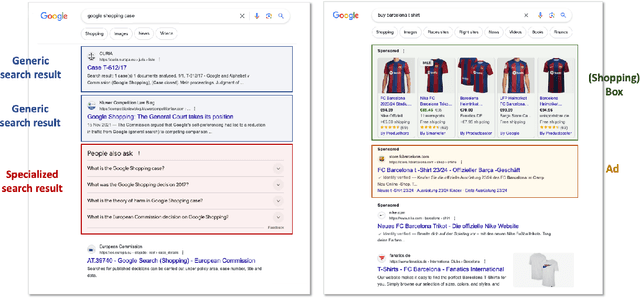
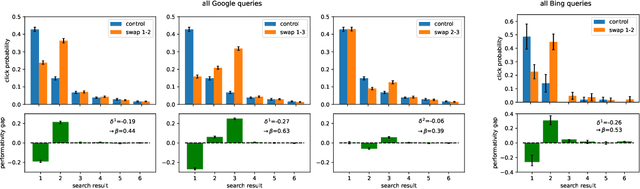
The power of digital platforms is at the center of major ongoing policy and regulatory efforts. To advance existing debates, we designed and executed an experiment to measure the power of online search providers, building on the recent definition of performative power. Instantiated in our setting, performative power quantifies the ability of a search engine to steer web traffic by rearranging results. To operationalize this definition we developed a browser extension that performs unassuming randomized experiments in the background. These randomized experiments emulate updates to the search algorithm and identify the causal effect of different content arrangements on clicks. We formally relate these causal effects to performative power. Analyzing tens of thousands of clicks, we discuss what our robust quantitative findings say about the power of online search engines. More broadly, we envision our work to serve as a blueprint for how performative power and online experiments can be integrated with future investigations into the economic power of digital platforms.

Inherent Trade-Offs between Diversity and Stability in Multi-Task Benchmarks
May 06, 2024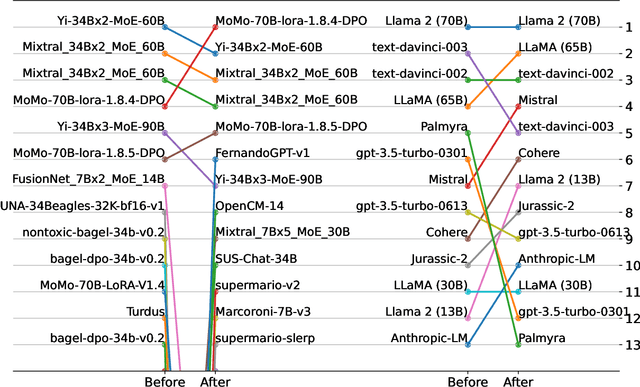
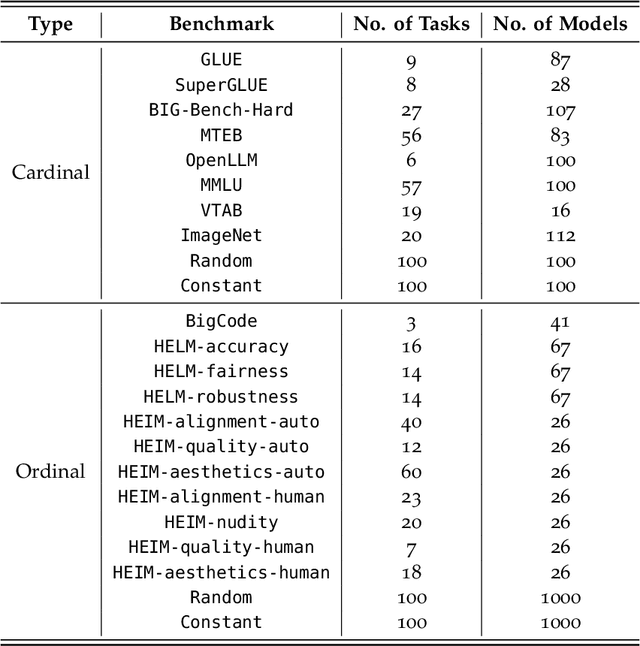
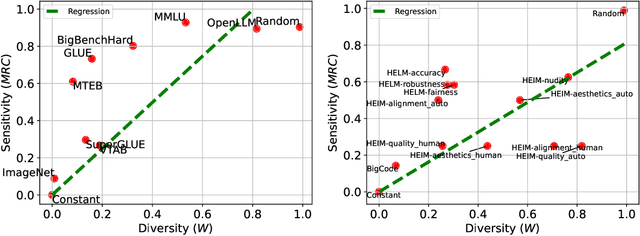
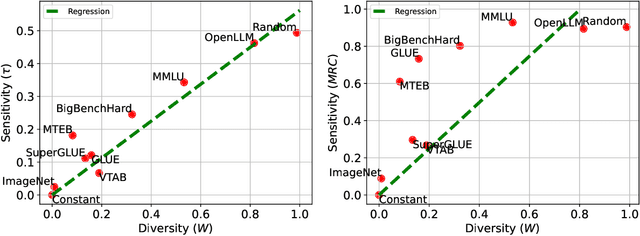
We examine multi-task benchmarks in machine learning through the lens of social choice theory. We draw an analogy between benchmarks and electoral systems, where models are candidates and tasks are voters. This suggests a distinction between cardinal and ordinal benchmark systems. The former aggregate numerical scores into one model ranking; the latter aggregate rankings for each task. We apply Arrow's impossibility theorem to ordinal benchmarks to highlight the inherent limitations of ordinal systems, particularly their sensitivity to the inclusion of irrelevant models. Inspired by Arrow's theorem, we empirically demonstrate a strong trade-off between diversity and sensitivity to irrelevant changes in existing multi-task benchmarks. Our result is based on new quantitative measures of diversity and sensitivity that we introduce. Sensitivity quantifies the impact that irrelevant changes to tasks have on a benchmark. Diversity captures the degree of disagreement in model rankings across tasks. We develop efficient approximation algorithms for both measures, as exact computation is computationally challenging. Through extensive experiments on seven cardinal benchmarks and eleven ordinal benchmarks, we demonstrate a clear trade-off between diversity and stability: The more diverse a multi-task benchmark, the more sensitive to trivial changes it is. Additionally, we show that the aggregated rankings of existing benchmarks are highly unstable under irrelevant changes. The codes and data are available at https://socialfoundations.github.io/benchbench/.
ImageNot: A contrast with ImageNet preserves model rankings
Apr 02, 2024We introduce ImageNot, a dataset designed to match the scale of ImageNet while differing drastically in other aspects. We show that key model architectures developed for ImageNet over the years rank identically when trained and evaluated on ImageNot to how they rank on ImageNet. This is true when training models from scratch or fine-tuning them. Moreover, the relative improvements of each model over earlier models strongly correlate in both datasets. We further give evidence that ImageNot has a similar utility as ImageNet for transfer learning purposes. Our work demonstrates a surprising degree of external validity in the relative performance of image classification models. This stands in contrast with absolute accuracy numbers that typically drop sharply even under small changes to a dataset.
Predictors from causal features do not generalize better to new domains
Feb 15, 2024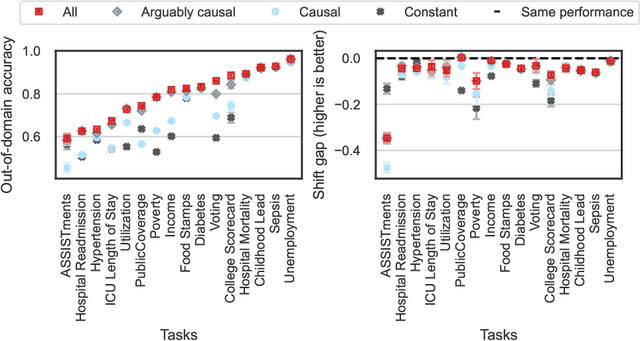
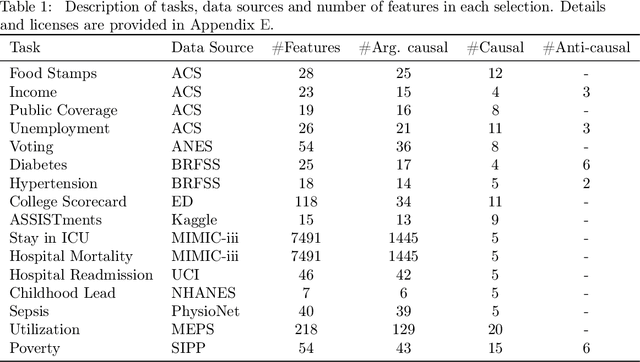
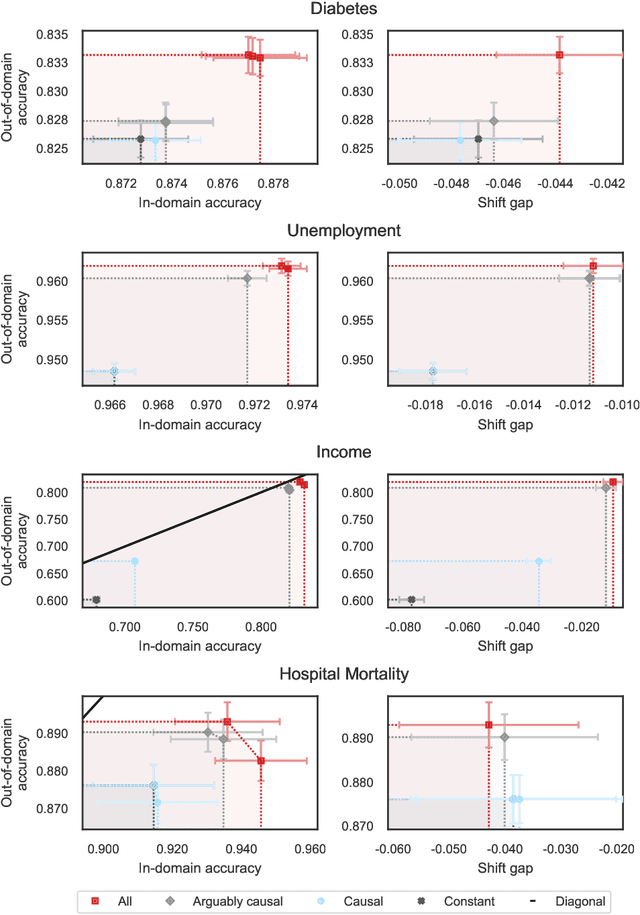
We study how well machine learning models trained on causal features generalize across domains. We consider 16 prediction tasks on tabular datasets covering applications in health, employment, education, social benefits, and politics. Each dataset comes with multiple domains, allowing us to test how well a model trained in one domain performs in another. For each prediction task, we select features that have a causal influence on the target of prediction. Our goal is to test the hypothesis that models trained on causal features generalize better across domains. Without exception, we find that predictors using all available features, regardless of causality, have better in-domain and out-of-domain accuracy than predictors using causal features. Moreover, even the absolute drop in accuracy from one domain to the other is no better for causal predictors than for models that use all features. If the goal is to generalize to new domains, practitioners might as well train the best possible model on all available features.
Don't Label Twice: Quantity Beats Quality when Comparing Binary Classifiers on a Budget
Feb 03, 2024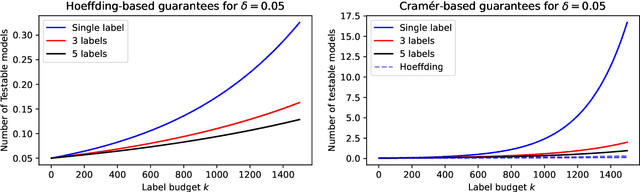
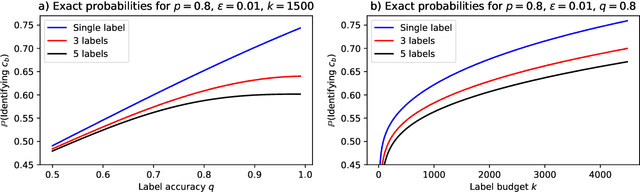
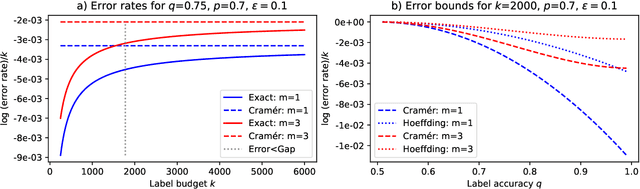
We study how to best spend a budget of noisy labels to compare the accuracy of two binary classifiers. It's common practice to collect and aggregate multiple noisy labels for a given data point into a less noisy label via a majority vote. We prove a theorem that runs counter to conventional wisdom. If the goal is to identify the better of two classifiers, we show it's best to spend the budget on collecting a single label for more samples. Our result follows from a non-trivial application of Cram\'er's theorem, a staple in the theory of large deviations. We discuss the implications of our work for the design of machine learning benchmarks, where they overturn some time-honored recommendations. In addition, our results provide sample size bounds superior to what follows from Hoeffding's bound.
Performative Prediction: Past and Future
Oct 25, 2023Predictions in the social world generally influence the target of prediction, a phenomenon known as performativity. Self-fulfilling and self-negating predictions are examples of performativity. Of fundamental importance to economics, finance, and the social sciences, the notion has been absent from the development of machine learning. In machine learning applications, performativity often surfaces as distribution shift. A predictive model deployed on a digital platform, for example, influences consumption and thereby changes the data-generating distribution. We survey the recently founded area of performative prediction that provides a definition and conceptual framework to study performativity in machine learning. A consequence of performative prediction is a natural equilibrium notion that gives rise to new optimization challenges. Another consequence is a distinction between learning and steering, two mechanisms at play in performative prediction. The notion of steering is in turn intimately related to questions of power in digital markets. We review the notion of performative power that gives an answer to the question how much a platform can steer participants through its predictions. We end on a discussion of future directions, such as the role that performativity plays in contesting algorithmic systems.
What Makes ImageNet Look Unlike LAION
Jun 27, 2023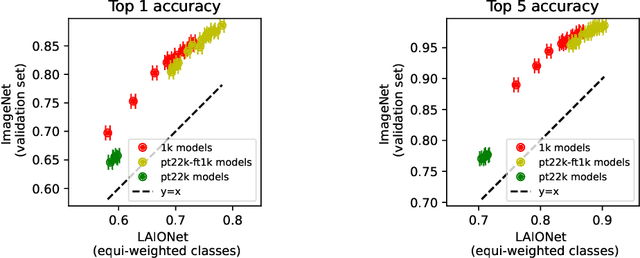
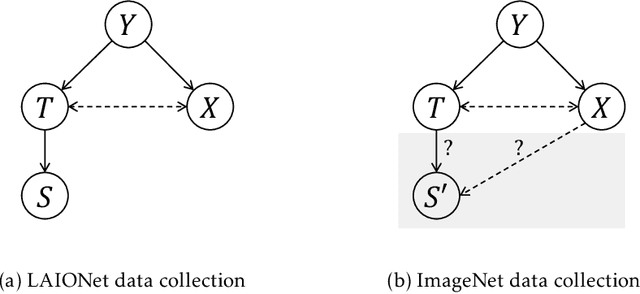
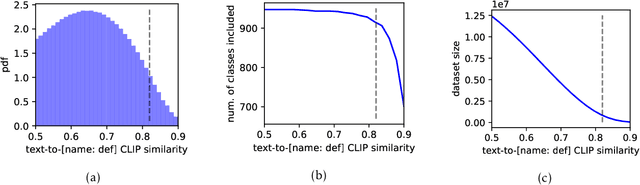
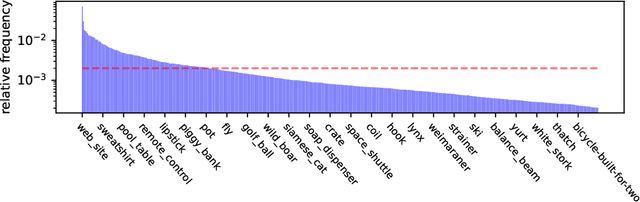
ImageNet was famously created from Flickr image search results. What if we recreated ImageNet instead by searching the massive LAION dataset based on image captions alone? In this work, we carry out this counterfactual investigation. We find that the resulting ImageNet recreation, which we call LAIONet, looks distinctly unlike the original. Specifically, the intra-class similarity of images in the original ImageNet is dramatically higher than it is for LAIONet. Consequently, models trained on ImageNet perform significantly worse on LAIONet. We propose a rigorous explanation for the discrepancy in terms of a subtle, yet important, difference in two plausible causal data-generating processes for the respective datasets, that we support with systematic experimentation. In a nutshell, searching based on an image caption alone creates an information bottleneck that mitigates the selection bias otherwise present in image-based filtering. Our explanation formalizes a long-held intuition in the community that ImageNet images are stereotypical, unnatural, and overly simple representations of the class category. At the same time, it provides a simple and actionable takeaway for future dataset creation efforts.
Unprocessing Seven Years of Algorithmic Fairness
Jun 15, 2023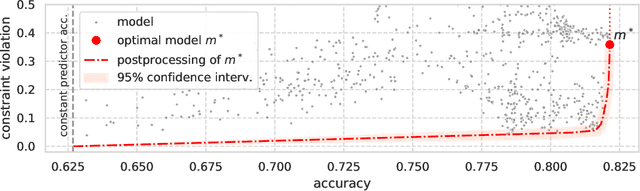
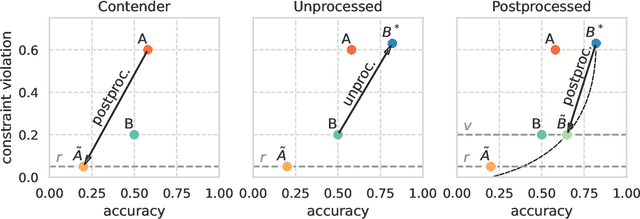
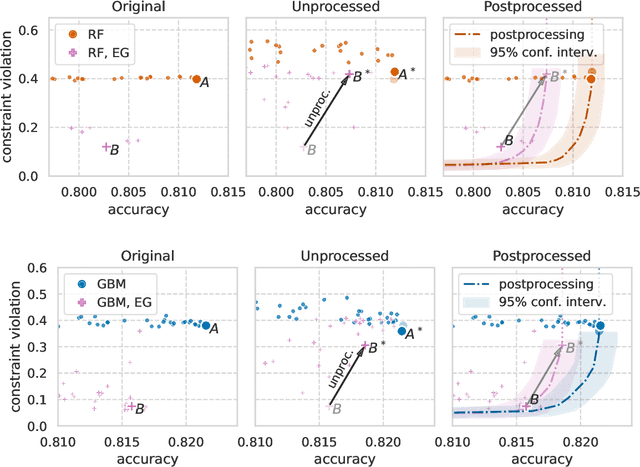
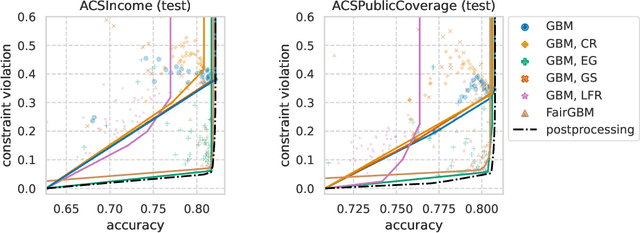
Seven years ago, researchers proposed a postprocessing method to equalize the error rates of a model across different demographic groups. The work launched hundreds of papers purporting to improve over the postprocessing baseline. We empirically evaluate these claims through thousands of model evaluations on several tabular datasets. We find that the fairness-accuracy Pareto frontier achieved by postprocessing contains all other methods we were feasibly able to evaluate. In doing so, we address two common methodological errors that have confounded previous observations. One relates to the comparison of methods with different unconstrained base models. The other concerns methods achieving different levels of constraint relaxation. At the heart of our study is a simple idea we call unprocessing that roughly corresponds to the inverse of postprocessing. Unprocessing allows for a direct comparison of methods using different underlying models and levels of relaxation. Interpreting our findings, we recall a widely overlooked theoretical argument, present seven years ago, that accurately predicted what we observe.
Questioning the Survey Responses of Large Language Models
Jun 13, 2023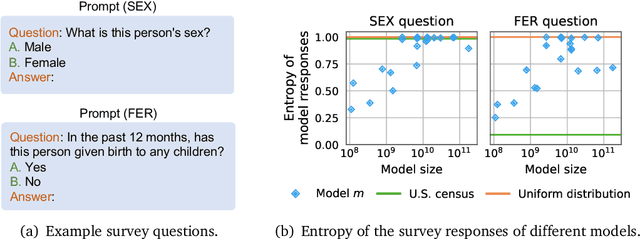
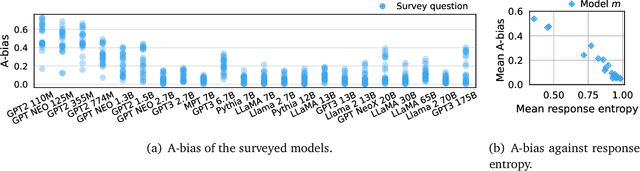


As large language models increase in capability, researchers have started to conduct surveys of all kinds on these models with varying scientific motivations. In this work, we examine what we can learn from a model's survey responses on the basis of the well-established American Community Survey (ACS) by the U.S. Census Bureau. Evaluating more than a dozen different models, varying in size from a few hundred million to ten billion parameters, hundreds of thousands of times each on questions from the ACS, we systematically establish two dominant patterns. First, smaller models have a significant position and labeling bias, for example, towards survey responses labeled with the letter "A". This A-bias diminishes, albeit slowly, as model size increases. Second, when adjusting for this labeling bias through randomized answer ordering, models still do not trend toward US population statistics or those of any cognizable population. Rather, models across the board trend toward uniformly random aggregate statistics over survey responses. This pattern is robust to various different ways of prompting the model, including what is the de-facto standard. Our findings demonstrate that aggregate statistics of a language model's survey responses lack the signals found in human populations. This absence of statistical signal cautions about the use of survey responses from large language models at present time.
Test-Time Training on Nearest Neighbors for Large Language Models
Jun 07, 2023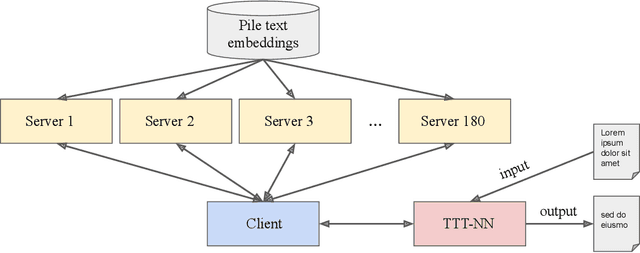
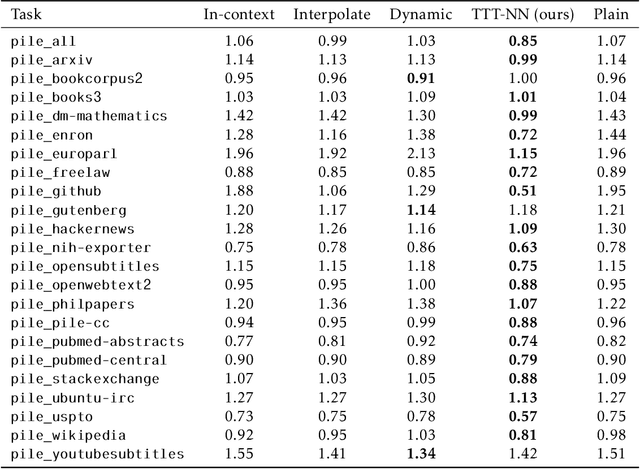
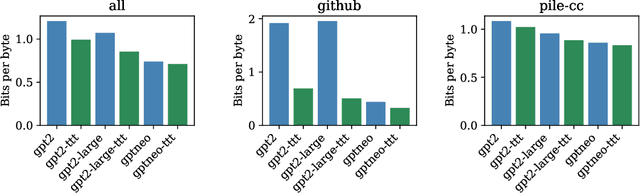

Many recent efforts aim to augment language models with relevant information retrieved from a database at test time. We avoid the need for prompt engineering by directly fine-tuning the model on data retrieved at test time using its standard training setup. For this purpose, we build a large-scale distributed nearest neighbor index based on text embeddings of the Pile dataset. Given a query to a language model, our system retrieves the neighbors of the query and fine-tunes the model on the text data corresponding to those neighbors. Surprisingly, retrieving and training on as few as 20 neighbors, each for only one gradient iteration, drastically improves performance across more than twenty language modeling tasks in the Pile benchmark. For example, test-time training significantly narrows the performance gap between a small GPT2 model and a GPTNeo model, more than ten times larger, that was specifically trained to convergence on the Pile. Sufficient index quality and size, however, are important. Our work establishes a valuable first baseline for implementing test-time training in the context of large language models, opening the door to numerous promising research avenues.