 Add to Chrome
 Add to Firefox
 Add to Edge
PAKE: Learning Whole-Body Loco-Manipulation with Partial Kinematic Embeddings
Jul 13, 2026
Loco-manipulation has recently shown promising capabilities; however, achieving high-precision control, managing the high-dimensional action space induced by many degrees of freedom (DoFs), and fully exploiting the inherent redundancy of whole-body systems remain challenging. In this paper, we propose a novel whole-body control framework that effectively addresses these challenges by decomposing the complex loco-manipulation problem into partial reference motion generation and low-level imitation control. We introduce a new Kinematic Normalizing Flow (KNF) model, trained on a large-scale kinematic dataset, that generates diverse yet feasible partial reference motions. A high-level controller is then trained to navigate the KNF's latent space to exploit redundant solutions, while a low-level controller ensures physically feasible and accurate motion execution. We validate our approach on the quadrupedal robot equipped with a six-DoF robotic arm. In simulation, experimental results show that our approach significantly outperforms state-of-the-art methods in terms of tracking accuracy and feasible workspace coverage. For hardware deployment, we evaluate the system over 24 episodes across 8 different mobile loco-manipulation tasks. The system achieves end-effector pose-tracking errors of 4.5 cm and 0.14 rad, while maintaining accurate locomotion tracking with linear and angular velocity errors of 0.1 m/s and 0.01 rad/s, respectively, outperforming competitive baselines. Our method represents a practical and powerful solution for accurate and generalized whole-body loco-manipulation in high-DoF robotic systems, with promising potential for diverse downstream robotic tasks.

Learning Whole-body Manipulation for Quadrupedal Robot
Sep 06, 2023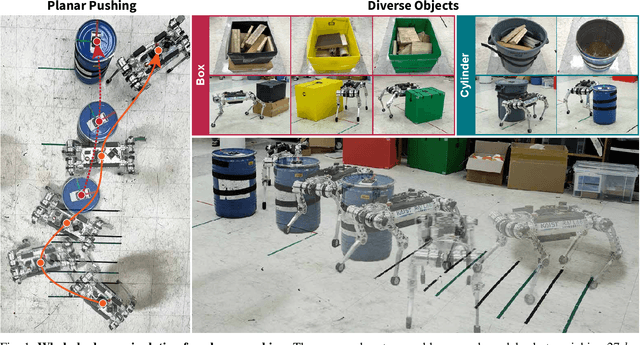
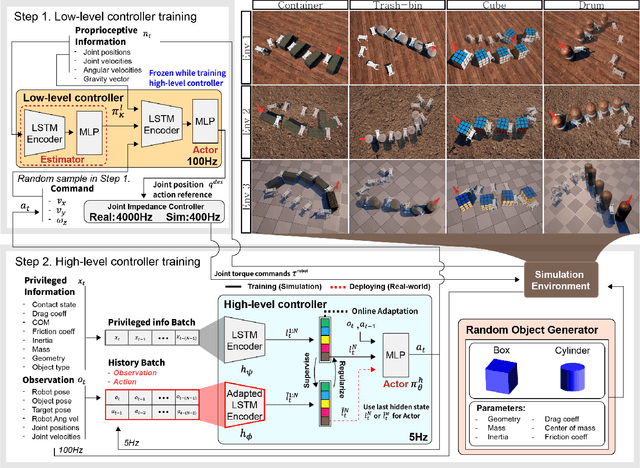
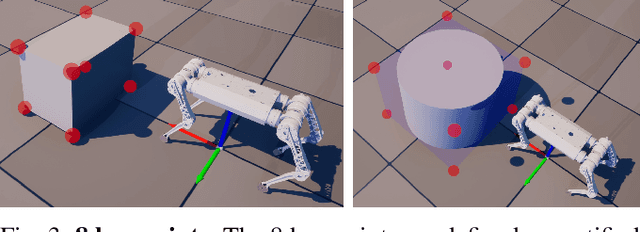
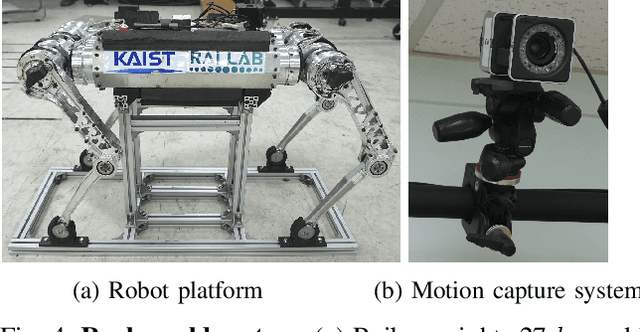
We propose a learning-based system for enabling quadrupedal robots to manipulate large, heavy objects using their whole body. Our system is based on a hierarchical control strategy that uses the deep latent variable embedding which captures manipulation-relevant information from interactions, proprioception, and action history, allowing the robot to implicitly understand object properties. We evaluate our framework in both simulation and real-world scenarios. In the simulation, it achieves a success rate of 93.6 % in accurately re-positioning and re-orienting various objects within a tolerance of 0.03 m and 5 {\deg}. Real-world experiments demonstrate the successful manipulation of objects such as a 19.2 kg water-filled drum and a 15.3 kg plastic box filled with heavy objects while the robot weighs 27 kg. Unlike previous works that focus on manipulating small and light objects using prehensile manipulation, our framework illustrates the possibility of using quadrupeds for manipulating large and heavy objects that are ungraspable with the robot's entire body. Our method does not require explicit object modeling and offers significant computational efficiency compared to optimization-based methods. The video can be found at https://youtu.be/fO_PVr27QxU.
Not Only Rewards But Also Constraints: Applications on Legged Robot Locomotion
Aug 24, 2023


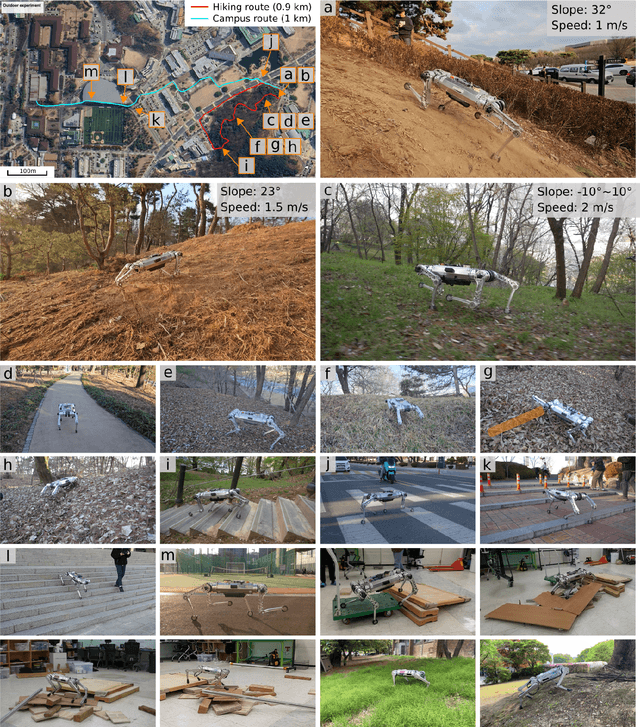
Several earlier studies have shown impressive control performance in complex robotic systems by designing the controller using a neural network and training it with model-free reinforcement learning. However, these outstanding controllers with natural motion style and high task performance are developed through extensive reward engineering, which is a highly laborious and time-consuming process of designing numerous reward terms and determining suitable reward coefficients. In this work, we propose a novel reinforcement learning framework for training neural network controllers for complex robotic systems consisting of both rewards and constraints. To let the engineers appropriately reflect their intent to constraints and handle them with minimal computation overhead, two constraint types and an efficient policy optimization algorithm are suggested. The learning framework is applied to train locomotion controllers for several legged robots with different morphology and physical attributes to traverse challenging terrains. Extensive simulation and real-world experiments demonstrate that performant controllers can be trained with significantly less reward engineering, by tuning only a single reward coefficient. Furthermore, a more straightforward and intuitive engineering process can be utilized, thanks to the interpretability and generalizability of constraints. The summary video is available at https://youtu.be/KAlm3yskhvM.