 Add to Chrome
 Add to Firefox
 Add to Edge
Beyond Global Editing: Per-Instance Disentangled Subspaces for Training-Free Hallucination Mitigation in LVLMs
Aug 10, 2026
Recent advances in large vision-language models (LVLMs) have enabled powerful multimodal reasoning by integrating visual encoders with large language models (LLMs). However, their reliability is frequently undermined by hallucinations, where generated text inaccurately describes the visual input. Although fine-tuning can mitigate this problem, it is computationally expensive and requires large, curated datasets, making training-free alternatives attractive. Among these, model editing is more promising than decoding-based approaches: decoding methods adapt outputs per input but introduce computational overhead and instability, whereas model editing modifies internal representations offline, providing a more efficient and stable solution. However, existing model-editing techniques typically rely on a single global subspace to correct hallucinations, treating all test samples identically and failing to capture diverse hallucination modes across inputs. To address this limitation, we propose a training-free hallucination mitigation framework for dynamic, per-instance suppression at test time. Our method first constructs a set of Disentangled Hallucination Subspaces, each isolating a distinct hallucination mode. During inference, the model adaptively calculates weights reflecting each input's relationship to these subspaces, guiding a dynamically combined projection that selectively suppresses the most probable hallucination directions while preserving image-grounded semantics. Extensive experiments across multiple vision-language benchmarks and LVLM families demonstrate consistent improvements, highlighting the robustness, generalizability, and efficiency of our approach.

RVD: A Handheld Device-Based Fundus Video Dataset for Retinal Vessel Segmentation
Jul 13, 2023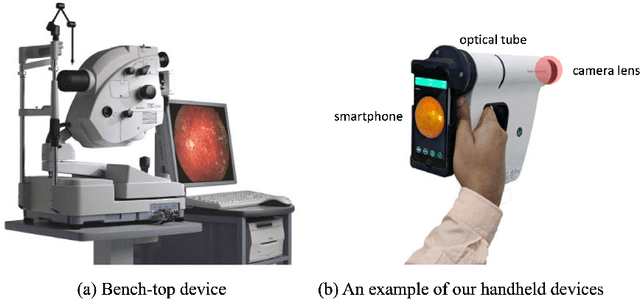
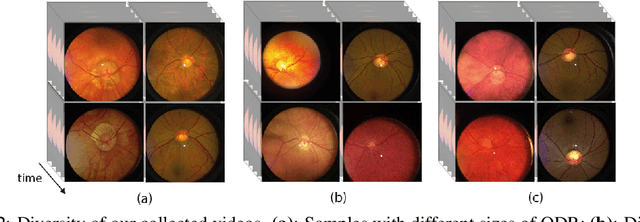
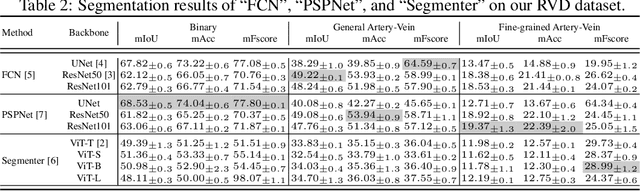

Retinal vessel segmentation is generally grounded in image-based datasets collected with bench-top devices. The static images naturally lose the dynamic characteristics of retina fluctuation, resulting in diminished dataset richness, and the usage of bench-top devices further restricts dataset scalability due to its limited accessibility. Considering these limitations, we introduce the first video-based retinal dataset by employing handheld devices for data acquisition. The dataset comprises 635 smartphone-based fundus videos collected from four different clinics, involving 415 patients from 50 to 75 years old. It delivers comprehensive and precise annotations of retinal structures in both spatial and temporal dimensions, aiming to advance the landscape of vasculature segmentation. Specifically, the dataset provides three levels of spatial annotations: binary vessel masks for overall retinal structure delineation, general vein-artery masks for distinguishing the vein and artery, and fine-grained vein-artery masks for further characterizing the granularities of each artery and vein. In addition, the dataset offers temporal annotations that capture the vessel pulsation characteristics, assisting in detecting ocular diseases that require fine-grained recognition of hemodynamic fluctuation. In application, our dataset exhibits a significant domain shift with respect to data captured by bench-top devices, thus posing great challenges to existing methods. In the experiments, we provide evaluation metrics and benchmark results on our dataset, reflecting both the potential and challenges it offers for vessel segmentation tasks. We hope this challenging dataset would significantly contribute to the development of eye disease diagnosis and early prevention.