 Add to Chrome
 Add to Firefox
 Add to Edge
S-SONDO: Self-Supervised Knowledge Distillation for General Audio Foundation Models
Apr 27, 2026
General audio foundation models have recently achieved remarkable progress, enabling strong performance across diverse tasks. However, state-of-the-art models remain extremely large, often with hundreds of millions of parameters, leading to high inference costs and limited deployability on edge devices. Knowledge distillation is a proven strategy for model compression, but prior work in audio has mostly focused on supervised settings, relying on class logits, intermediate features, or architecture-specific techniques. Such assumptions exclude models that output only embeddings, such as self-supervised or metric-learning models. We introduce S-SONDO (Self-Supervised KnOwledge DistillatioN for General AuDio FOundation Models), the first framework to distill general audio models using only their output embeddings. By avoiding the need for logits or layer-level alignment, S-SONDO is architecture-agnostic and broadly applicable to embedding-based teachers. We demonstrate its effectiveness by distilling two audio foundation models into three efficient students that are up to 61 times smaller while retaining up to 96% of teacher performance. We also provide practical insights on loss choice and clustering-based balanced data sampling. Code is available here: https://github.com/MedAliAdlouni/ssondo.

Macroscopic Emission Modeling of Urban Traffic Using Probe Vehicle Data: A Machine Learning Approach
Nov 11, 2025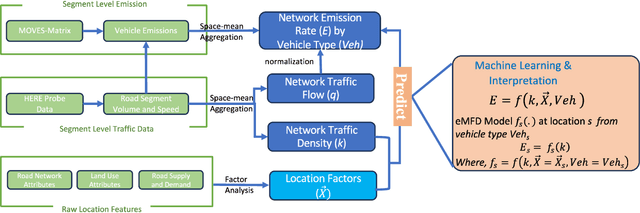
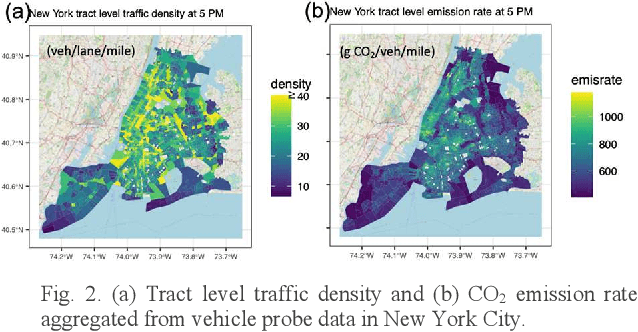
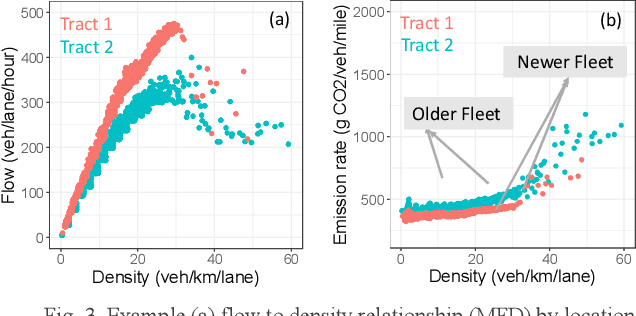
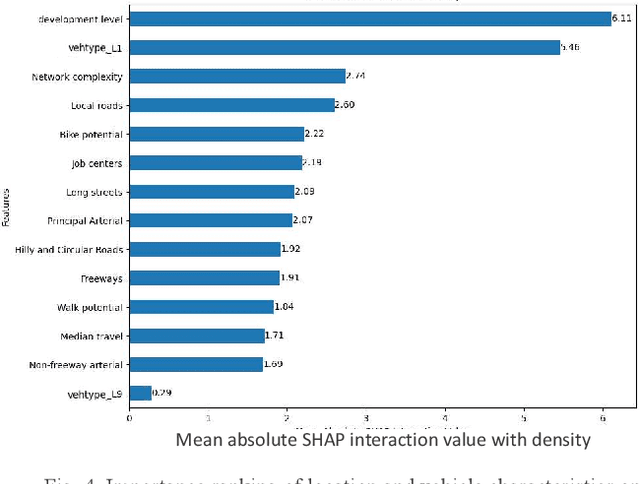
Urban congestions cause inefficient movement of vehicles and exacerbate greenhouse gas emissions and urban air pollution. Macroscopic emission fundamental diagram (eMFD)captures an orderly relationship among emission and aggregated traffic variables at the network level, allowing for real-time monitoring of region-wide emissions and optimal allocation of travel demand to existing networks, reducing urban congestion and associated emissions. However, empirically derived eMFD models are sparse due to historical data limitation. Leveraging a large-scale and granular traffic and emission data derived from probe vehicles, this study is the first to apply machine learning methods to predict the network wide emission rate to traffic relationship in U.S. urban areas at a large scale. The analysis framework and insights developed in this work generate data-driven eMFDs and a deeper understanding of their location dependence on network, infrastructure, land use, and vehicle characteristics, enabling transportation authorities to measure carbon emissions from urban transport of given travel demand and optimize location specific traffic management and planning decisions to mitigate network-wide emissions.