 Add to Chrome
 Add to Firefox
 Add to Edge
Macroscopic Emission Modeling of Urban Traffic Using Probe Vehicle Data: A Machine Learning Approach
Nov 11, 2025
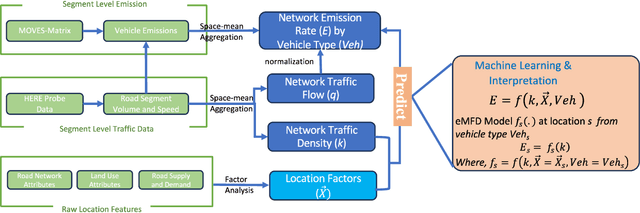
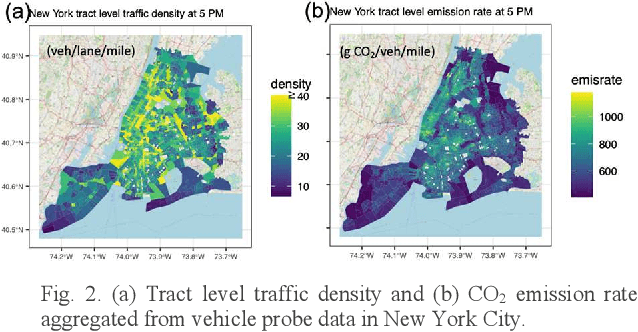
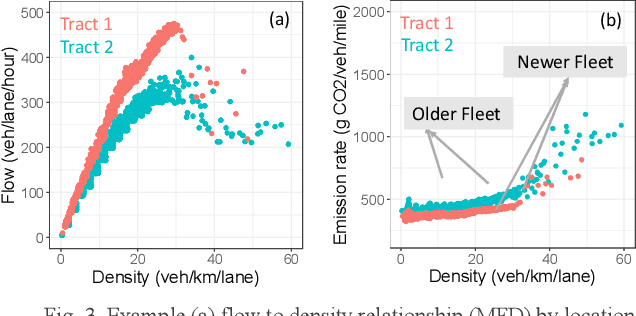
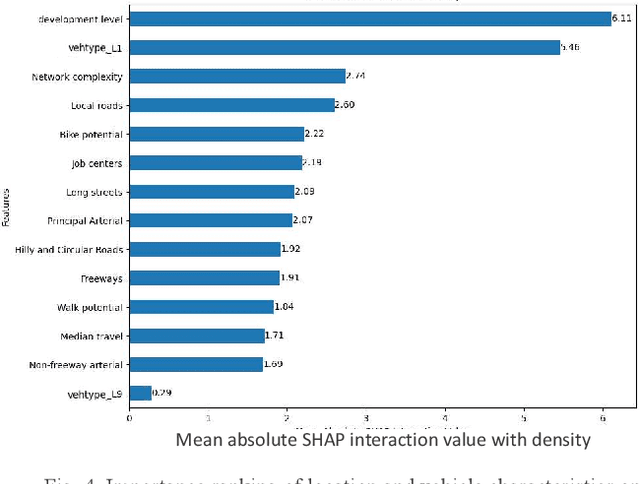
Urban congestions cause inefficient movement of vehicles and exacerbate greenhouse gas emissions and urban air pollution. Macroscopic emission fundamental diagram (eMFD)captures an orderly relationship among emission and aggregated traffic variables at the network level, allowing for real-time monitoring of region-wide emissions and optimal allocation of travel demand to existing networks, reducing urban congestion and associated emissions. However, empirically derived eMFD models are sparse due to historical data limitation. Leveraging a large-scale and granular traffic and emission data derived from probe vehicles, this study is the first to apply machine learning methods to predict the network wide emission rate to traffic relationship in U.S. urban areas at a large scale. The analysis framework and insights developed in this work generate data-driven eMFDs and a deeper understanding of their location dependence on network, infrastructure, land use, and vehicle characteristics, enabling transportation authorities to measure carbon emissions from urban transport of given travel demand and optimize location specific traffic management and planning decisions to mitigate network-wide emissions.

Scaling Graph Neural Networks for Particle Track Reconstruction
Apr 07, 2025Particle track reconstruction is an important problem in high-energy physics (HEP), necessary to study properties of subatomic particles. Traditional track reconstruction algorithms scale poorly with the number of particles within the accelerator. The Exa.TrkX project, to alleviate this computational burden, introduces a pipeline that reduces particle track reconstruction to edge classification on a graph, and uses graph neural networks (GNNs) to produce particle tracks. However, this GNN-based approach is memory-prohibitive and skips graphs that would exceed GPU memory. We introduce improvements to the Exa.TrkX pipeline to train on samples of input particle graphs, and show that these improvements generalize to higher precision and recall. In addition, we adapt performance optimizations, introduced for GNN training, to fit our augmented Exa.TrkX pipeline. These optimizations provide a $2\times$ speedup over our baseline implementation in PyTorch Geometric.
A Language Model for Particle Tracking
Feb 14, 2024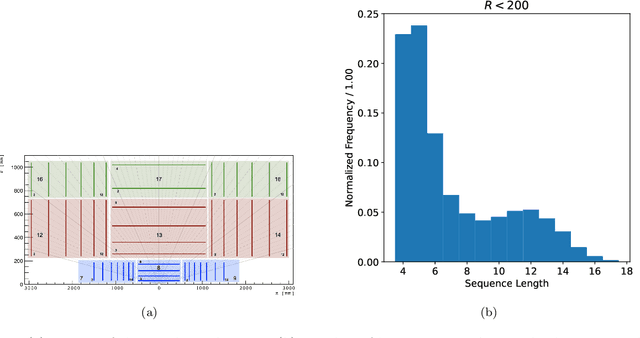

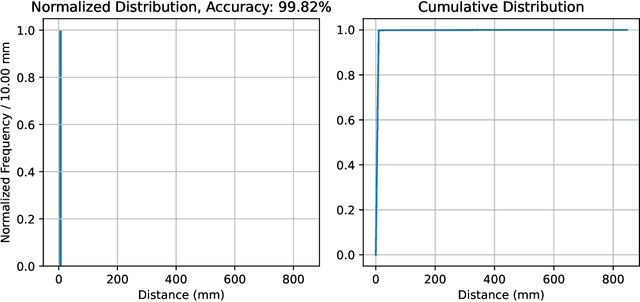
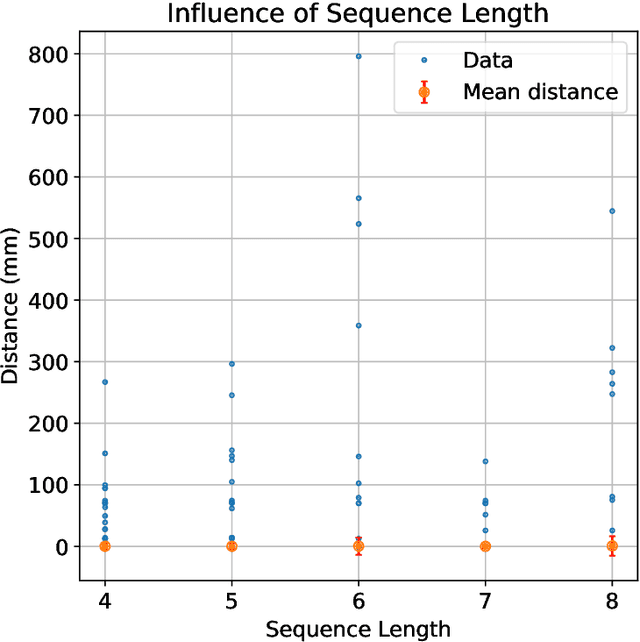
Particle tracking is crucial for almost all physics analysis programs at the Large Hadron Collider. Deep learning models are pervasively used in particle tracking related tasks. However, the current practice is to design and train one deep learning model for one task with supervised learning techniques. The trained models work well for tasks they are trained on but show no or little generalization capabilities. We propose to unify these models with a language model. In this paper, we present a tokenized detector representation that allows us to train a BERT model for particle tracking. The trained BERT model, namely TrackingBERT, offers latent detector module embedding that can be used for other tasks. This work represents the first step towards developing a foundational model for particle detector understanding.
Investigating Underlying Drivers of Variability in Residential Energy Usage Patterns with Daily Load Shape Clustering of Smart Meter Data
Feb 16, 2021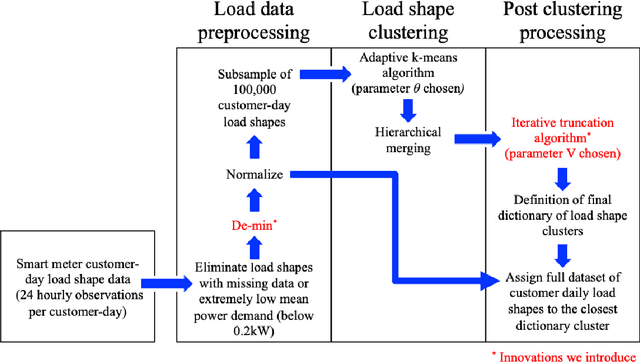
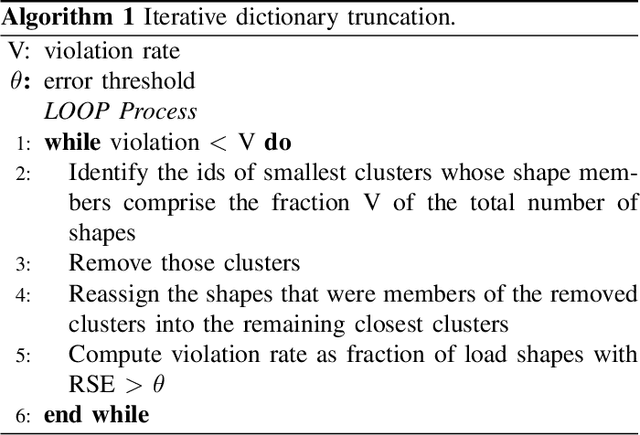
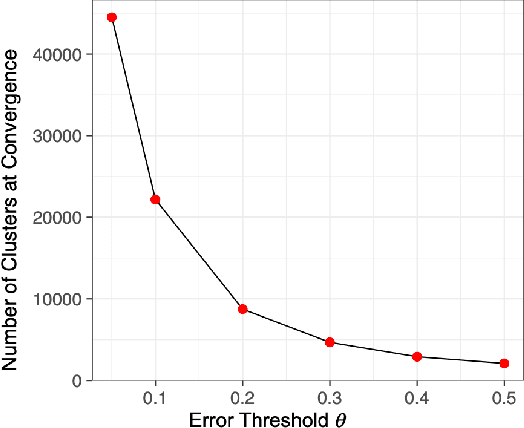
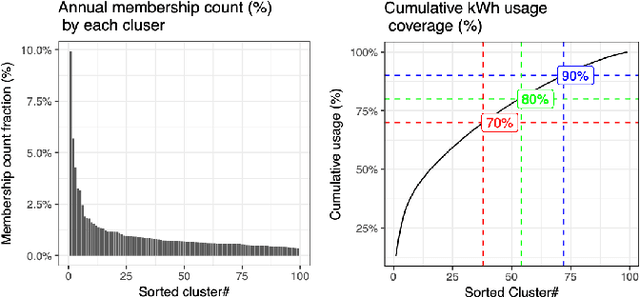
Residential customers have traditionally not been treated as individual entities due to the high volatility in residential consumption patterns as well as a historic focus on aggregated loads from the utility and system feeder perspective. Large-scale deployment of smart meters has motivated increasing studies to explore disaggregated daily load patterns, which can reveal important heterogeneity across different time scales, weather conditions, as well as within and across individual households. This paper aims to shed light on the mechanisms by which electricity consumption patterns exhibit variability and the different constraints that may affect demand-response (DR) flexibility. We systematically evaluate the relationship between daily time-of-use patterns and their variability to external and internal influencing factors, including time scales of interest, meteorological conditions, and household characteristics by application of an improved version of the adaptive K-means clustering method to profile "household-days" of a summer peaking utility. We find that for this summer-peaking utility, outdoor temperature is the most important external driver of the load shape variability relative to seasonality and day-of-week. The top three consumption patterns represent approximately 50% of usage on the highest temperature days. The variability in summer load shapes across customers can be explained by the responsiveness of the households to outside temperature. Our results suggest that depending on the influencing factors, not all the consumption variability can be readily translated to consumption flexibility. Such information needs to be further explored in segmenting customers for better program targeting and tailoring to meet the needs of the rapidly evolving electricity grid.