 Add to Chrome
 Add to Firefox
 Add to Edge
Transceiver Design for Cell-Free Unsourced Random Access
Aug 10, 2026
We propose a low-complexity, energy-efficient solution for cell-free unsourced random access (URA), in which multiple distributed access points are connected to a central processing unit via a fronthaul. Assuming that each user transmits a pilot sequence followed by a polar codeword whose symbols are placed to the data part of the frame according to an on-off pattern, we utilize iterative decoding, including orthogonal matching pursuit (OMP)-based pilot detection and channel estimation, symbol estimation using a linear minimum mean square error (MMSE) solution, symbol combining, single-user decoding, and successive interference cancellation (SIC). We also present finite blocklength (FBL) performance and detailed complexity analyses. Numerical results demonstrate that the FBL analysis properly characterizes system performance and that the proposed cell-free URA scheme offers superior performance compared to existing low-complexity schemes. Namely, it offers a superior performance of up to 4.5 dB and can accommodate up to 1800 active users.

Cluster-Aware Over-the-Air Federated Learning with Energy-Harvesting Devices: From Global Training to Model Personalization
Aug 02, 2026Federated learning (FL) enables distributed optimization and learning across decentralized edge devices while preserving data privacy, but its performance is fundamentally constrained by heterogeneous data distributions, limited communication resources, and energy availability. In practical wireless networks, mobile devices (MDs) often exhibit diverse data and learning objectives, naturally forming clusters of users with jointly trainable models. When devices rely on energy harvesting (EH), stochastic energy arrivals further complicate participation and scheduling under communication constraints. In this work, we study over-the-air (OTA) FL with EH MDs under heterogeneous data distributions, and investigate two closely related learning objectives within a unified framework: one aiming for a more representative global model by reducing data bias, and the other learning more personalized cluster-specific models by exploiting this bias. In the global training mode, cluster information guides energy- and diversity-aware scheduling, ensuring that the scheduled active users provide a more representative aggregate update. In the personalization mode, the same cluster structure defines cluster-level learning objectives and OTA recovery targets, enabling the parameter server to train multiple cluster-specific models through simultaneous transmissions over the wireless multiple-access channel. Numerical results demonstrate that the proposed unified framework improves fairness or personalization, depending on the operating mode, while reducing communication overhead.
Fully Asynchronous Unsourced Random Access over Fading Channels
Dec 22, 2025We examine unsourced random access in a fully asynchronous setup, where active users transmit their data without restriction on the start time over a fading channel. In the proposed scheme, the transmitted signal consists of a pilot sequence and a polar codeword, with the polar codeword distributed across the data part of the packet in an on-off pattern. The receiver uses a double sliding-window decoder, where the inner window employs iterative decoding with joint timing and pilot detection, channel estimation, single-user decoding, and successive interference cancellation to recover the message bits, while the outer window enhances interference cancellation. The numerical results indicate that the proposed scheme exhibits only a slight performance loss compared to the synchronous benchmark while being more applicable in practice.
Learned Digital Codes for Over-the-Air Computation in Federated Edge Learning
Dec 22, 2025Federated edge learning (FEEL) enables wireless devices to collaboratively train a centralised model without sharing raw data, but repeated uplink transmission of model updates makes communication the dominant bottleneck. Over-the-air (OTA) aggregation alleviates this by exploiting the superposition property of the wireless channel, enabling simultaneous transmission and merging communication with computation. Digital OTA schemes extend this principle by incorporating the robustness of conventional digital communication, but current designs remain limited in low signal-to-noise ratio (SNR) regimes. This work proposes a learned digital OTA framework that improves recovery accuracy, convergence behaviour, and robustness to challenging SNR conditions while maintaining the same uplink overhead as state-of-the-art methods. The design integrates an unsourced random access (URA) codebook with vector quantisation and AMP-DA-Net, an unrolled approximate message passing (AMP)-style decoder trained end-to-end with the digital codebook and parameter server local training statistics. The proposed design extends OTA aggregation beyond averaging to a broad class of symmetric functions, including trimmed means and majority-based rules. Experiments on highly heterogeneous device datasets and varying numbers of active devices show that the proposed design extends reliable digital OTA operation by more than 10 dB into low SNR regimes while matching or improving performance across the full SNR range. The learned decoder remains effective under message corruption and nonlinear aggregation, highlighting the broader potential of end-to-end learned design for digital OTA communication in FEEL.
A Fully Asynchronous Unsourced Random Access Scheme
Apr 15, 2025We investigate fully asynchronous unsourced random access (URA), and propose a high-performing scheme that employs on-off division multiple access (ODMA). In this scheme, active users distribute their data over the transmit block based on a sparse transmission pattern without any limitations on the starting time. At the receiver side, we adopt a double sliding-window decoding approach, utilizing a smaller inner decoding window of two block lengths within a larger outer window to enhance the interference cancellation process. Within the inner window, the receiver iteratively applies preamble-free joint starting time and pattern detection, single-user decoding, and successive interference cancellation operations. A notable feature of the proposed scheme is its elimination of the need for a preamble for starting time detection; this is achieved using ODMA transmission patterns. Numerical results demonstrate that the proposed asynchronous URA scheme outperforms existing alternatives.
Update Estimation and Scheduling for Over-the-Air Federated Learning with Energy Harvesting Devices
Jan 30, 2025We study over-the-air (OTA) federated learning (FL) for energy harvesting devices with heterogeneous data distribution over wireless fading multiple access channel (MAC). To address the impact of low energy arrivals and data heterogeneity on global learning, we propose user scheduling strategies. Specifically, we develop two approaches: 1) entropy-based scheduling for known data distributions and 2) least-squares-based user representation estimation for scheduling with unknown data distributions at the parameter server. Both methods aim to select diverse users, mitigating bias and enhancing convergence. Numerical and analytical results demonstrate improved learning performance by reducing redundancy and conserving energy.
Over-the-Air Federated Edge Learning with Hierarchical Clustering
Jul 19, 2022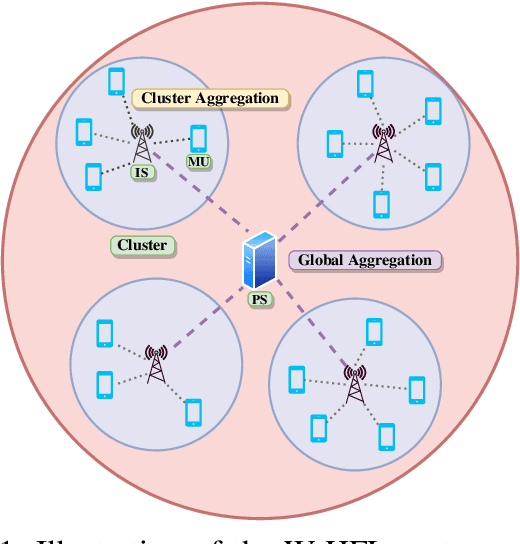

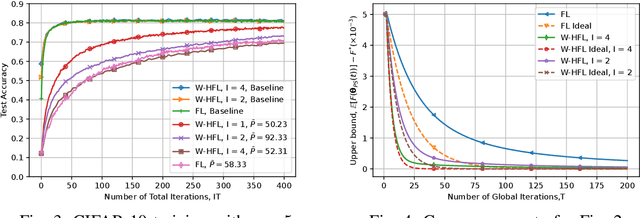
We examine federated learning (FL) with over-the-air (OTA) aggregation, where mobile users (MUs) aim to reach a consensus on a global model with the help of a parameter server (PS) that aggregates the local gradients. In OTA FL, MUs train their models using local data at every training round and transmit their gradients simultaneously using the same frequency band in an uncoded fashion. Based on the received signal of the superposed gradients, the PS performs a global model update. While the OTA FL has a significantly decreased communication cost, it is susceptible to adverse channel effects and noise. Employing multiple antennas at the receiver side can reduce these effects, yet the path-loss is still a limiting factor for users located far away from the PS. To ameliorate this issue, in this paper, we propose a wireless-based hierarchical FL scheme that uses intermediate servers (ISs) to form clusters at the areas where the MUs are more densely located. Our scheme utilizes OTA cluster aggregations for the communication of the MUs with their corresponding IS, and OTA global aggregations from the ISs to the PS. We present a convergence analysis for the proposed algorithm, and show through numerical evaluations of the derived analytical expressions and experimental results that utilizing ISs results in a faster convergence and a better performance than the OTA FL alone while using less transmit power. We also validate the results on the performance using different number of cluster iterations with different datasets and data distributions. We conclude that the best choice of cluster aggregations depends on the data distribution among the MUs and the clusters.
Hierarchical Over-the-Air Federated Edge Learning
Dec 21, 2021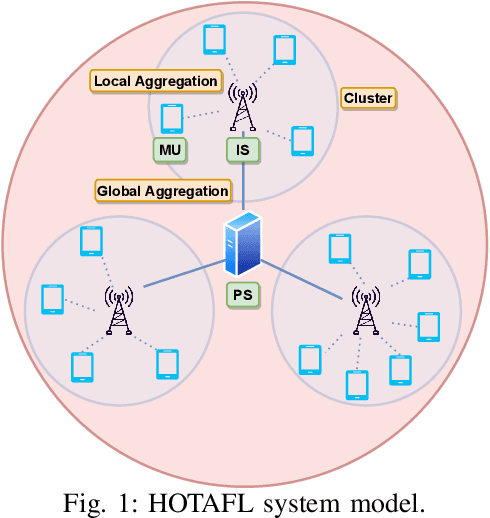
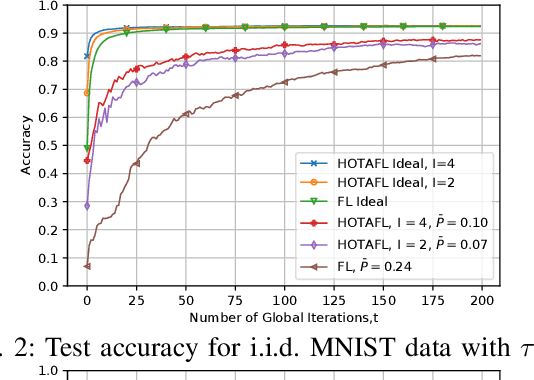
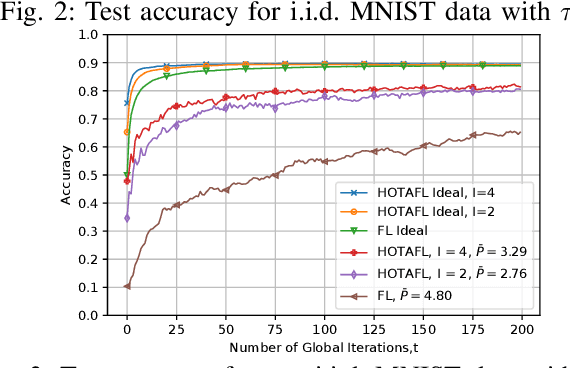
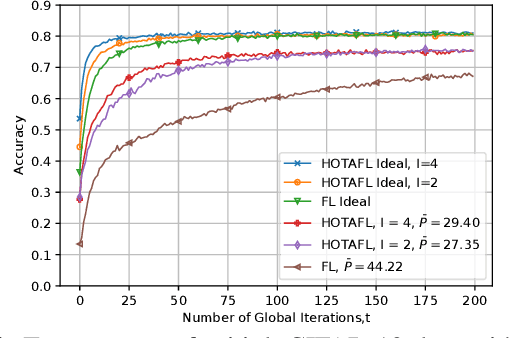
Federated learning (FL) over wireless communication channels, specifically, over-the-air (OTA) model aggregation framework is considered. In OTA wireless setups, the adverse channel effects can be alleviated by increasing the number of receive antennas at the parameter server (PS), which performs model aggregation. However, the performance of OTA FL is limited by the presence of mobile users (MUs) located far away from the PS. In this paper, to mitigate this limitation, we propose hierarchical over-the-air federated learning (HOTAFL), which utilizes intermediary servers (IS) to form clusters near MUs. We provide a convergence analysis for the proposed setup, and demonstrate through theoretical and experimental results that local aggregation in each cluster before global aggregation leads to a better performance and faster convergence than OTA FL.