 Add to Chrome
 Add to Firefox
 Add to Edge
A Constrained RL Approach for Cost-Efficient Delivery of Latency-Sensitive Applications
Mar 04, 2026
Next-generation networks aim to provide performance guarantees to real-time interactive services that require timely and cost-efficient packet delivery. In this context, the goal is to reliably deliver packets with strict deadlines imposed by the application while minimizing overall resource allocation cost. A large body of work has leveraged stochastic optimization techniques to design efficient dynamic routing and scheduling solutions under average delay constraints; however, these methods fall short when faced with strict per-packet delay requirements. We formulate the minimum-cost delay-constrained network control problem as a constrained Markov decision process and utilize constrained deep reinforcement learning (CDRL) techniques to effectively minimize total resource allocation cost while maintaining timely throughput above a target reliability level. Results indicate that the proposed CDRL-based solution can ensure timely packet delivery even when existing baselines fall short, and it achieves lower cost compared to other throughput-maximizing methods.

Over-the-Air Federated Edge Learning with Hierarchical Clustering
Jul 19, 2022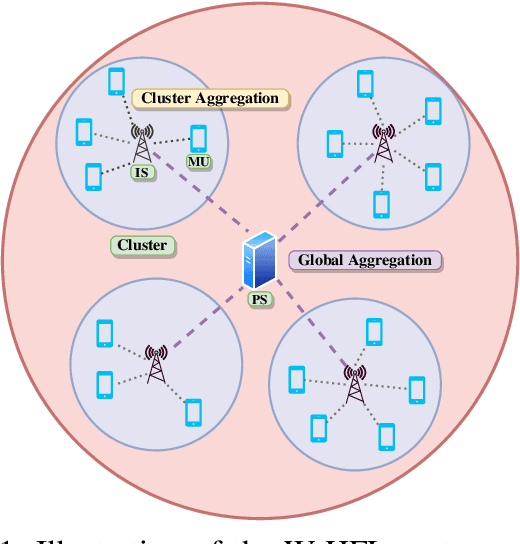

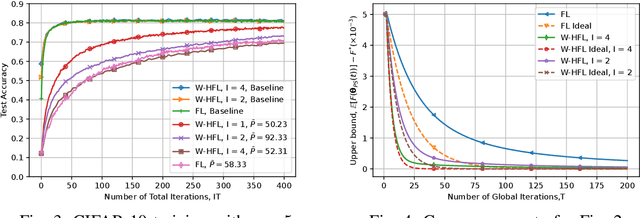
We examine federated learning (FL) with over-the-air (OTA) aggregation, where mobile users (MUs) aim to reach a consensus on a global model with the help of a parameter server (PS) that aggregates the local gradients. In OTA FL, MUs train their models using local data at every training round and transmit their gradients simultaneously using the same frequency band in an uncoded fashion. Based on the received signal of the superposed gradients, the PS performs a global model update. While the OTA FL has a significantly decreased communication cost, it is susceptible to adverse channel effects and noise. Employing multiple antennas at the receiver side can reduce these effects, yet the path-loss is still a limiting factor for users located far away from the PS. To ameliorate this issue, in this paper, we propose a wireless-based hierarchical FL scheme that uses intermediate servers (ISs) to form clusters at the areas where the MUs are more densely located. Our scheme utilizes OTA cluster aggregations for the communication of the MUs with their corresponding IS, and OTA global aggregations from the ISs to the PS. We present a convergence analysis for the proposed algorithm, and show through numerical evaluations of the derived analytical expressions and experimental results that utilizing ISs results in a faster convergence and a better performance than the OTA FL alone while using less transmit power. We also validate the results on the performance using different number of cluster iterations with different datasets and data distributions. We conclude that the best choice of cluster aggregations depends on the data distribution among the MUs and the clusters.
Hierarchical Over-the-Air Federated Edge Learning
Dec 21, 2021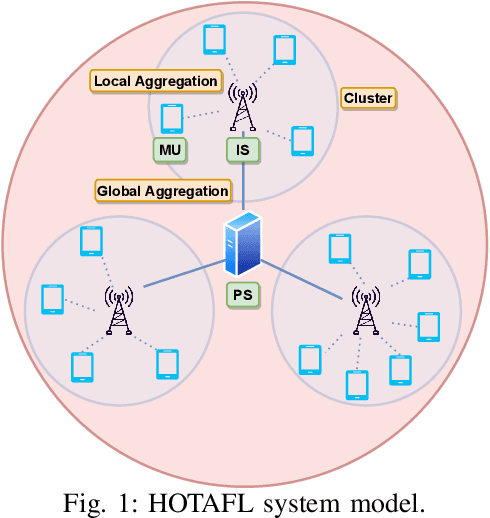
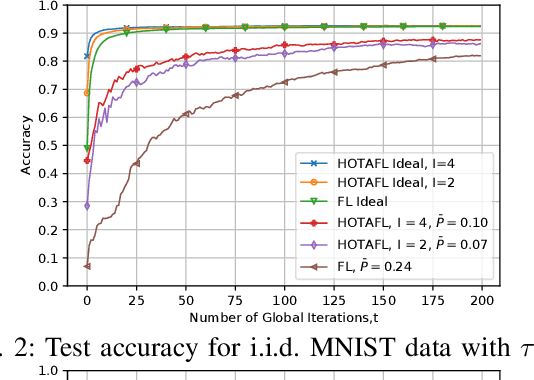
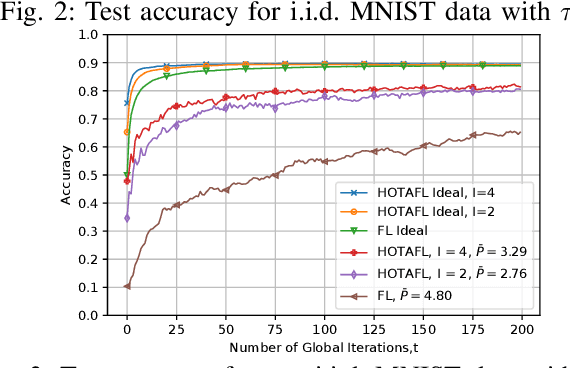
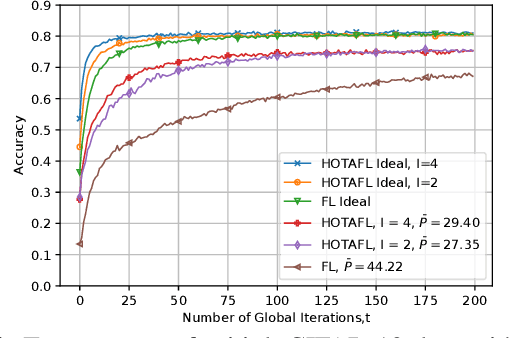
Federated learning (FL) over wireless communication channels, specifically, over-the-air (OTA) model aggregation framework is considered. In OTA wireless setups, the adverse channel effects can be alleviated by increasing the number of receive antennas at the parameter server (PS), which performs model aggregation. However, the performance of OTA FL is limited by the presence of mobile users (MUs) located far away from the PS. In this paper, to mitigate this limitation, we propose hierarchical over-the-air federated learning (HOTAFL), which utilizes intermediary servers (IS) to form clusters near MUs. We provide a convergence analysis for the proposed setup, and demonstrate through theoretical and experimental results that local aggregation in each cluster before global aggregation leads to a better performance and faster convergence than OTA FL.