 Add to Chrome
 Add to Firefox
 Add to Edge
DeFRiS: Silo-Cooperative IoT Applications Scheduling via Decentralized Federated Reinforcement Learning
Mar 16, 2026
Next-generation IoT applications increasingly span across autonomous administrative entities, necessitating silo-cooperative scheduling to leverage diverse computational resources while preserving data privacy. However, realizing efficient cooperation faces significant challenges arising from infrastructure heterogeneity, Non-IID workload shifts, and the inherent risks of adversarial environments. Existing approaches, relying predominantly on centralized coordination or independent learning, fail to address the incompatibility of state-action spaces across heterogeneous silos and lack robustness against malicious attacks. This paper proposes DeFRiS, a Decentralized Federated Reinforcement Learning framework for robust and scalable Silo-cooperative IoT application scheduling. DeFRiS integrates three synergistic innovations: (i) an action-space-agnostic policy utilizing candidate resource scoring to enable seamless knowledge transfer across heterogeneous silos; (ii) a silo-optimized local learning mechanism combining Generalized Advantage Estimation (GAE) with clipped policy updates to resolve sparse delayed reward challenges; and (iii) a Dual-Track Non-IID robust decentralized aggregation protocol leveraging gradient fingerprints for similarity-aware knowledge transfer and anomaly detection, and gradient tracking for optimization momentum. Extensive experiments on a distributed testbed with 20 heterogeneous silos and realistic IoT workloads demonstrate that DeFRiS significantly outperforms state-of-the-art baselines, reducing average response time by 6.4% and energy consumption by 7.2%, while lowering tail latency risk (CVaR$_{0.95}$) by 10.4% and achieving near-zero deadline violations. Furthermore, DeFRiS achieves over 3 times better performance retention as the system scales and over 8 times better stability in adversarial environments compared to the best-performing baseline.

AuditNet: A Conversational AI-based Security Assistant [DEMO]
Jul 19, 2024![Figure 1 for AuditNet: A Conversational AI-based Security Assistant [DEMO]](/_next/image?url=https%3A%2F%2Ffigures.semanticscholar.org%2Fa16debdf2346773669dd4ce81a2bdea6a20da580%2F3-Figure1-1.png&w=640&q=75)
![Figure 2 for AuditNet: A Conversational AI-based Security Assistant [DEMO]](/_next/image?url=https%3A%2F%2Ffigures.semanticscholar.org%2Fa16debdf2346773669dd4ce81a2bdea6a20da580%2F4-Figure2-1.png&w=640&q=75)
In the age of information overload, professionals across various fields face the challenge of navigating vast amounts of documentation and ever-evolving standards. Ensuring compliance with standards, regulations, and contractual obligations is a critical yet complex task across various professional fields. We propose a versatile conversational AI assistant framework designed to facilitate compliance checking on the go, in diverse domains, including but not limited to network infrastructure, legal contracts, educational standards, environmental regulations, and government policies. By leveraging retrieval-augmented generation using large language models, our framework automates the review, indexing, and retrieval of relevant, context-aware information, streamlining the process of verifying adherence to established guidelines and requirements. This AI assistant not only reduces the manual effort involved in compliance checks but also enhances accuracy and efficiency, supporting professionals in maintaining high standards of practice and ensuring regulatory compliance in their respective fields. We propose and demonstrate AuditNet, the first conversational AI security assistant designed to assist IoT network security experts by providing instant access to security standards, policies, and regulations.
A Distributed Deep Reinforcement Learning Technique for Application Placement in Edge and Fog Computing Environments
Oct 24, 2021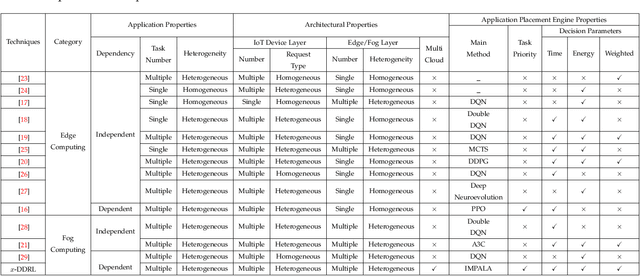
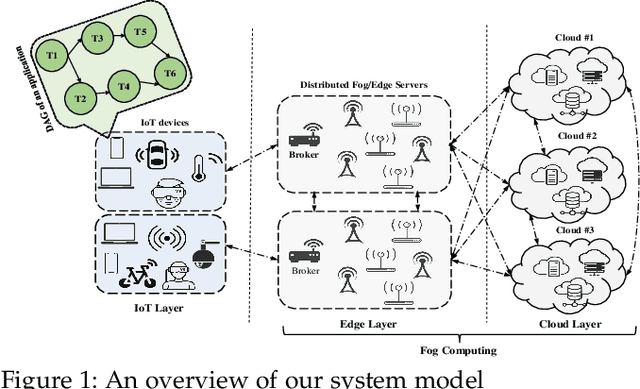
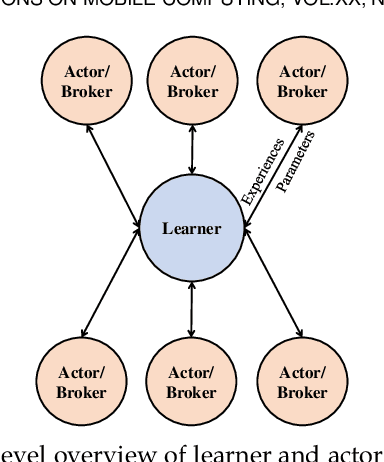
Fog/Edge computing is a novel computing paradigm supporting resource-constrained Internet of Things (IoT) devices by the placement of their tasks on the edge and/or cloud servers. Recently, several Deep Reinforcement Learning (DRL)-based placement techniques have been proposed in fog/edge computing environments, which are only suitable for centralized setups. The training of well-performed DRL agents requires manifold training data while obtaining training data is costly. Hence, these centralized DRL-based techniques lack generalizability and quick adaptability, thus failing to efficiently tackle application placement problems. Moreover, many IoT applications are modeled as Directed Acyclic Graphs (DAGs) with diverse topologies. Satisfying dependencies of DAG-based IoT applications incur additional constraints and increase the complexity of placement problems. To overcome these challenges, we propose an actor-critic-based distributed application placement technique, working based on the IMPortance weighted Actor-Learner Architectures (IMPALA). IMPALA is known for efficient distributed experience trajectory generation that significantly reduces the exploration costs of agents. Besides, it uses an adaptive off-policy correction method for faster convergence to optimal solutions. Our technique uses recurrent layers to capture temporal behaviors of input data and a replay buffer to improve the sample efficiency. The performance results, obtained from simulation and testbed experiments, demonstrate that our technique significantly improves the execution cost of IoT applications up to 30\% compared to its counterparts.