 Add to Chrome
 Add to Firefox
 Add to Edge
SPARK: Spatial Policy-driven Adaptive Reinforcement learning for Knowledge distillation
Jun 13, 2026
Low-bit quantization enables deployment of image restoration (IR) networks on resource-constrained devices, but introduces rounding noise that disproportionately degrades high-frequency regions such as edges and fine textures. Existing knowledge distillation (KD) methods apply distillation signals uniformly across all spatial locations, overlooking the varying reconstruction difficulty across image regions. To address this, we propose SPARK (Spatial Policy-driven Adaptive Reinforcement Learning for Knowledge Distillation), a framework that adaptively allocates distillation effort using a lightweight reinforcement learning (RL) policy network. At each training step, a difficulty feature extractor computes four signals, namely Laplacian variance, pixel variance, student reconstruction error, and teacher-student knowledge gap, which are fed into a compact policy CNN that produces a stochastic spatial weight map to modulate the KD loss during quantization-aware training (QAT). SPARK is IR task-agnostic, adds no inference cost, and integrates into any existing QAT pipeline without architectural changes. Experiments on benchmark datasets demonstrate that SPARK consistently outperforms PTQ, QAT, and state-of-the-art (SOTA) KD approaches across multiple student architectures, achieving reconstruction quality closest to the full-precision teacher under significant computational constraints.

Theoretical Foundations of Prompt Engineering: From Heuristics to Expressivity
Dec 14, 2025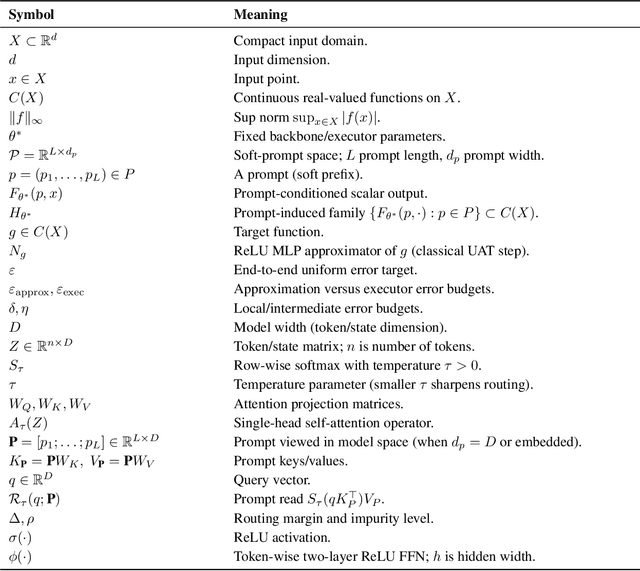
Prompts can switch a model's behavior even when the weights are fixed, yet this phenomenon is rarely treated as a clean theoretical object rather than a heuristic. We study the family of functions obtainable by holding a Transformer backbone fixed as an executor and varying only the prompt. Our core idea is to view the prompt as an externally injected program and to construct a simplified Transformer that interprets it to implement different computations. The construction exposes a mechanism-level decomposition: attention performs selective routing from prompt memory, the FFN performs local arithmetic conditioned on retrieved fragments, and depth-wise stacking composes these local updates into a multi-step computation. Under this viewpoint, we prove a constructive existential result showing that a single fixed backbone can approximate a broad class of target behaviors via prompts alone. The framework provides a unified starting point for formalizing trade-offs under prompt length/precision constraints and for studying structural limits of prompt-based switching, while remaining distinct from empirical claims about pretrained LLMs.
$φ$-test: Global Feature Selection and Inference for Shapley Additive Explanations
Dec 08, 2025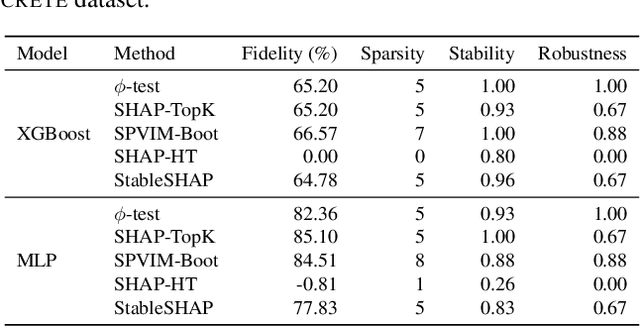
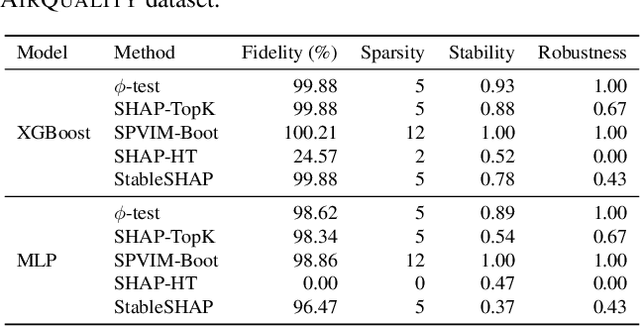
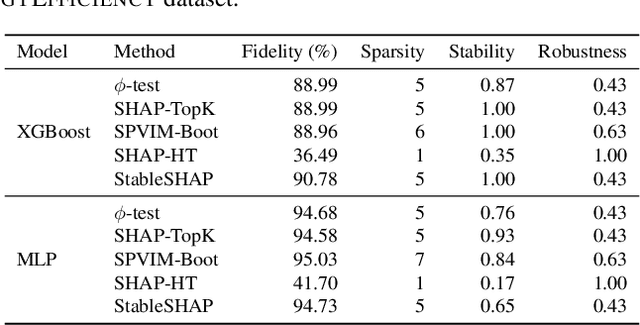
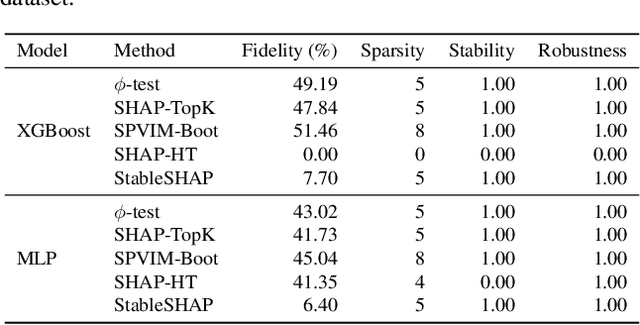
We propose $φ$-test, a global feature-selection and significance procedure for black-box predictors that combines Shapley attributions with selective inference. Given a trained model and an evaluation dataset, $φ$-test performs SHAP-guided screening and fits a linear surrogate on the screened features via a selection rule with a tractable selective-inference form. For each retained feature, it outputs a Shapley-based global score, a surrogate coefficient, and post-selection $p$-values and confidence intervals in a global feature-importance table. Experiments on real tabular regression tasks with tree-based and neural backbones suggest that $φ$-test can retain much of the predictive ability of the original model while using only a few features and producing feature sets that remain fairly stable across resamples and backbone classes. In these settings, $φ$-test acts as a practical global explanation layer linking Shapley-based importance summaries with classical statistical inference.