 Add to Chrome
 Add to Firefox
 Add to Edge
Theoretical Foundations of Prompt Engineering: From Heuristics to Expressivity
Dec 14, 2025
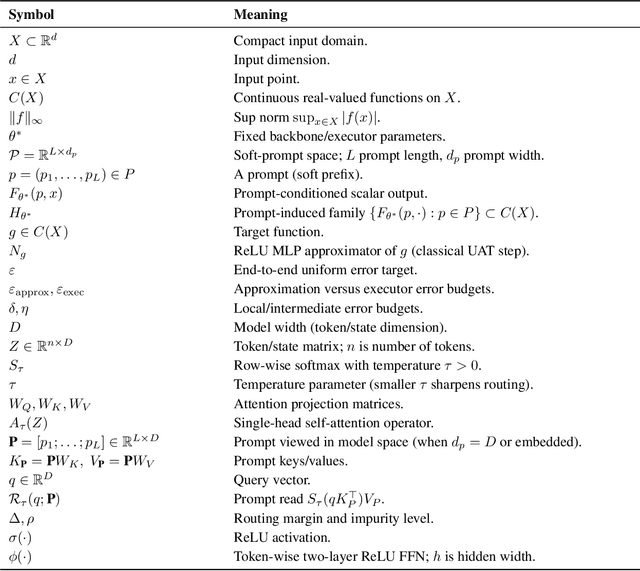
Prompts can switch a model's behavior even when the weights are fixed, yet this phenomenon is rarely treated as a clean theoretical object rather than a heuristic. We study the family of functions obtainable by holding a Transformer backbone fixed as an executor and varying only the prompt. Our core idea is to view the prompt as an externally injected program and to construct a simplified Transformer that interprets it to implement different computations. The construction exposes a mechanism-level decomposition: attention performs selective routing from prompt memory, the FFN performs local arithmetic conditioned on retrieved fragments, and depth-wise stacking composes these local updates into a multi-step computation. Under this viewpoint, we prove a constructive existential result showing that a single fixed backbone can approximate a broad class of target behaviors via prompts alone. The framework provides a unified starting point for formalizing trade-offs under prompt length/precision constraints and for studying structural limits of prompt-based switching, while remaining distinct from empirical claims about pretrained LLMs.

$φ$-test: Global Feature Selection and Inference for Shapley Additive Explanations
Dec 08, 2025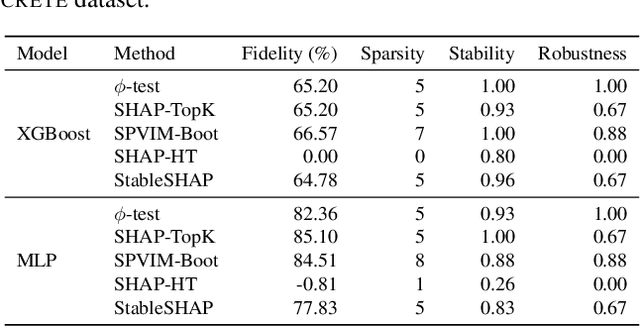
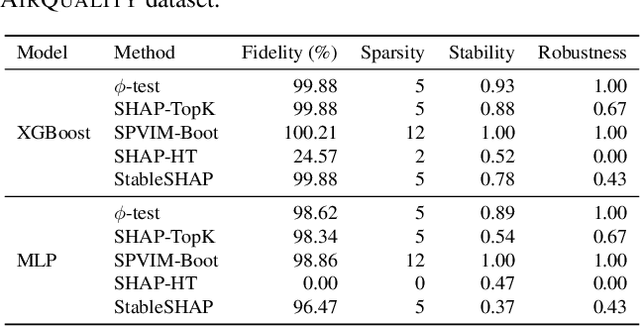
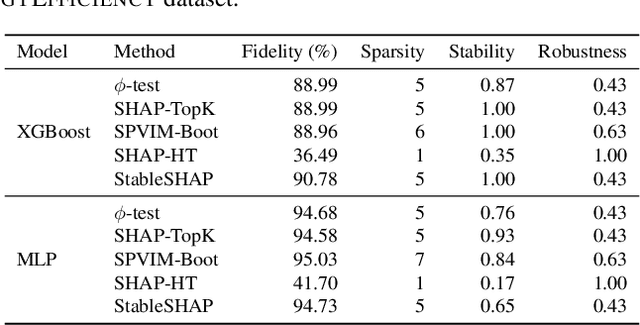
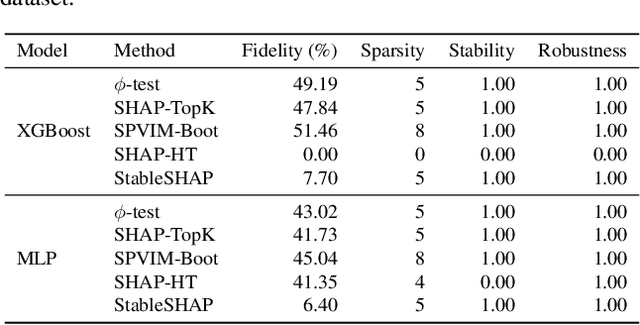
We propose $φ$-test, a global feature-selection and significance procedure for black-box predictors that combines Shapley attributions with selective inference. Given a trained model and an evaluation dataset, $φ$-test performs SHAP-guided screening and fits a linear surrogate on the screened features via a selection rule with a tractable selective-inference form. For each retained feature, it outputs a Shapley-based global score, a surrogate coefficient, and post-selection $p$-values and confidence intervals in a global feature-importance table. Experiments on real tabular regression tasks with tree-based and neural backbones suggest that $φ$-test can retain much of the predictive ability of the original model while using only a few features and producing feature sets that remain fairly stable across resamples and backbone classes. In these settings, $φ$-test acts as a practical global explanation layer linking Shapley-based importance summaries with classical statistical inference.