 Add to Chrome
 Add to Firefox
 Add to Edge
High-Resolution Climate Projections Using Diffusion-Based Downscaling of a Lightweight Climate Emulator
Feb 13, 2026
The proliferation of data-driven models in weather and climate sciences has marked a significant paradigm shift, with advanced models demonstrating exceptional skill in medium-range forecasting. However, these models are often limited by long-term instabilities, climatological drift, and substantial computational costs during training and inference, restricting their broader application for climate studies. Addressing these limitations, Guan et al. (2024) introduced LUCIE, a lightweight, physically consistent climate emulator utilizing a Spherical Fourier Neural Operator (SFNO) architecture. This model is able to reproduce accurate long-term statistics including climatological mean and seasonal variability. However, LUCIE's native resolution (~300 km) is inadequate for detailed regional impact assessments. To overcome this limitation, we introduce a deep learning-based downscaling framework, leveraging probabilistic diffusion-based generative models with conditional and posterior sampling frameworks. These models downscale coarse LUCIE outputs to 25 km resolution. They are trained on approximately 14,000 ERA5 timesteps spanning 2000-2009 and evaluated on LUCIE predictions from 2010 to 2020. Model performance is assessed through diverse metrics, including latitude-averaged RMSE, power spectrum, probability density functions and First Empirical Orthogonal Function of the zonal wind. We observe that the proposed approach is able to preserve the coarse-grained dynamics from LUCIE while generating fine-scaled climatological statistics at ~28km resolution.

LUCIE: A Lightweight Uncoupled ClImate Emulator with long-term stability and physical consistency for O(1000)-member ensembles
May 25, 2024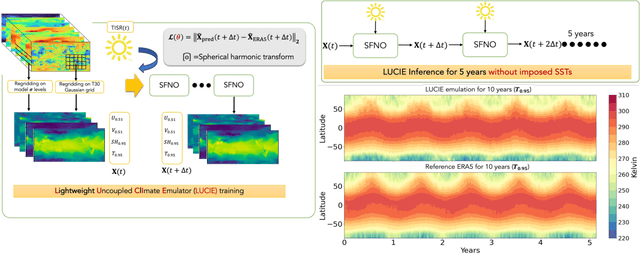
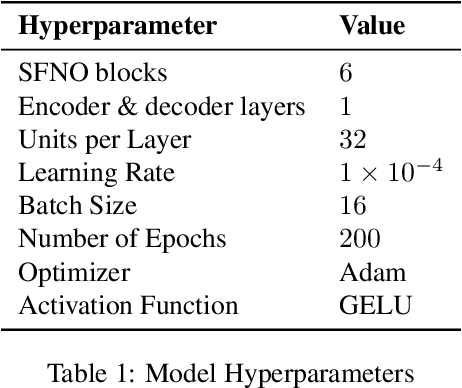
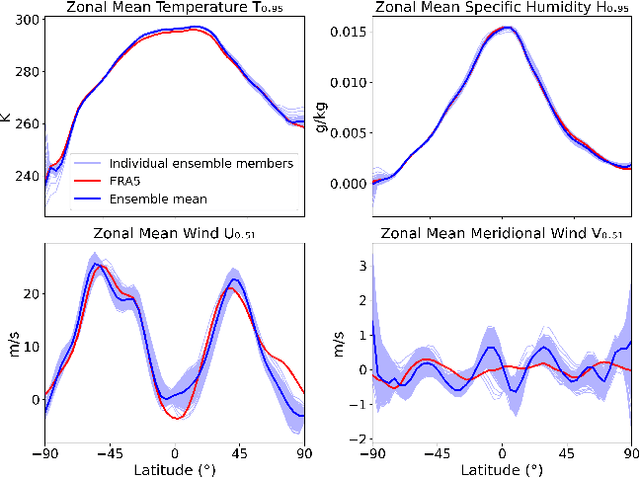
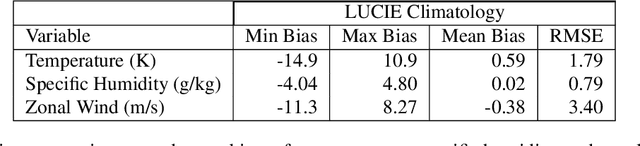
We present LUCIE, a $1000$- member ensemble data-driven atmospheric emulator that remains stable during autoregressive inference for thousands of years without a drifting climatology. LUCIE has been trained on $9.5$ years of coarse-resolution ERA5 data with $4$ prognostic variables on a single A100 GPU for $2.4$ h. Owing to the cheap computational cost of inference, $1000$ model ensembles are executed for $5$ years to compute an uncertainty-quantified climatology for the prognostic variables that closely match the climatology obtained from ERA5. Unlike all the other state-of-the-art AI weather models, LUCIE is neither unstable nor does it produce hallucinations that result in unphysical drift of the emulated climate. Furthermore, LUCIE \textbf{does not impose} ``true" sea-surface temperature (SST) from a coupled numerical model to enforce the annual cycle in temperature. We demonstrate the long-term climatology obtained from LUCIE as well as subseasonal-to-seasonal scale prediction skills on the prognostic variables. We also demonstrate a $20$-year emulation with LUCIE here: https://drive.google.com/file/d/1mRmhx9RRGiF3uGo_mRQK8RpwQatrCiMn/view