 Add to Chrome
 Add to Firefox
 Add to Edge
ACIArena: Toward Unified Evaluation for Agent Cascading Injection
Apr 09, 2026
Collaboration and information sharing empower Multi-Agent Systems (MAS) but also introduce a critical security risk known as Agent Cascading Injection (ACI). In such attacks, a compromised agent exploits inter-agent trust to propagate malicious instructions, causing cascading failures across the system. However, existing studies consider only limited attack strategies and simplified MAS settings, limiting their generalizability and comprehensive evaluation. To bridge this gap, we introduce ACIArena, a unified framework for evaluating the robustness of MAS. ACIArena offers systematic evaluation suites spanning multiple attack surfaces (i.e., external inputs, agent profiles, inter-agent messages) and attack objectives (i.e., instruction hijacking, task disruption, information exfiltration). Specifically, ACIArena establishes a unified specification that jointly supports MAS construction and attack-defense modules. It covers six widely used MAS implementations and provides a benchmark of 1,356 test cases for systematically evaluating MAS robustness. Our benchmarking results show that evaluating MAS robustness solely through topology is insufficient; robust MAS require deliberate role design and controlled interaction patterns. Moreover, defenses developed in simplified environments often fail to transfer to real-world settings; narrowly scoped defenses may even introduce new vulnerabilities. ACIArena aims to provide a solid foundation for advancing deeper exploration of MAS design principles.

CopyrightMeter: Revisiting Copyright Protection in Text-to-image Models
Nov 20, 2024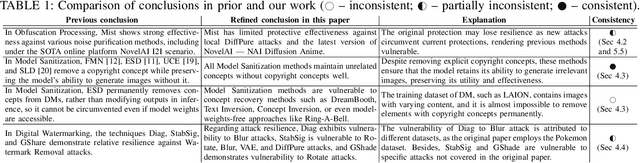

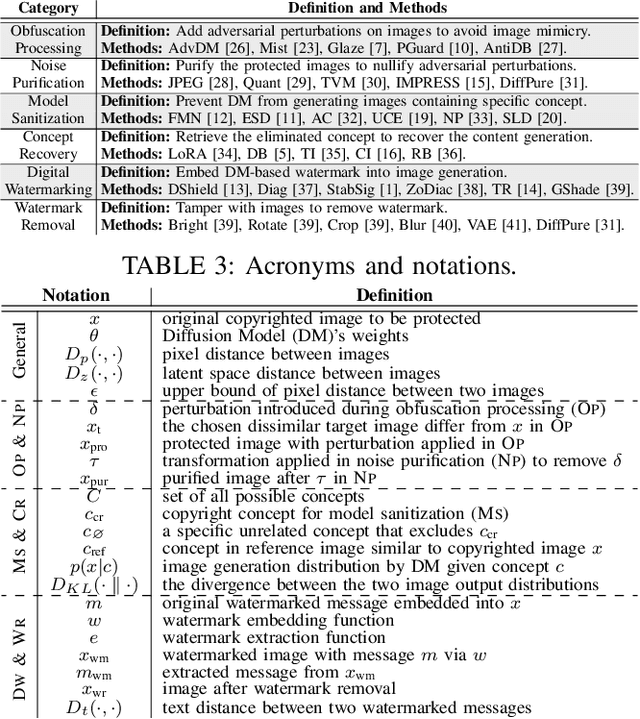
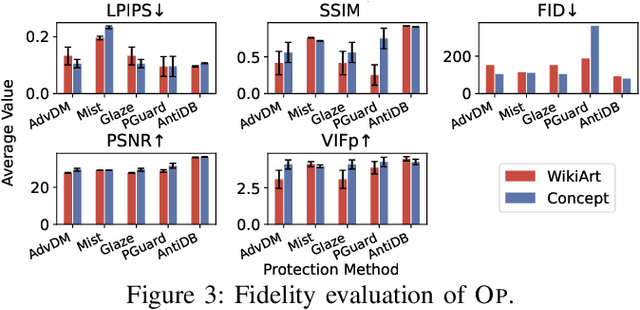
Text-to-image diffusion models have emerged as powerful tools for generating high-quality images from textual descriptions. However, their increasing popularity has raised significant copyright concerns, as these models can be misused to reproduce copyrighted content without authorization. In response, recent studies have proposed various copyright protection methods, including adversarial perturbation, concept erasure, and watermarking techniques. However, their effectiveness and robustness against advanced attacks remain largely unexplored. Moreover, the lack of unified evaluation frameworks has hindered systematic comparison and fair assessment of different approaches. To bridge this gap, we systematize existing copyright protection methods and attacks, providing a unified taxonomy of their design spaces. We then develop CopyrightMeter, a unified evaluation framework that incorporates 17 state-of-the-art protections and 16 representative attacks. Leveraging CopyrightMeter, we comprehensively evaluate protection methods across multiple dimensions, thereby uncovering how different design choices impact fidelity, efficacy, and resilience under attacks. Our analysis reveals several key findings: (i) most protections (16/17) are not resilient against attacks; (ii) the "best" protection varies depending on the target priority; (iii) more advanced attacks significantly promote the upgrading of protections. These insights provide concrete guidance for developing more robust protection methods, while its unified evaluation protocol establishes a standard benchmark for future copyright protection research in text-to-image generation.