 Add to Chrome
 Add to Firefox
 Add to Edge
RAS: Reflection-Augmented Scaling with In-Context Learning for Executable Cypher Query Generation
May 21, 2026
Inference-time scaling can reduce errors in structured query generation, but methods to allocate the compute for query code generation remains underexplored. We study Text2Cypher, where language models generate Cypher queries that execute against property graph databases. Non-executable queries constitute a distinct syntactic failure separate from semantic inaccuracy: a syntax error triggers a system-generated error message from the database. These error messages are typically discarded at inference time rather than leveraged through in-context learning (ICL). We compare two inference methods: Independent Scaling (IS), which performs memoryless resampling, and Reflection-Augmented Scaling (RAS), which conditions each new attempt on prior execution feedback via ICL. Across three Neo4j datasets and five code-specialized language models, RAS reduces the Query Execution Error Rate by 41--50% at n{=}5, outperforming IS at 32--38%. Execution errors are not merely failures to discard but actionable feedback, and structuring inference-time compute around them is a more efficient path to executability than scaling independent samples.

Group-Adaptive Threshold Optimization for Robust AI-Generated Text Detection
Feb 10, 2025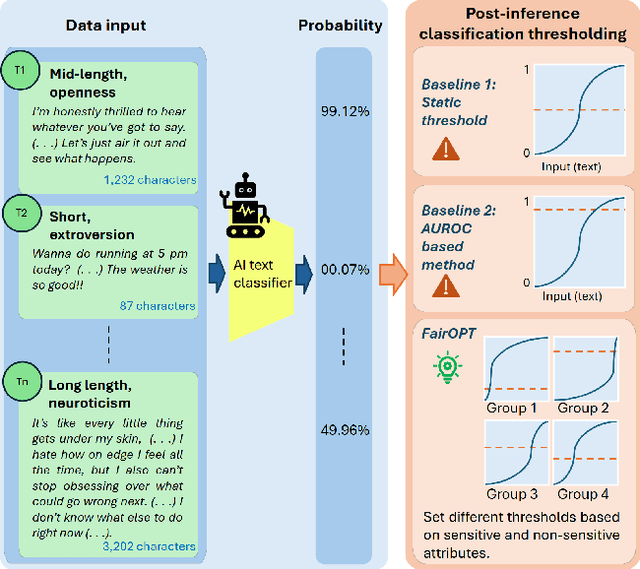
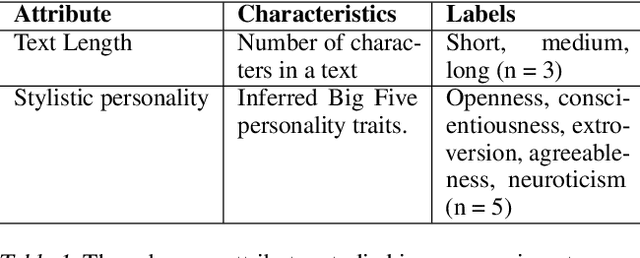
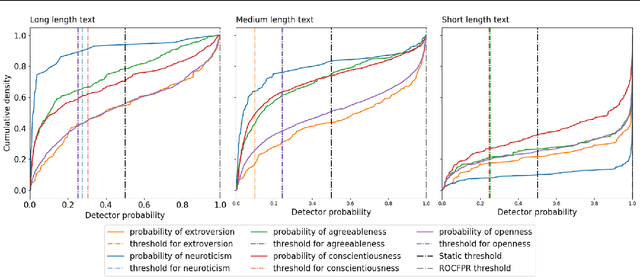
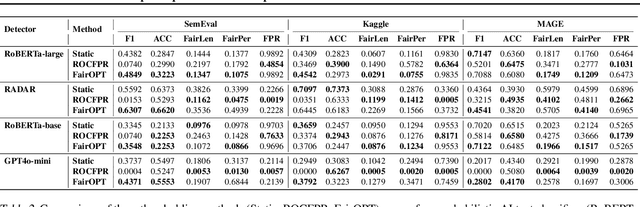
The advancement of large language models (LLMs) has made it difficult to differentiate human-written text from AI-generated text. Several AI-text detectors have been developed in response, which typically utilize a fixed global threshold (e.g., {\theta} = 0.5) to classify machine-generated text. However, we find that one universal threshold can fail to account for subgroup-specific distributional variations. For example, when using a fixed threshold, detectors make more false positive errors on shorter human-written text than longer, and more positive classifications on neurotic writing styles than open among long text. These discrepancies can lead to misclassification that disproportionately affects certain groups. We address this critical limitation by introducing FairOPT, an algorithm for group-specific threshold optimization in AI-generated content classifiers. Our approach partitions data into subgroups based on attributes (e.g., text length and writing style) and learns decision thresholds for each group, which enables careful balancing of performance and fairness metrics within each subgroup. In experiments with four AI text classifiers on three datasets, FairOPT enhances overall F1 score and decreases balanced error rate (BER) discrepancy across subgroups. Our framework paves the way for more robust and fair classification criteria in AI-generated output detection.