 Add to Chrome
 Add to Firefox
 Add to Edge
Geometry-Aware Representation Denoising for Robust Multi-view 3D Reconstruction
May 25, 2026
Multi-view 3D reconstruction has achieved remarkable progress with the advent of feed-forward 3D reconstruction models. However, these models are typically trained and evaluated under ideal, degradation-free imaging conditions, whereas real-world observations often contain degradations that differ significantly from such settings. Improving robustness for multi-view 3D reconstruction under degraded conditions therefore remains an important challenge. We present Geometry-Aware Representation Denoising (GARD), a novel framework that performs diffusion-based multi-view restoration directly in the feature space of a feed-forward 3D reconstruction model. This design exploits the geometry-aware feature representations of the 3D reconstructor to effectively recover accurate scene geometry. Furthermore, by employing an additional RGB image decoder, the refined representations can also be used to restore high-quality RGB images, thereby enabling the simultaneous recovery of 3D scene geometry and high-quality imagery. Comprehensive experiments on the Depth Anything 3 (DA3) benchmark demonstrate the effectiveness of the proposed GARD framework.

Text-Aware Image Restoration with Diffusion Models
Jun 11, 2025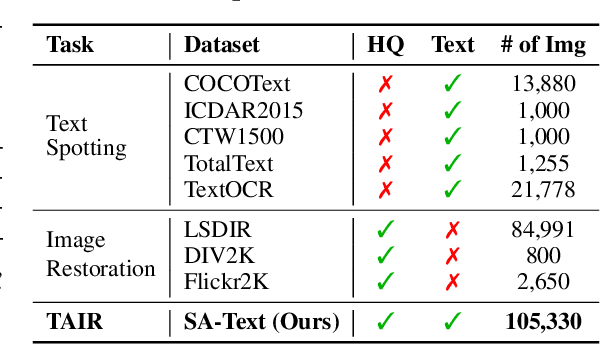
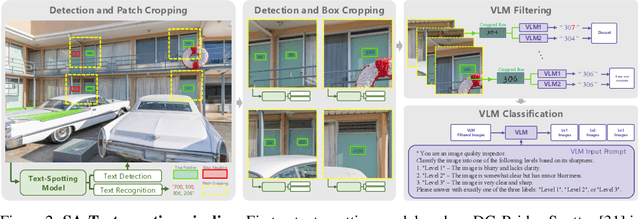
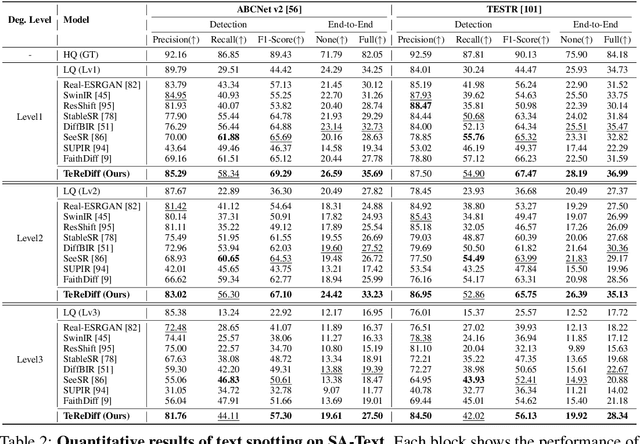
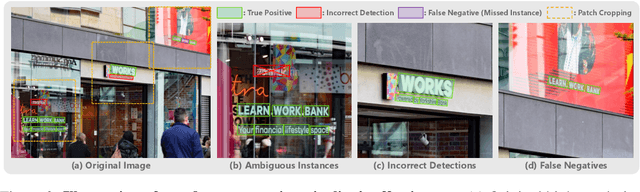
Image restoration aims to recover degraded images. However, existing diffusion-based restoration methods, despite great success in natural image restoration, often struggle to faithfully reconstruct textual regions in degraded images. Those methods frequently generate plausible but incorrect text-like patterns, a phenomenon we refer to as text-image hallucination. In this paper, we introduce Text-Aware Image Restoration (TAIR), a novel restoration task that requires the simultaneous recovery of visual contents and textual fidelity. To tackle this task, we present SA-Text, a large-scale benchmark of 100K high-quality scene images densely annotated with diverse and complex text instances. Furthermore, we propose a multi-task diffusion framework, called TeReDiff, that integrates internal features from diffusion models into a text-spotting module, enabling both components to benefit from joint training. This allows for the extraction of rich text representations, which are utilized as prompts in subsequent denoising steps. Extensive experiments demonstrate that our approach consistently outperforms state-of-the-art restoration methods, achieving significant gains in text recognition accuracy. See our project page: https://cvlab-kaist.github.io/TAIR/