 Add to Chrome
 Add to Firefox
 Add to Edge
SoCRATES: Towards Reliable Automated Evaluation of Proactive LLM Mediation across Domains and Socio-cognitive Variations
Jun 04, 2026
Evaluating LLM mediators remains challenging, as mediation unfolds as a real-time trajectory shaped by disputants' shifting emotions, intentions, and context. Existing testbeds rely on a few expert-authored domains, vary mainly strategic posture, and score every turn against every topic, introducing off-topic noise. We introduce SoCRATES, a benchmark for evaluating proactive LLM mediators in realistic, multi-domain testbeds. It constructs scenarios from real conflicts through an agentic pipeline across eight domains, probes five socio-cognitive adaptation axes (strategic posture, party composition, history length, emotional reactivity, and cultural identity), and scores each topic only on the turns that advance it via a topic-localized evaluator. The evaluator reaches 0.82 alignment with human experts, more than doubling a per-turn baseline. Benchmarking eight frontier LLMs, we find that even the strongest mediator closes only about a third of the unmediated consensus gap under diverse and realistic testbeds, with performance varying sharply by socio-cognitive axis, highlighting that progress lies in social adaptation to diverse conditions.

Distilling Long-CoT Reasoning through Collaborative Step-wise Multi-Teacher Decoding
May 04, 2026Distilling large reasoning models is essential for making Long-CoT reasoning practical, as full-scale inference remains computationally prohibitive. Existing curation-based approaches select complete reasoning traces post-hoc, overlooking collaboration among heterogeneous teachers and lacking dynamic exploration, which leads to redundant sampling and missed complementary reasoning. We introduce CoRD, a collaborative multi-teacher decoding framework that performs step-wise reasoning synthesis guided by predictive perplexity-based scoring and beam search. This enables heterogeneous LRMs to jointly construct coherent reasoning trajectories while efficiently preserving diverse, high-potential hypotheses. Experiments show that CoRD produces higher-quality reasoning data and achieves near teacher-level student performance with fewer, structured supervision signals, without substantial efficiency overhead. CoRD further generalizes well to out-of-domain and open-ended settings. The dataset and model are available at \href{https://github.com/DISL-Lab/CoRD}{https://github.com/DISL-Lab/CoRD}.
What Makes a Sale? Rethinking End-to-End Seller--Buyer Retail Dynamics with LLM Agents
Apr 06, 2026Evaluating retail strategies before deployment is difficult, as outcomes are determined across multiple stages, from seller-side persuasion through buyer-seller interaction to purchase decisions. However, existing retail simulators capture only partial aspects of this process and do not model cross-stage dependencies, making it difficult to assess how early decisions affect downstream outcomes. We present RetailSim, an end-to-end retail simulation framework that models this pipeline in a unified environment, explicitly designed for simulation fidelity through diverse product spaces, persona-driven agents, and multi-turn interactions. We evaluate RetailSim with a dual protocol comprising human evaluation of behavioral fidelity and meta-evaluation against real-world economic regularities, showing that it successfully reproduces key patterns such as demographic purchasing behavior, the price-demand relationship, and heterogeneous price elasticity. We further demonstrate its practical utility via decision-oriented use cases, including persona inference, seller-buyer interaction analysis, and sales strategy evaluation, showing RetailSim's potential as a controlled testbed for exploring retail strategies.
Completing Missing Annotation: Multi-Agent Debate for Accurate and Scalable Relevant Assessment for IR Benchmarks
Feb 06, 2026Information retrieval (IR) evaluation remains challenging due to incomplete IR benchmark datasets that contain unlabeled relevant chunks. While LLMs and LLM-human hybrid strategies reduce costly human effort, they remain prone to LLM overconfidence and ineffective AI-to-human escalation. To address this, we propose DREAM, a multi-round debate-based relevance assessment framework with LLM agents, built on opposing initial stances and iterative reciprocal critique. Through our agreement-based debate, it yields more accurate labeling for certain cases and more reliable AI-to-human escalation for uncertain ones, achieving 95.2% labeling accuracy with only 3.5% human involvement. Using DREAM, we build BRIDGE, a refined benchmark that mitigates evaluation bias and enables fairer retriever comparison by uncovering 29,824 missing relevant chunks. We then re-benchmark IR systems and extend evaluation to RAG, showing that unaddressed holes not only distort retriever rankings but also drive retrieval-generation misalignment. The relevance assessment framework is available at https: //github.com/DISL-Lab/DREAM-ICLR-26; and the BRIDGE dataset is available at https://github.com/DISL-Lab/BRIDGE-Benchmark.
Learning to Verify Summary Facts with Fine-Grained LLM Feedback
Dec 14, 2024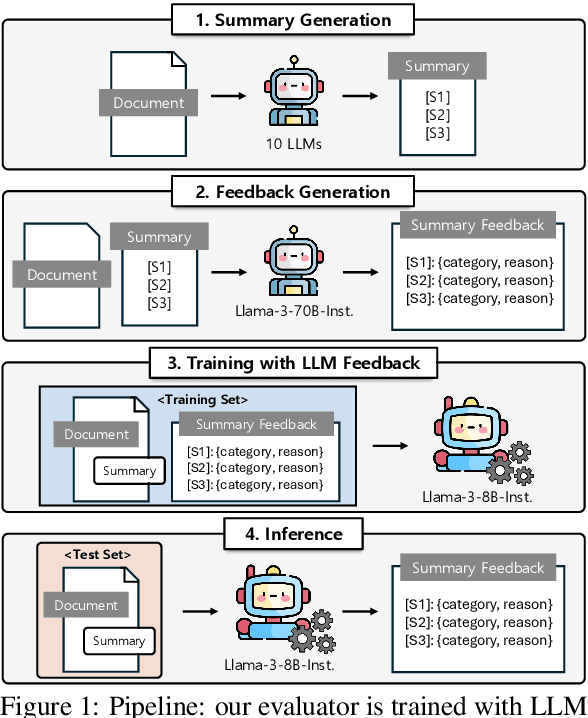
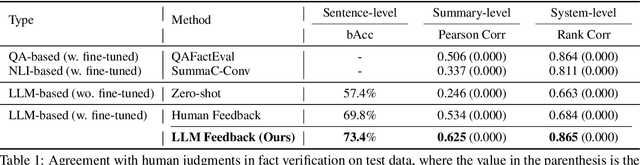

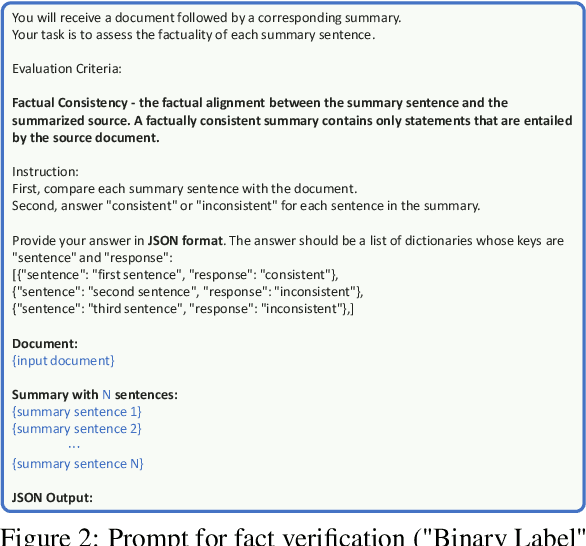
Training automatic summary fact verifiers often faces the challenge of a lack of human-labeled data. In this paper, we explore alternative way of leveraging Large Language Model (LLM) generated feedback to address the inherent limitation of using human-labeled data. We introduce FineSumFact, a large-scale dataset containing fine-grained factual feedback on summaries. We employ 10 distinct LLMs for diverse summary generation and Llama-3-70B-Instruct for feedback. We utilize this dataset to fine-tune the lightweight open-source model Llama-3-8B-Instruct, optimizing resource efficiency while maintaining high performance. Our experimental results reveal that the model trained on extensive LLM-generated datasets surpasses that trained on smaller human-annotated datasets when evaluated using human-generated test sets. Fine-tuning fact verification models with LLM feedback can be more effective and cost-efficient than using human feedback. The dataset is available at https://github.com/DISL-Lab/FineSumFact.
DM: Dual-path Magnitude Network for General Speech Restoration
Sep 13, 2024


In this paper, we introduce a novel general speech restoration model: the Dual-path Magnitude (DM) network, designed to address multiple distortions including noise, reverberation, and bandwidth degradation effectively. The DM network employs dual parallel magnitude decoders that share parameters: one uses a masking-based algorithm for distortion removal and the other employs a mapping-based approach for speech restoration. A novel aspect of the DM network is the integration of the magnitude spectrogram output from the masking decoder into the mapping decoder through a skip connection, enhancing the overall restoration capability. This integrated approach overcomes the inherent limitations observed in previous models, as detailed in a step-by-step analysis. The experimental results demonstrate that the DM network outperforms other baseline models in the comprehensive aspect of general speech restoration, achieving substantial restoration with fewer parameters.