 Add to Chrome
 Add to Firefox
 Add to Edge
Disentangling Knowledge States with Ability and Proficiency Modeling for Knowledge Tracing
Jul 14, 2026
Knowledge tracing (KT) aims to predict students' future performance by modeling their evolving knowledge states from historical interactions. Existing KT methods usually treat the raw interaction sequence as a unified behavioral process, overlooking the phase-specific nature of learning behaviors. Our preliminary observations show that students are more likely to correctly answer previously failed knowledge concepts after sufficient practice, suggesting a transition from ability-building to proficiency-oriented learning. Motivated by this, we propose Phase-Aware Knowledge Tracing (PAKT), a KT framework that decomposes student interactions into ability and proficiency phases based on the tailored decomposition mechanism. To effectively exploit the decomposed sequences, we design a multi-branch Transformer with a type-aware readout module to jointly capture phase-specific and holistic knowledge states. We further provide a causal analysis to reveal the confounding bias caused by entangling complex learning behaviors in phase-agnostic KT models. Extensive experiments on six public benchmarks demonstrate that our method consistently outperforms representative baselines, with a maximum AUC gain of 1.33% and an average gain of 0.82%.

PhysBench: A Benchmark Framework for Remote Physiological Sensing with New Dataset and Baseline
May 07, 2023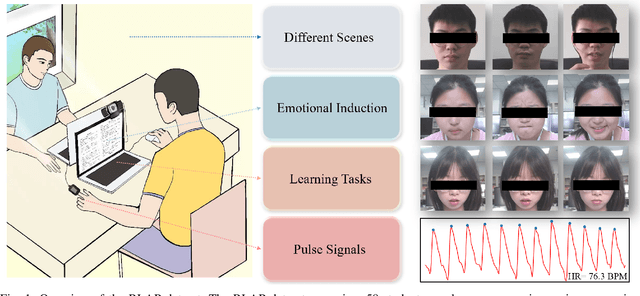
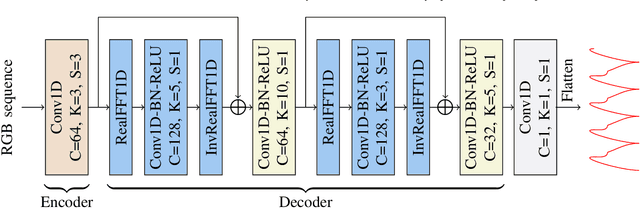
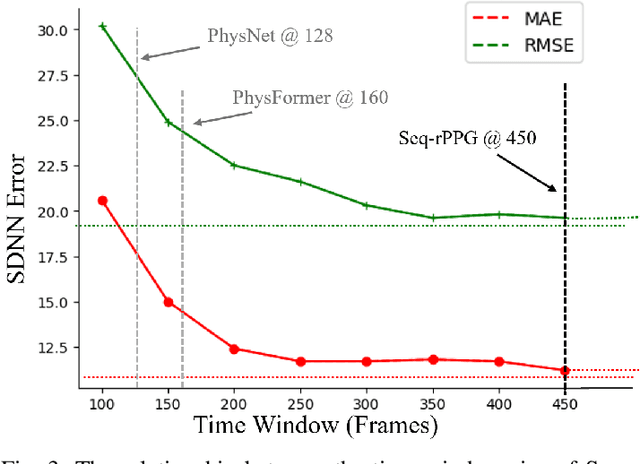
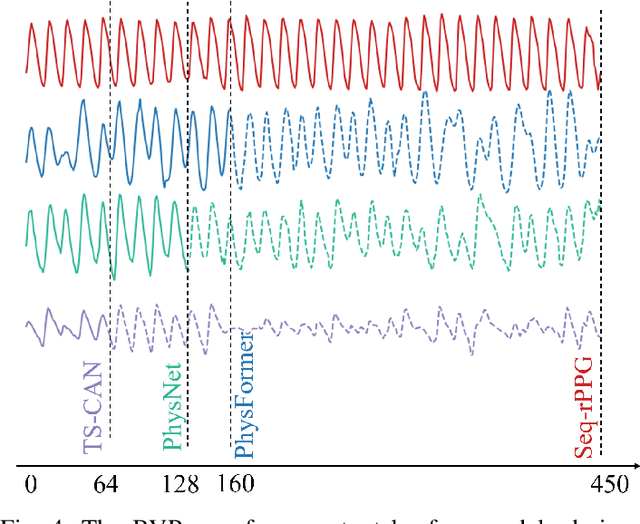
In recent years, due to the widespread use of internet videos, physiological remote sensing has gained more and more attention in the fields of affective computing and telemedicine. Recovering physiological signals from facial videos is a challenging task that involves a series of preprocessing, image algorithms, and post-processing to finally restore waveforms. We propose a complete and efficient end-to-end training and testing framework that provides fair comparisons for different algorithms through unified preprocessing and post-processing. In addition, we introduce a highly synchronized lossless format dataset along with a lightweight algorithm. The dataset contains over 32 hours (3.53M frames) of video from 58 subjects; by training on our collected dataset both our proposed algorithm as well as existing ones can achieve improvements.