 Add to Chrome
 Add to Firefox
 Add to Edge
SciForge: An AI-Native, Multimodal Workbench for Scientific Discovery
Jul 17, 2026
Scientific work increasingly spans heterogeneous artifacts -- papers, code, datasets, scientific file formats, model outputs, figures, manuscripts, and team decisions -- yet general-purpose AI assistants rarely preserve these objects as a coherent, auditable research state. We present SciForge, a multimodal research-native AI workbench that reserves the graphical interface for human judgment while search, parsing, model routing, workflow execution, plotting, writing, and presentation generation run as modular agent-accessible services. SciForge is built around five pillars: (i) \emph{goal-scoped scientific decision governance} for \textbf{goal-oriented} research, with review gates and shared review surfaces; (ii) \emph{translate-then-reason} for \textbf{multimodal} input, routing scientific objects through domain translators before the agent reasons; (iii) \emph{evidence governance} for \textbf{auditable} traceability, linking claims to provenance chains and audit findings; (iv) \emph{collaborative team science} for \textbf{collaborative} research, enabling multi-role decision governance, with shared team workspaces planned for future releases; and (v) \emph{real-world application scenarios} for \textbf{practical} impact, demonstrated through eight end-to-end user cases, with flagship demonstrations including multi-day agentic research sprints for gene discovery, AI-guided de novo protein design, molecular optimization, and genome-to-BGC discovery. The system combines a thin interaction layer, contextual research capability patterns, an Agent Runtime and Workflow Engine, an Evidence-DAG audit sidecar and a Scientific Model Router. SciForge currently runs as a desktop application, with mobile supervision support; future releases will deepen team collaboration. The system is open-source and available at https://github.com/AGI4Sci/SciForge

Circinus: Efficient Query Planner for Compound ML Serving
Apr 23, 2025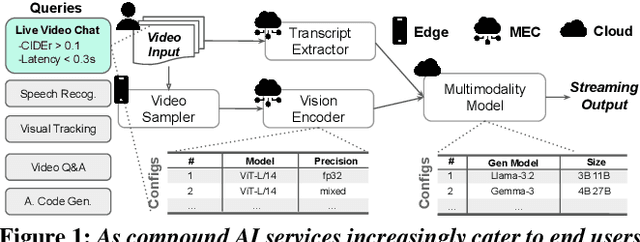
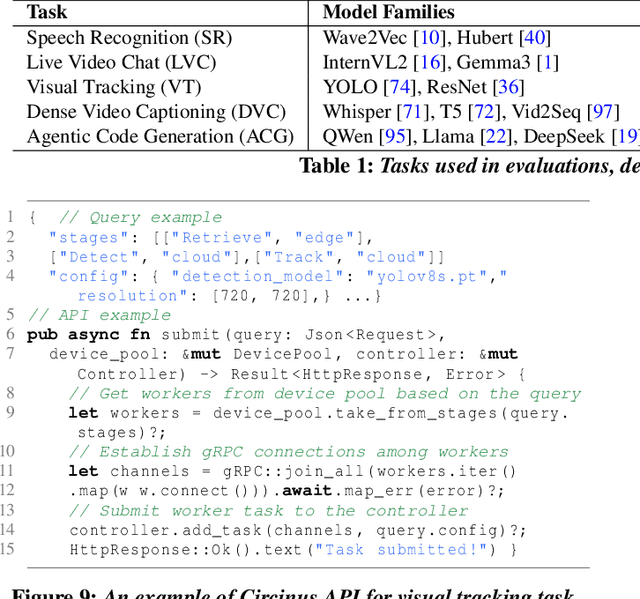
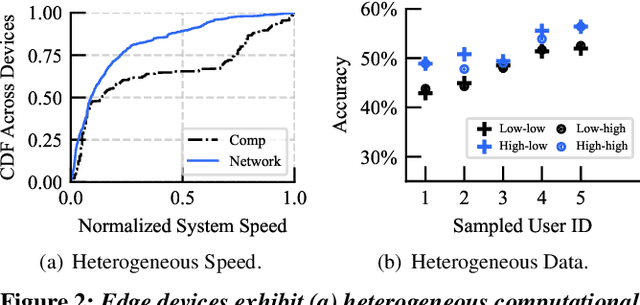
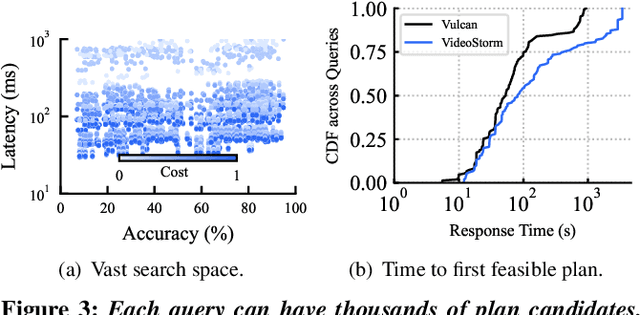
The rise of compound AI serving -- integrating multiple operators in a pipeline that may span edge and cloud tiers -- enables end-user applications such as autonomous driving, generative AI-powered meeting companions, and immersive gaming. Achieving high service goodput -- i.e., meeting service level objectives (SLOs) for pipeline latency, accuracy, and costs -- requires effective planning of operator placement, configuration, and resource allocation across infrastructure tiers. However, the diverse SLO requirements, varying edge capabilities, and high query volumes create an enormous planning search space, rendering current solutions fundamentally limited for real-time serving and cost-efficient deployments. This paper presents Circinus, an SLO-aware query planner for large-scale compound AI workloads. Circinus novelly decomposes multi-query planning and multi-dimensional SLO objectives while preserving global decision quality. By exploiting plan similarities within and across queries, it significantly reduces search steps. It further improves per-step efficiency with a precision-aware plan profiler that incrementally profiles and strategically applies early stopping based on imprecise estimates of plan performance. At scale, Circinus selects query-plan combinations to maximize global SLO goodput. Evaluations in real-world settings show that Circinus improves service goodput by 3.2-5.0$\times$, accelerates query planning by 4.2-5.8$\times$, achieving query response in seconds, while reducing deployment costs by 3.2-4.0$\times$ over state of the arts even in their intended single-tier deployments.